

Espresso Machine Maintenance Tips for Longevity
Table of Contents
- Why Espresso Machine Maintenance Matters
- Daily Cleaning and Post-Use Care
- How to Clean an Espresso Machine Weekly and Deeper
- Espresso Machine Descaling and Scale Prevention
- Water Quality and Filtration for Machine Longevity
- Espresso Machine Maintenance Checklist and Schedule
- Common Maintenance Mistakes That Shorten Machine Life
- Protecting Your Investment Long-Term
- Frequently Asked Questions
Last Updated: October 19, 2026
Why Espresso Machine Maintenance Matters
Regular espresso machine maintenance is the difference between a machine that delivers café-quality shots for years and one that fails within months. Neglect builds up fast. Coffee oils accumulate. Mineral deposits clog internal passages. The group head gasket hardens and loses its seal. Performance drops, flavour suffers, and repair costs climb.
A machine that costs £2,000 or more deserves proper care. The good news: consistent maintenance isn't complicated. It's a series of simple habits that protect your investment and keep every shot tasting as good as the last.
Think of it like servicing a car. You don't wait for the engine to fail before changing the oil. You follow a schedule. The same principle applies here. Daily cleaning takes five minutes. Weekly maintenance takes ten. A few hours per year of deeper care adds years to your machine's working life.
Daily Cleaning and Post-Use Care
Every shot leaves residue behind. Dried coffee oils cling to metal surfaces. Mineral-rich water leaves microscopic deposits. These accumulate fast. The solution is simple: clean immediately after use, while everything is hot and soft.
Start with the portafilter and filter baskets. Remove the basket from the portafilter. Tap out spent grounds into a bin. Rinse both under hot running water. Use your thumb to scrub the basket interior where oils collect.
The group head needs attention next. Backflushing removes oils that water alone cannot. Insert the portafilter without a basket. Activate the pump for one second, then stop. Repeat five to eight times. You'll see dark water spray out.
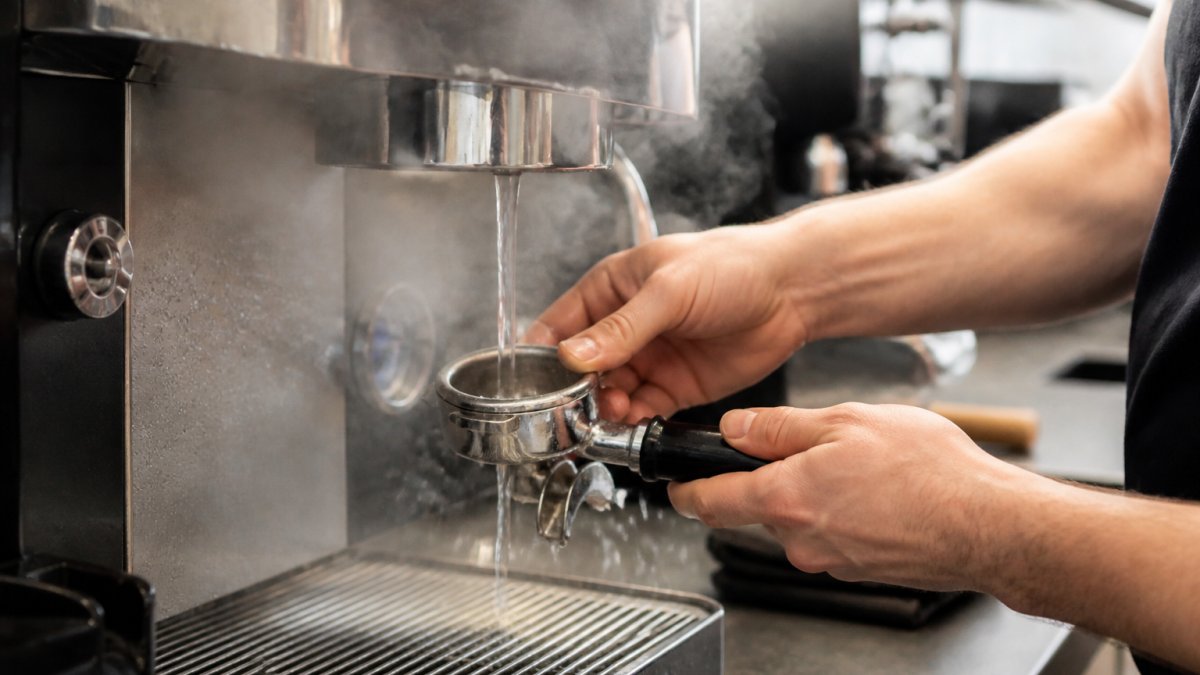
The steam wand requires immediate attention. Milk residue hardens fast. Within minutes, it becomes difficult to remove. Wipe the wand with a damp cloth straight after steaming.

Empty the drip tray and rinse it. Wipe down the exterior with a dry cloth. This whole process takes five minutes and prevents 90% of common problems.
How to Clean an Espresso Machine Weekly and Deeper
One day per week, go deeper. This is when you address what daily cleaning misses: the shower screen, the group gasket, and internal passages.
Remove the shower screen and soak it. This is the perforated disc that sits above the group head. Unscrew it (most machines use a simple turn). Soak it in hot water with a small amount of espresso machine cleaner for ten minutes. Scrub gently with a soft brush. Rinse thoroughly. Dry and reinstall. A clean shower screen distributes water evenly and prevents channelling, which ruins shot quality.
The group gasket is a rubber ring that seals the portafilter to the group head. Inspect it weekly. Push your finger against it. It should feel firm and spring back. If it feels hard or compressed, it's time to replace it. A worn gasket allows water to bypass grounds, producing weak shots. Replacement takes two minutes and costs very little.
Remove and inspect the brew group. Some machines have a removable brew group that comes out completely. Check your machine's manual. If yours does, remove it and soak in hot water with cleaner. Use a soft brush to remove any buildup inside. This prevents mineral deposits from restricting water flow.
Espresso Machine Descaling and Scale Prevention
Mineral buildup is silent and destructive. Hard water leaves calcium and magnesium deposits inside pipes and the boiler. Over time, these narrow the passages, restrict flow, and reduce temperature stability. Shots become slow and weak.
Descaling removes mineral buildup, but it is not a universal fix. The right approach depends on your machine's design and your water. Before you descale, answer three questions:
- What does your manufacturer say? Some machines, particularly those with aluminium boilers or certain thermoblock designs, should not be descaled with standard acidic solutions. Always check the manual or the manufacturer's guidance first. If the manual says "do not descale" or specifies a proprietary method, follow it exactly.
- How hard is your water? Use a test kit (see the water quality section) to measure hardness in parts per million (ppm) or German degrees (dH). As a rule of thumb: below 60 ppm, descale every 6-12 months or when the machine indicates; 60-120 ppm, every 3-6 months; 120-180 ppm, every 2-3 months; above 180 ppm, monthly or consider a filter.
- Does your machine have a descaling programme? Many modern machines guide you through the cycle, including rinse steps. Use it. Manual descaling without a programme risks leaving acid in the system.
Choose the right descaler. Use a product formulated for espresso machines. The Jura 2-Phase Descaling Tablets are formulated to remove limescale safely whilst protecting internal components. Never use vinegar or generic kettle descalers: the acetic acid can attack seals, gaskets, and metal finishes, and the residue is difficult to rinse completely. Follow the instructions precisely. Run the solution through the group head and steam wand. Let it sit for the specified time. Rinse thoroughly with fresh water afterwards. Never skip the rinse step, residual descaler will ruin your coffee and can corrode internal parts.
Prevention is easier than cure. The best defence against scale is filtered water. A water filter reduces mineral content significantly. The Sage ClaroSwiss Water Filter fits compatible Sage machines and extends intervals between descales. Replace it every two months. If you live in a hard-water area, consider a plumbed-in filtration system or a softer water source for your machine.

Water Quality and Filtration for Machine Longevity
Water makes up 98% of espresso. Poor water quality damages machines and ruins flavour.
Tap water varies by location. Some areas have very soft water. Others are extremely hard. Hard water accelerates scale buildup (Water Hardness / Hard Water). Soft water can be corrosive to metal components.
Test your water, don't guess. Many water companies publish hardness data online, but it varies by supply zone and season. For a precise reading, use a simple drop test kit or an electronic TDS meter. If you use a filter, test the filtered water too, to see when the filter is exhausted.
Sage ClaroSwiss Water Filter →
Interpret your results:
- 0-50 ppm hardness: Soft. Low scale risk, but check for corrosion if your machine has copper or brass components. A filter may not be necessary, but a carbon block filter can still improve taste.
- 50-100 ppm: Ideal. Maintain with a basic filter and descale every 3-6 months or per manufacturer guidance.
- 100-180 ppm: Hard. Use a scale-reducing filter and descale every 2-3 months. Monitor the machine's indicator.
- Above 180 ppm: Very hard. Consider a reverse-osmosis system or bottled low-mineral water for your machine. Descale monthly or as indicated.
Choose the right filter. Not all filters remove hardness. Carbon filters improve taste and remove chlorine but leave minerals. Ion-exchange or scale-reducing filters (often called "softening" filters) replace calcium and magnesium with sodium or hydrogen. The Sage ClaroSwiss Water Filter is a scale-reducing filter designed for compatible Sage machines. Replace it every two months.
Filtered water isn't just about scale prevention. It changes flavour. Minerals contribute to taste. Too many minerals muddy the shot. Too few flatten it. A quality filter strikes a balance, removing the worst offenders whilst preserving desirable minerals.
Espresso Machine Maintenance Checklist and Schedule
Consistency matters more than intensity. A few minutes daily beats a frantic deep clean once a month.
| Task | Frequency | Time |
|---|---|---|
| Purge group head | After each use | 30 seconds |
| Clean portafilter and basket | After each use | 2 minutes |
| Wipe steam wand | After each use | 1 minute |
| Backflush group head | Daily | 1 minute |
| Soak shower screen | Weekly | 10 minutes |
| Inspect group gasket | Weekly | 1 minute |
| Run cleaning cycle | Weekly | 15 minutes |
| Descale machine | Monthly to quarterly | 30 minutes |
| Replace water filter | Every 2 months | 2 minutes |
| Professional service | varies |
Daily tasks take ten minutes total and prevent most problems. Weekly tasks add another fifteen minutes and keep your machine running smoothly. Monthly descaling protects against mineral damage. Annual professional servicing catches wear you can't see and replaces parts before they fail.
Common Maintenance Mistakes That Shorten Machine Life
Most damage comes from skipping steps, not from doing something wrong.
Ignoring the steam wand. Milk hardens into a concrete-like coating. Once it sets, it blocks the tip and forces pressure into the wand body, which can crack. Clean it immediately. Every time. No exceptions.
Backflushing without a basket. Never backflush with a basket installed. The pressure can damage it. Always remove the basket first, then insert the empty portafilter.
Using the wrong descaler. Espresso machines have tight tolerances. Generic descalers can damage internal seals and gaskets. Use a product formulated for espresso machines, like the Jura 3-in-1 Cleaning Tablets, which are designed to clean safely whilst protecting components.
Skipping water filtration. Unfiltered water is the fastest way to scale up your machine. The cost of a filter is tiny compared to repair bills.
Replacing the group gasket too late. A worn gasket lets water bypass grounds. You'll notice shots running fast and tasting weak. Replace it before this happens. Check it weekly.
Protecting Your Investment Long-Term
A well-maintained espresso machine lasts ten years or more. A neglected one fails in two. The difference is routine.
Think of maintenance as an investment, not a chore. Thirty minutes per week keeps your machine performing like new. Skip it, and you're spending hundreds on repairs and losing the joy of good coffee in the meantime.
The machines we stock at Coffee Craft Studio are built for precision and durability. Start with daily cleaning. Add weekly deeper maintenance. Descale on schedule. Use filtered water. Replace worn parts before they fail. Follow this routine and your machine will deliver café-quality espresso for years to come.
Your espresso machine maintenance routine protects one of your most valuable kitchen investments. Consistent care prevents costly repairs, preserves flavour quality, and extends your machine's working life by years. Coffee Craft Studio provides everything you need: premium machines built for longevity, plus maintenance essentials like water filters and cleaning products designed to protect your equipment. Get started with Coffee Craft Studio and transform your espresso routine into a sustainable, rewarding practice.
Frequently Asked Questions
How often should you clean an espresso machine?
Daily cleaning is essential after each use: purge the group head, backflush with water, wipe the shower screen, and immediately clean the steam wand. Weekly, perform deeper cleaning of the portafilter and baskets using cleaning tablets. Monthly, inspect the group gasket and drip tray. Descaling frequency depends on water hardness, typically every 2-3 months for moderately hard water, or more frequently if you notice reduced flow or flavour changes.
What is the best water for an espresso machine?
Filtered or softened water extends machine life significantly. Hard water causes mineral buildup and limescale, reducing performance and increasing maintenance costs. Use a quality water filter designed for your machine model, such as the Sage ClaroSwiss Water Filter, which removes chlorine and reduces hardness. If your tap water is very hard (above 200 ppm), consider a whole-home softening system or purchasing filtered water. Testing your water hardness helps you determine the right filtration approach and descaling schedule.
How do you descale an espresso machine safely?
Always consult your machine's manual first, as descaling procedures vary by model. Most machines use commercial descaling solutions or tablets designed for espresso equipment. For Jura machines, the 2-Phase Descaling Tablets dissolve limescale in phase one and protect internal components in phase two. Run the descaling cycle through the group head and steam wand according to your machine's programme. After descaling, flush the machine thoroughly with fresh water to remove all descaling residue. Never use vinegar or generic descalers, as these can damage seals and void warranties.
Can poor maintenance damage an espresso machine?
Yes. Neglecting daily cleaning allows coffee oils and residue to accumulate, causing blockages, reduced flow, and flavour degradation. Skipping descaling leads to mineral buildup that damages the thermoblock, heating element, and internal pipes, potentially causing permanent failure. A poorly maintained machine may fail within 2-3 years, whilst a well-maintained one can last 10+ years. Regular maintenance preserves brew quality, machine reliability, and your investment value.