

Daily Espresso Machine Cleaning Routine Guide
Table of Contents
- Why a Daily Espresso Machine Cleaning Routine Matters
- What You'll Need for Your Daily Cleaning Routine
- Step-by-Step Daily Espresso Machine Cleaning Routine
- Espresso Machine Backflushing Guide: When and How
- How to Clean Steam Wand Daily for Perfect Milk Foam
- Espresso Machine Maintenance Schedule: Daily, Weekly, Monthly
- Conclusion: Protect Your Investment with Daily Care
- Frequently Asked Questions
Last Updated: October 2, 2026
Why a Daily Espresso Machine Cleaning Routine Matters
A daily espresso machine cleaning routine is the practice of purging, rinsing and wiping your machine's key parts after each session to stop coffee oils and milk residue building up.
Here is the part most owners miss: cleaning is not just about hygiene. Coffee oils turn rancid within hours.
Below, we break down exactly what you need, the four daily steps, and how to build a maintenance schedule that actually sticks.
What You'll Need for Your Daily Cleaning Routine
You need very little for the daily routine. A soft cloth, warm water and a blind basket cover most of it. The deeper products come later, on a weekly or monthly basis.
Your daily kit:
- A clean microfibre cloth for the steam wand and bodywork
- A second cloth for the drip tray and portafilter
- A small nylon brush for the basket and shower screen
- Warm water for rinsing
- A blind basket for backflushing, if your machine supports it
For periodic deep cleaning, keep proper consumables on hand. Genuine Jura 3-in-1 Cleaning Tablets (Jura 3-in-1 Cleaning Tablets, £11.95) handle the group head and internal circuit on automatic machines. For milk systems, Jura Milk System Cleaner Mini Tabs (Jura Milk System Cleaner Mini Tabs, £14.50) break down milk fats and proteins. And for scale, Jura 2-Phase Descaling Tablets (Jura 2-Phase Descaling Tablets, £15.50) remove limescale and protect the thermoblock.


Step-by-Step Daily Espresso Machine Cleaning Routine
The full daily routine takes about five minutes. Do it at the end of your last session, not the start of the next one, so residue never sits overnight.
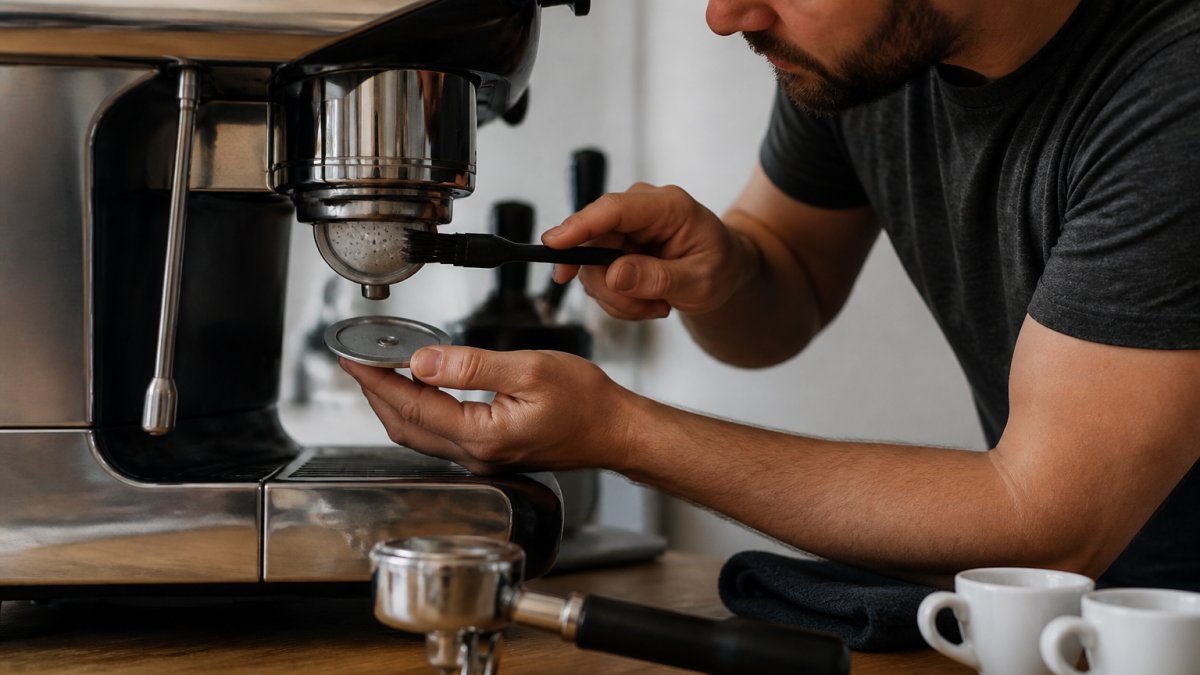
Step 1: Purge the Group Head
Run a short flush of water through the group head with no portafilter fitted. This pushes loose grounds and oils out of the shower screen and solenoid valve. Ten seconds is enough. Wipe the screen with your brush afterwards.
Step 2: Clean the Portafilter and Basket
Knock out the puck, then rinse the basket under warm water. Use your brush to clear the holes. A clogged basket chokes the flow rate and throws off your extraction. Dry both parts before refitting.
Step 3: Wipe Down the Steam Wand
Purge the wand for a second to clear milk from the tip. Wipe it down with a damp cloth while it is still warm. Milk residue baked onto the wand is the hardest deposit to shift later.
Step 4: Empty and Rinse the Drip Tray
Pull the drip tray and rinse it in warm water. Stale water left in the tray breeds bacteria and smells. Dry it and refit.
Espresso Machine Backflushing Guide: When and How
Backflushing is the process of forcing water backwards through the group head using a blind basket to clear oils from the internal valve. Do it weekly, or daily on a busy machine. It is not part of the basic daily wipe-down unless you pull a high volume of shots.
How to backflush:
- Fit the blind basket into the portafilter
- Run the pump for five seconds, then stop for five
- Repeat five times to flush the valve
- Add espresso machine cleaner for a deeper clean once a week
- Finish with a plain-water flush
Water-Only Flush vs. Detergent Backflush
These are not the same task, and conflating them is a common error. A water-only backflush clears loose grounds and fresh oils and is safe to do daily. A detergent backflush uses a purpose-made espresso machine cleaner to dissolve the stubborn, polymerised oils that water alone cannot shift. Most practitioners do a water-only flush daily and a detergent backflush weekly.
Machine-Specific Backflushing
Machines with a three-way solenoid valve are designed for backflushing and benefit from it most, because the valve is where oils collect. E61 group heads can be backflushed, but the lever cam also needs periodic lubrication, and the mushroom and jet should be inspected for scale during a deep clean. Manual and lever machines without a solenoid valve should not be backflushed at all; focus on the shower screen, dispersion screw and basket instead.
Jura 3-in-1 Cleaning Tablets →
If You Skip Backflushing
Skipped backflushing shows up as a slow, uneven flow through the group, a solenoid that sticks or buzzes, and shots that taste muddy even with fresh beans. If the lever or valve feels gritty, a detergent backflush followed by a plain-water flush usually restores smooth operation. If it does not, the valve may need a service rather than another clean.
How to Clean Steam Wand Daily for Perfect Milk Foam
Cleaning the steam wand daily is what separates silky microfoam from flat, bubbly milk. Purge, wipe and purge again, every single time you steam.
A blocked wand cannot introduce air evenly. Your foam turns coarse and collapses fast. If you notice the foam getting weaker over a few days, the wand is usually the cause, not your technique.
For machines with automatic milk systems, run the built-in cleaning programme with a suitable cleaner after every milk session. Jura Milk System Cleaner Mini Tabs are made for exactly this, dissolving quickly to clear milk fats from pipes and frothing units.
Espresso Machine Maintenance Schedule: Daily, Weekly, Monthly
An espresso machine maintenance schedule spreads the work so nothing gets forgotten. Daily tasks protect flavour. Weekly and monthly tasks protect the machine itself. But the single biggest mistake owners make is treating every machine the same. A thermoblock, a dual boiler and an E61 group head all accumulate scale and oils at different rates, so the schedule below should be read as a baseline, not a fixed law.
| Frequency | Task | Why It Matters |
|---|---|---|
| Daily | Purge group head, wipe steam wand, rinse drip tray | Stops oils and milk residue building up |
| Weekly | Backflush, brush shower screen, soak basket | Clears internal valves and screens |
| Monthly | Descale, deep-clean milk system, check gasket | Removes limescale and worn seals |
| Every 6-12 months | Replace gasket and water filter | Keeps pressure and water quality steady |
How Machine Type Changes the Schedule
Thermoblock machines heat water in a narrow channel, so limescale chokes flow quickly. Dual-boiler machines hold larger volumes of water at temperature, which slows scale but makes the brew boiler more sensitive to stale water if left idle. E61 group heads rely on a lever and cam mechanism that benefits from regular backflushing and a light food-safe lubricant on the cam every few months, something most generic guides never mention.
Water Hardness: The Variable That Sets Your Descale Frequency
Water quality sits behind most scale problems, and it should dictate how often you descale rather than the calendar. Hard water leaves limescale in the thermoblock and pipes, which cuts flow rate and brewing temperature. If you live in a hard-water area, monthly descaling may be too infrequent; in a soft-water area, it may be unnecessary. A good water filter, such as the Sage ClaroSwiss Water Filter (Sage ClaroSwiss Water Filter, £14.95), reduces that build-up between descales. Check your machine's batch compatibility before ordering. For official guidance on water hardness and its effects, see the Water UK guidance on water hardness.
When to Clean by Symptom, Not by Calendar
Time-based schedules are a starting point, but your machine gives you clearer signals. Watch for these visual and sensory indicators:
- Flow rate slows noticeably, scale or oil build-up in the group or thermoblock
- Shots taste flat or bitter despite fresh beans, rancid oils in the group head
- Steam wand sputters or pulses, blocked air holes in the tip
- White crust on the shower screen, limescale, descale now
- Portafilter feels stiff to lock in, worn or dirty gasket
- Milk foam collapses faster than usual, milk residue in the frothing circuit
If two or more of these appear together, bring your next deep clean forward rather than waiting for the scheduled date.
Conclusion: Protect Your Investment with Daily Care
A five-minute daily routine is the cheapest insurance you can buy for a serious espresso machine. Skip it and you pay twice: once in flat, bitter coffee, and again in repairs.
At Coffee Craft Studio, we stock the genuine consumables that make each stage simple. The Jura 3-in-1 Cleaning Tablets handle your group head, the Jura Milk System Cleaner Mini Tabs keep your foam clean, and the Jura 2-Phase Descaling Tablets protect against scale.
Build the daily habit first. Add the weekly backflush and monthly descale, and your machine will reward you with consistent, café-quality shots for years.
Frequently Asked Questions
How often should you backflush an espresso machine?
Backflushing should be done daily if you use your machine regularly. For home baristas pulling two to three shots a day, a quick water backflush takes under a minute after your last coffee. A deeper backflush with espresso machine cleaner should be performed weekly. If you notice bitterness or restricted flow, backflush immediately rather than waiting for your next scheduled session.
What is the best way to clean a steam wand daily?
Purge the steam wand immediately after every use to clear milk residue from the tip. Wipe the wand with a damp cloth while it is still warm, then purge again briefly. For a deeper clean, soak the tip in warm water with a drop of mild detergent for a few minutes. This prevents milk proteins from baking onto the surface and blocking the steam holes.
Do I need to use cleaning chemicals for a daily espresso machine routine?
Not every day. Daily cleaning can be done with water, a microfiber cloth and a group head brush. Cleaning powder or tablets are needed for weekly backflushing and monthly descaling. For Jura machines, Jura 3-in-1 Cleaning Tablets are designed for the integrated cleaning programme and remove coffee oils while protecting internal components. Always use products formulated for your specific machine.
Why is daily maintenance important for espresso machine longevity?
Coffee oils and milk residue build up quickly inside group heads, steam wands and solenoid valves. Without daily cleaning, these deposits harden, restrict flow rate, affect pressure and create bitterness in every shot. Limescale from hard water is another risk. A consistent espresso machine maintenance schedule prevents costly repairs and keeps extraction consistent for years.