

How to Choose a Home Espresso Machine: A Buyer's Guide
Table of Contents
- Understand the Different Types of Espresso Machines
- Manual vs Automatic Espresso Machines: Control and Consistency
- Single Boiler vs Dual Boiler Espresso Machine Performance
- Built-In Grinder or Separate? Choosing Your Grinding Solution
- Assess Your Space, Workflow, and Budget
- Key Features That Affect Espresso Quality and Ease of Use
- Water Quality and Maintenance Considerations
- Making Your Final Decision
- Frequently Asked Questions
Last Updated: October 11, 2026
Understand the Different Types of Espresso Machines
Choosing a home espresso machine starts with understanding what's available. Manual machines demand technique and patience. Semi-automatic models automate water delivery but leave extraction timing to you. Automatic machines handle most decisions for you. Super-automatic models grind, dose, tamp, brew, and steam milk with minimal input.

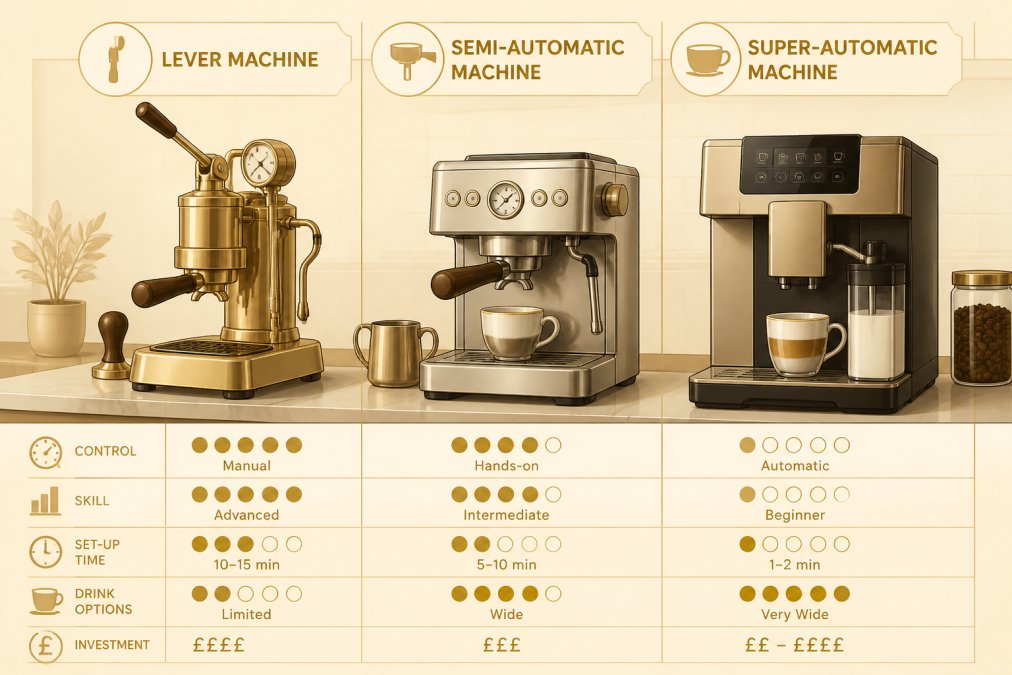
Each type serves different priorities. If you value control and understand extraction principles, manual or semi-automatic machines reward that knowledge. If you want consistency without technique, automatic or super-automatic machines deliver it. If convenience matters more than quality, pod systems offer speed at the cost of flavour depth.
Manual, Semi-Automatic, and Automatic Options
Manual machines use lever pressure to force water through coffee, so you control temperature, pressure, and extraction timing entirely. This demands skill: tamping pressure, grind consistency, and timing all affect the result. Semi-automatic machines automate water delivery via an electric pump but still require you to start and stop the shot. Automatic machines pre-programme shot volume and stop extraction automatically. Super-automatic machines handle grinding, dosing, tamping, and extraction with one button press.
The learning curve differs sharply. Manual machines punish mistakes visibly: poor tamping or uneven pressure produces weak, bitter, or sour shots. Semi-automatic machines teach cause and effect clearly. Automatic machines hide complexity behind automation, making them forgiving but less educational. Super-automatic machines eliminate the learning curve almost entirely, appealing to those who want excellent coffee without becoming baristas.
Pod and Capsule Systems
Pod and capsule machines (Nespresso, Dolce Gusto, and similar brands) use pre-packaged coffee in sealed containers. Insert the pod, press a button, and the machine forces hot water through it. No grinding, no tamping, no adjustment.
These systems prioritise convenience and consistency: every shot tastes the same because the coffee is pre-measured and pre-ground, and cleanup is minimal. The trade-off is significant: pods cost more per cup than whole beans, packaging has a higher environmental impact, and quality rarely matches freshly ground, properly extracted shots. Pods suit offices or households where speed and zero maintenance matter more than espresso excellence.
Manual vs Automatic Espresso Machines: Control and Consistency
The core tension between manual and automatic machines is control versus consistency. Manual and semi-automatic machines give you direct control over every variable: grind size, dose weight, tamp pressure, water temperature, and extraction time.
Automatic and super-automatic machines remove variables from your hands, measuring dose, tamping at a set pressure, and stopping extraction at a predetermined volume. This consistency is valuable if you're making dozens of drinks daily, but reduces your ability to adjust for bean freshness, roast level, or humidity.
For home use, the choice depends on your habits. If you make one or two espressos daily and enjoy dialling in shots, manual or semi-automatic machines reward that engagement. If you make multiple drinks daily and want reliability, automatic machines deliver consistency with less effort.
Single Boiler vs Dual Boiler Espresso Machine Performance
Boiler design determines how efficiently you can brew espresso and steam milk simultaneously. Single-boiler machines use one boiler for both functions, so switching from brewing to steaming means waiting for the boiler to reach steam temperature.
Dual-boiler machines maintain separate boilers at their ideal temperatures: the espresso boiler at 88-92°C for extraction, the steam boiler at 120°C or higher for milk texturing.
The Sage The Dual Boiler Espresso Machine exemplifies this advantage, with dedicated stainless steel boilers for espresso extraction and steam production. This design allows simultaneous brewing and steaming without temperature instability, which is essential for consistent milk-based drinks.

Single-boiler machines cost less upfront and occupy less counter space, working fine for households making primarily black espresso or occasional milk drinks.
Built-In Grinder or Separate? Choosing Your Grinding Solution
Grinder choice affects convenience and coffee quality more than most people realise. Machines with built-in grinders offer simplicity: beans go in one end, ground coffee comes out ready to brew, eliminating a separate appliance and reducing counter clutter.
The limitations are real. Built-in grinders often sacrifice grind consistency for compactness, and smaller burr sets produce less uniform particle size, affecting extraction evenness. They also cannot be upgraded separately, and cleaning them is sometimes awkward because you cannot fully access the burr chamber.
Separate grinders give you flexibility: you choose one matched to your machine's performance level rather than accepting whatever fits inside.
The Sage The Oracle Dual Boiler Espresso Machine includes an integrated Baratza European precision burr grinder with 45 grind settings and automatic adjustment, which bridges this gap by offering respectable grinding performance built in.
| Grinding Approach | Best For | Key Trade-Off |
|---|---|---|
| Built-in grinder | Convenience, compact kitchens, automatic workflow | Limited grind consistency, cannot upgrade separately |
| Separate grinder | Extraction quality, flexibility, future upgrades | Extra counter space, separate purchase and cleaning |
Assess Your Space, Workflow, and Budget
Three practical constraints shape the right machine: physical space, daily drink volume, and total investment.
Counter Space and Kitchen Layout
Espresso machines range from compact (The Sage Bambino at roughly 15cm wide) to substantial (dual-boiler models often exceed 30cm). Measure your counter space honestly: a machine you must move every time you need room will frustrate you within weeks.
Consider workflow too. Machines designed for frequent access (semi-automatic or super-automatic) benefit from easy reach, while pod machines can live in less convenient spots because setup time is minimal.
Daily Volume and Recovery Time
How many espresso-based drinks do you make daily? One or two? Five to ten? Twenty or more?
Single-boiler machines recover slowly between shots: after brewing, the boiler must reheat to steam temperature if your next drink involves milk, and this delay compounds across multiple drinks. Dual-boiler machines eliminate the bottleneck, maintaining temperature independently so you move from espresso to steam and back without waiting.
Super-automatic machines handle high volume efficiently by automating repetitive steps, while manual machines demand focus and technique for each shot.
Total Cost of Ownership
Purchase price is only the beginning. Calculate full ownership cost over five years:
Sage The Oracle Dual Boiler Espresso Machine (Stainless Steel) →
- Machine cost (initial purchase)
- Grinder (if separate)
- Water filtration or treatment system (essential for machine longevity)
- Accessories (tamper, distribution tool, milk pitcher, cleaning supplies)
- Annual maintenance (descaling chemicals, replacement parts)
- Electricity consumption (dual-boiler machines use more than single-boiler)
A budget machine at £300 might cost £800 total over five years once you add a decent grinder (£150-250), water treatment (£100-150), and maintenance. A premium machine at £1,200 might cost £1,600 total if repairs are less frequent and parts readily available.
The Sage Bambino Espresso Machine at £329.95 represents good value for compact, entry-level espresso. The Sage Barista Touch Impress at £1,199.95 includes automation that reduces technique demands, justifying its price through consistency and ease. The Sage The Oracle Dual Boiler at £2,499.95 targets serious home baristas who make multiple milk drinks daily and want commercial-grade performance at home.

Key Features That Affect Espresso Quality and Ease of Use
Beyond machine type, specific features determine shot quality and how much technique you need.
Temperature Stability and Heating Systems
Water temperature during extraction directly affects flavour: too cool and extraction is weak, sour, and thin; too hot and it becomes bitter and harsh. Stable temperature throughout the shot matters more than hitting a single target.
Commercial machines use large boilers whose thermal mass absorbs heat loss during extraction. Home machines use smaller boilers that cool slightly when you pull a shot.
The Sage The Dual Boiler uses PID temperature control on the espresso boiler, which maintains accurate brewing temperatures throughout extraction.
Machines with poor temperature stability require you to "flush" the group head before each shot to adjust temperature, wasting water and complicating the workflow. Good thermal stability or PID control eliminates this step.
Milk Steaming and Texture Control
Milk texturing divides into three approaches: manual steam wands (you control air injection and temperature), semi-automatic systems (guided controls with preset temperatures), and fully automatic texturing (the machine froths milk to a set texture).
Manual steam wands demand practice: positioning the wand correctly, injecting air to expand the milk, and rolling the pitcher to heat and texture it evenly. Mastery produces silky microfoam suitable for latte art; mistakes produce large bubbles or scorched milk.
Semi-automatic systems like the Sage Barista Touch Impress include the Auto MilQ steam system, which creates microfoam automatically with adjustable temperature settings from 40°C to 75°C and multiple texture levels.
Fully automatic milk systems (found on super-automatic machines) dispense textured milk directly into your cup with one button press. Convenience is maximum, but you cannot adjust texture or temperature for different drinks.
Water Quality and Maintenance Considerations
Water quality affects both espresso flavour and machine longevity. Tap water contains minerals that accumulate in boilers and group heads, restricting flow and reducing heat transfer, and hard water causes scale buildup faster than soft water (Water Hardness / Hard Water).
Filtered or treated water extends machine life and improves shot consistency. Options range from carbon filters (removing chlorine and improving taste) to reverse osmosis systems (removing nearly all minerals).
Descaling removes mineral buildup. Most machines need it every 3-6 months depending on water hardness. Use a descaler designed for espresso machines (citric acid or commercial solution) and follow the instructions; neglecting descaling shortens machine life and degrades performance.
Regular cleaning of the portafilter, basket, and group head prevents coffee oil buildup, which causes rancid flavours. Backflushing clears old grounds and oils. Daily cleaning takes five minutes and dramatically improves shot quality.
Making Your Final Decision
Start by answering three questions honestly:
How much time do you want to spend? If you enjoy grinding, tamping, and dialling in shots, choose a semi-automatic or manual machine. If you want excellent coffee with minimal fuss, choose automatic or super-automatic.
How many milk drinks will you make? If it's mostly black espresso, a single-boiler machine suffices. If you make multiple cappuccinos or lattes daily, a dual-boiler machine eliminates frustrating waits.
What's your budget, including grinder and accessories? Don't just budget the machine cost. Add £150-300 for a separate grinder (if needed), £100-150 for water treatment, and £100 for basic accessories.
Match your choice to your actual habits, not aspirational ones. A super-automatic machine in a household making one espresso daily is overkill, and a manual machine for someone who values speed will gather dust.
Choosing the right home espresso machine means balancing control, consistency, convenience, and cost against your actual daily habits. At Coffee Craft Studio, we've curated a range of premium espresso machines designed for different priorities.
Frequently Asked Questions
What's the real difference between a home espresso machine and a commercial one?
Home espresso machines are designed for smaller volumes and tighter spaces, with faster heat-up times and simpler controls. Commercial machines prioritise high throughput and durability for constant use. For home use, you don't need commercial-grade capacity. However, many home machines use commercial-style components like dual boilers and 58mm portafilters to deliver café-quality extraction. The Sage Dual Boiler, for example, combines commercial brewing principles with a home-friendly footprint and price point.
Do I really need a separate grinder, or is a built-in grinder enough?
Built-in grinders offer convenience, but separate grinders typically deliver better grind consistency and less heat generation, which preserves coffee flavour. If you make only one or two espressos daily, a built-in grinder may suffice. For multiple drinks or if you're particular about extraction, a dedicated grinder is worth the investment. Many serious home baristas prefer the flexibility of a separate grinder paired with a machine that lets you dial in your own shots.
Will I be able to use a professional espresso machine if I'm not a trained barista?
Yes, modern machines bridge the gap between ease and control. Semi-automatic and automatic machines guide you through the process, while manual machines require more skill. Machines with touchscreen guidance, automatic tamping, and pre-programmed drink profiles, like the Sage Barista Touch Impress, help beginners achieve consistent results without formal training. You'll improve naturally through practice, and the machine's feedback helps you refine technique over time.
How much space does a home espresso machine actually need?
Most home espresso machines require 30-50 centimetres of counter depth and 20-30 centimetres of width, depending on the model. Compact machines like the Sage Bambino take up less space and fit into smaller kitchens. Beyond the machine itself, account for space to the side for portafilter handling and above for steam wand clearance. Measure your counter and allow extra room if you plan to add a separate grinder or cup warmer.