

Lever Espresso Machine Pros and Cons: Worth the Effort?
Last Updated: October 25, 2026
Quick Summary
A lever espresso machine gives you direct control over brew pressure, quiet operation and simple mechanical maintenance, but it comes with a steep learning curve and punishes grind and dose errors immediately. Choose a spring lever for repeatability with less effort, or a direct lever if you want full control over the pressure curve.
- A lever machine uses a piston driven by a hand lever instead of a volumetric pump to build brew pressure.
- Spring levers deliver a repeatable pressure curve, while direct levers let you adjust pressure mid-shot.
- Lever machines run quietly because there is no pump, though warm-up time varies by boiler size.
- Replace group seals before they fail and lubricate the lever mechanism to keep performance consistent.
- Start with a spring lever rather than a direct lever if you are unsure which type suits you.
Table of Contents
- Lever Espresso Machine Pros and Cons at a Glance
- How a Lever Espresso Machine Works
- Lever Espresso Machine vs Pump: What Actually Changes in the Cup
- Manual Lever Espresso Machine: Direct Control and the Learning Curve
- Spring Lever Espresso Machine: Assisted Pressure and Repeatability
- Lever Espresso Machine Maintenance and Long-Term Ownership
- Is a Lever Espresso Machine Right for You?
- Choosing Your Espresso Machine at Coffee Craft Studio
- Frequently Asked Questions
Lever Espresso Machine Pros and Cons at a Glance
A lever espresso machine gives you direct command over brew pressure, and that control is the whole argument for owning one. At Coffee Craft Studio, we see this question constantly from home baristas weighing up the upgrade.
| Pros | Cons |
|---|---|
| Direct pressure control through the piston | Steep learning curve before shots become repeatable |
| Quiet operation, no pump noise | Manual effort on every shot with direct levers |
| Fewer electronic parts to fail | Longer recovery between shots on some designs |
| Visible feedback from the pressure gauge | Grind and dose errors are punished immediately |
| Simple mechanical maintenance | Spring levers need periodic spring and seal service |
Below, we break down exactly how each advantage and drawback plays out in daily use, so you can judge whether the trade is worth it for your kitchen.
How a Lever Espresso Machine Works
A lever espresso machine uses a piston driven by a hand lever to force hot water through the coffee puck.
That is the mechanical difference that matters. There is no volumetric pump pushing a fixed pressure at you. On a direct lever, your arm is the pump.
The brew pressure you generate travels through the portafilter into the coffee puck, and the pressure gauge, where fitted, shows you the pressure curve as it develops. Pre-infusion happens naturally as the puck saturates before full pressure arrives.
Lever Espresso Machine vs Pump: What Actually Changes in the Cup
The lever espresso machine vs pump debate comes down to one question: do you want pressure that is fixed or pressure that responds? A pump machine holds a steady brew pressure regardless of what the puck is doing. A lever lets you feel and adjust as the shot runs.
Pressure, pre-infusion and the pressure curve
On a pump machine, pressure profiling is either absent or handled by electronics. On a lever, you are the profile. You can ease into the shot, hold a gentle pre-infusion, then ramp up as the puck opens.
The catch: there is no automation to save a bad grind size or a sloppy coffee dose. A pump machine absorbs some of that error. A lever amplifies it.
Noise, warm-up time and energy use
Lever machines are notably quieter. Without a pump, the noise level in the room drops to steam and the occasional click. For anyone brewing early in a small flat, that matters more than spec sheets suggest.
Warm-up time varies by design and boiler size, so check the individual machine rather than assuming. Power consumption on a manual lever is modest because there is no pump to drive, though any machine with a large boiler will draw more while heating.
Manual Lever Espresso Machine: Direct Control and the Learning Curve
A manual lever espresso machine puts every variable in your hands, and that is both the appeal and the problem. The learning curve is real.
What experienced users know that guides skip: the lever tells you what is wrong. If the shot runs too fast, the lever drops with little resistance.
Expect to spend time dialling in grind size, coffee dose, and tamping before shot consistency arrives. Manual effort is genuine, particularly on direct levers with larger springs or heavier groups.
Spring Lever Espresso Machine: Assisted Pressure and Repeatability
A spring lever espresso machine splits the difference. You compress the spring, then release it, and the spring delivers a repeatable pressure curve without you muscling every shot.
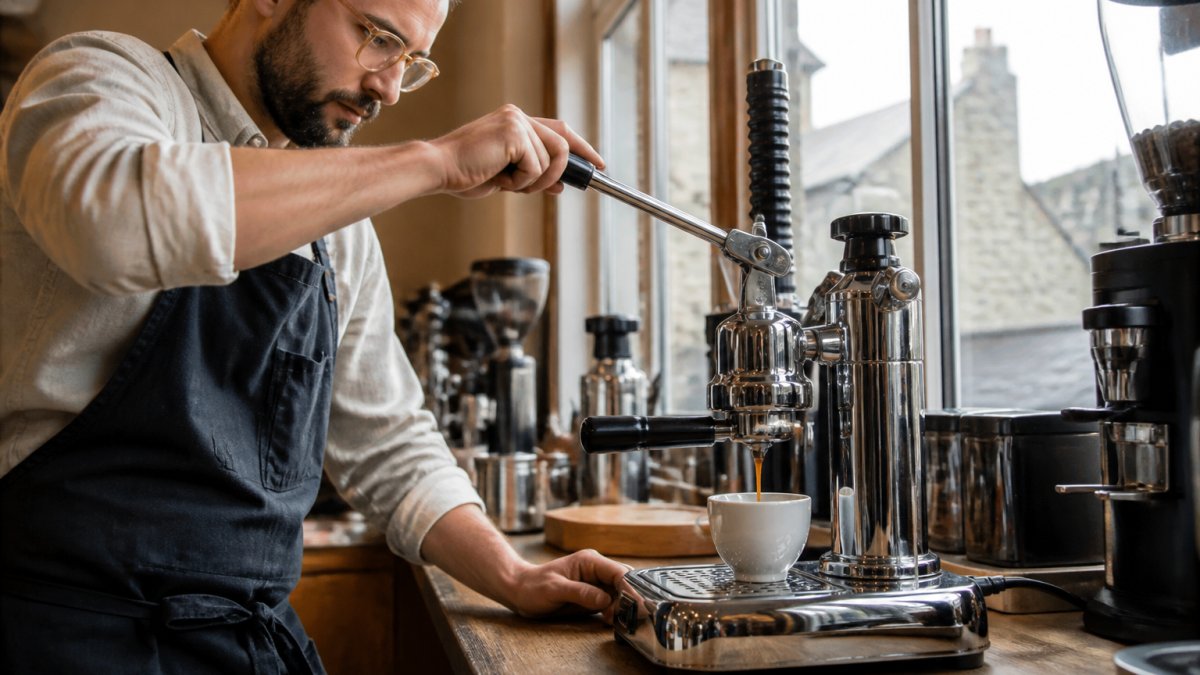
The trade-off is less flexibility. You cannot easily improvise a different pressure profile mid-shot the way a direct lever allows. For most home users, that is a fair exchange: predictable shots beat heroic ones.
Lever Espresso Machine Maintenance and Long-Term Ownership
Lever espresso machine maintenance is simpler than most pump machines, and that mechanical simplicity is a genuine long-term advantage. Fewer electronics means fewer failures, and the parts that do wear are usually accessible. But 'simple' does not mean 'free', and the practical ownership picture is where most guides stay vague.
What routine upkeep involves
- Flush the group after each session to clear grounds
- Backflush with detergent on a weekly schedule
- Check and replace group seals as they harden
- Lubricate the lever mechanism per the manufacturer's guidance
- Descale on the interval your water hardness demands
Practical ownership costs
Rather than broad claims, break the cost into four buckets. Purchase price varies widely by brand and build, so set a budget for the machine itself first. Accessories matter more on a lever: a decent tamper, a scale, and a grinder capable of fine adjustment are not optional if you want repeatable shots. Maintenance is mostly consumables, group seals, gaskets, and occasionally a spring, and these are inexpensive parts, though the labour adds up if you pay someone else. Repairs are where lever designs shine: a machine built around a simple piston is straightforward to service, and many owners handle seals and lubrication themselves. Energy use stays modest on manual designs because there is no pump to drive, though any machine with a large boiler will draw more while heating.
Faema E61 Legend Espresso Machine - 1 Group, 2 Group, 3 Group, Semi-Automatic →
A common pattern is to budget for the machine plus a realistic annual allowance for seals and servicing, and to factor in a grinder upgrade if you do not already own one. If you want a sense of the upkeep rhythm before committing, our guide to espresso machine maintenance tips for longevity walks through the routine in detail.
Durability and repairability
Repairability is where lever designs shine. Seals, gaskets and springs are consumable parts, and a machine built around a simple piston is straightforward to service. Durability tends to be strong because there is less to go wrong. The trade-off is that spring levers need periodic spring and seal service, and neglecting those consumables is the most common cause of poor performance over time.
Is a Lever Espresso Machine Right for You?
A lever espresso machine suits you if you want control, quiet operation and a machine you can service yourself. It does not suit you if you want repeatable shots with minimal input from day one. The useful question is not 'is a lever good?' but 'which lever, for which user?'
A decision framework by user needs
Map the machine to your priorities rather than to a brand:
- Quiet operation: any lever wins over a pump machine, but spring levers are the quietest because there is no pump at all.
- Convenience: a spring lever with a stable boiler and consistent group temperature is the closest lever gets to hands-off. Direct levers demand more input every shot.
- Experimentation: a direct lever gives you the most control over the pressure curve, pre-infusion and shot-to-shot variation. Spring levers are more repeatable but less flexible mid-shot.
- Portability: manual levers with small boilers or no boiler are the most portable, though warm-up and temperature stability suffer.
- High-volume use: neither lever type suits busy service as well as a pump machine with volumetric dosing. Lever recovery between shots can be slower, especially on designs with small boilers.
Realistic workflow and beginner suitability
A typical shot on a direct lever takes longer than a pump shot because you are part of the machine.
Expect to spend time dialling in grind size, coffee dose, and tamping before shot consistency arrives. Manual effort is genuine, particularly on direct levers with larger springs or heavier groups. If you brew several shots back to back, you will feel it.
Temperature stability and repeatability
Manual control is not an unqualified benefit. Warm-up time varies by design and boiler size, and shot-to-shot temperature variation is a real issue on machines with small boilers or no PID.
Ask yourself three questions:
- Do you enjoy the process as much as the result?
- Are you willing to dial in grind and dose shot by shot?
- Do you brew a small number of shots at a time rather than a rush?
If you answered yes to all three, a lever will reward you. The La Marzocco Linea Mini and the GS3 both deliver repeatable results with far less manual input, and both are built to commercial standards for home use.


Best for: baristas who want tactile control and quiet brewing. Skip if: you need fast, hands-off consistency for several people.
Choosing Your Espresso Machine at Coffee Craft Studio
Choosing well means matching the machine to how you actually brew, not to how you imagine you will.
For commercial-grade output, the Faema E61 Legend at £5,400.00 pairs a semi-automatic group with a stable 9-bar pump and Faema's patented pre-infusion, while the Faema E61 Jubilé at £7,200.00 adds programmable dosing for busier service. You can also explore the Graef Batessa Espresso Machine as a concrete option to evaluate.
Frequently Asked Questions
Are lever espresso machines difficult to use?
Manual lever espresso machines take practice. You control pre-infusion and the pressure curve by feel, so early shots can run fast or stall until you learn how the puck responds to grind size, dose and tamping. Spring lever espresso machines are easier because the spring applies the declining pressure for you, leaving you to manage the pull and shot time. Either way, expect a few weeks of deliberate practice before results become repeatable.
Do lever espresso machines make better espresso than pump machines?
Not automatically. A lever espresso machine gives you a declining pressure curve and hands-on pre-infusion that many drinkers find brings out sweetness and body, but a well-set-up pump machine with stable brew temperature and pre-infusion can match it. The difference is control and feedback: a lever rewards technique, while a pump machine with a pressure gauge and pre-infusion delivers consistency with less effort. Grind quality and fresh coffee matter more than the mechanism.
Are spring lever espresso machines easier to use than manual lever machines?
Yes, generally. On a spring lever espresso machine the spring stores the energy and releases it as a declining pressure profile, so you are not pushing against the puck yourself. That makes shot consistency easier to hold, especially across several drinks. Manual lever machines ask you to modulate force through the whole extraction, which offers more control but a steeper learning curve and more manual effort per shot.
Is a lever espresso machine suitable for beginners?
A spring lever espresso machine can suit a beginner who is willing to learn, because the spring handles pressure and you focus on grind, dose and shot time. A manual lever machine is harder to recommend as a first machine unless you enjoy the process of dialling in by feel. Whichever you choose, budget for a quality grinder and fresh beans, since those affect shot quality more than the lever itself.
What does lever espresso machine maintenance involve?
Routine work covers backflushing with a detergent, descaling on the schedule your water hardness demands, checking and replacing group seals and lubricating the lever mechanism. Lever espresso machine maintenance is helped by mechanical simplicity: there is no pump to fail and fewer electronics, so worn seals and gaskets are the usual service items. Keep water filtered and the machine should stay reliable for years, with most parts straightforward to replace.
The real question is not whether a lever is better, but whether you want to be part of every shot. If you do, we can help you choose equipment that rewards the effort. Get started with Coffee Craft Studio and brew with equipment built for precision, consistency and long-term performance.
