

Conical vs Flat Burrs: Which Grinder Suits Your Coffee?
Table of Contents
- What Are Conical and Flat Burrs?
- The Mechanics of Grinding: How Burr Type Affects Particle Size
- Particle Size Distribution: Bimodal vs Unimodal Grind Patterns
- Flavour Profile Differences: Conical vs Flat Burr Grinders
- Coffee Grinder Grind Consistency: Retention, Calibration, and Micro-Adjustments
- Best Burr Coffee Grinders UK: Espresso Grinder Burrs for Your Brewing Method
- Conical vs Flat Burrs: Practical Comparison for Home and Commercial Use
- Conclusion: Choosing Your Ideal Grinder
Conical vs Flat Burrs: Which Grinder Suits Your Coffee?
Last Updated: August 1, 2026
Understanding the difference between conical and flat burrs is essential when choosing a coffee grinder. The choice between these two designs shapes not just the coffee you brew, but your entire grinding workflow.

What Are Conical and Flat Burrs?
Conical burrs consist of two cone-shaped grinding surfaces, one stationary, one rotating, that force beans through a narrowing gap. Flat burrs use two parallel, rotating discs with teeth that shear and crush beans between them. Burr shape determines how beans move through the grinder, how uniformly they're reduced to particles, and how much heat builds up during grinding.

Conical Burr Design and Function
Conical burrs have been the standard in many commercial and home grinders for decades. The inner burr sits stationary whilst the outer burr rotates around it, creating a tapered grinding chamber. Beans tumble downward through gravity into progressively narrower spaces, where they're reduced in size.
This gravity-fed design requires less force to move beans through the grinder. The slower rotation speed generates less friction heat, which matters when grinding lighter roasts where heat sensitivity is critical. Conical burrs produce a bimodal particle distribution, a mix of finer particles and larger chunks, which many espresso drinkers associate with sweetness and body.
Flat Burr Design and Function
Flat burrs operate on a different principle. Both burrs rotate, and beans are sheared between parallel surfaces with cutting teeth. The grinding chamber is typically wider and shallower than conical designs, and centrifugal force plays a larger role in moving ground particles outward.
Flat burrs produce a more uniform, unimodal particle distribution, with particles clustering around a single size. This consistency is prized for filter coffee and espresso extraction, as it reduces the range of extraction rates across different particle sizes. The faster rotation speed means faster grinding, though it also generates more heat.
The Mechanics of Grinding: How Burr Type Affects Particle Size
Conical burrs rely primarily on gravity to pull beans downward. Once a bean enters the grinding zone, it's compressed and fractured as the gap narrows. Larger pieces fall through quickly; smaller particles may bounce around longer before exiting, creating the characteristic bimodal distribution.
Flat burrs use centrifugal force to push ground particles outward toward the exit. Beans spend more time between the burrs, and the grinding path is more consistent. Particles are more uniformly sized because they experience similar grinding forces.

Heat Dissipation and Thermal Stability
Heat is the silent enemy of coffee grinding. Excessive heat can damage delicate flavour compounds, particularly in light roasts. Conical burrs, rotating at lower speeds, generate less frictional heat and give heat more time to dissipate. For light roasts, where acidity and floral notes are prized, this can be a meaningful advantage.
Flat burrs, spinning at higher speeds, generate more heat through friction. Commercial flat burr grinders often incorporate cooling fins or other heat-management features to mitigate this.
Particle Size Distribution: Bimodal vs Unimodal Grind Patterns
A bimodal distribution (typical of conical burrs) shows two distinct populations: fine particles and larger pieces. This creates a mixed extraction profile where fines extract quickly, releasing sweetness and body, whilst larger particles extract more slowly, contributing clarity and structure.
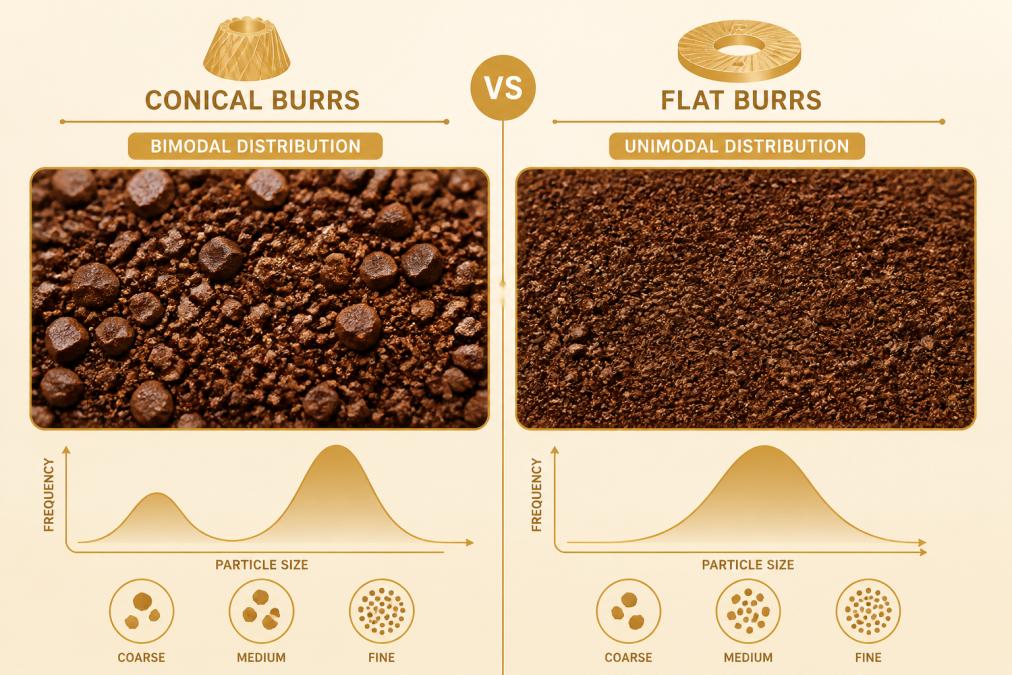
A unimodal distribution (typical of flat burrs) clusters particles around a single, consistent size. Extraction is more uniform across all particles, producing cleaner, brighter cups, particularly in filter coffee.
Fines, Boulders, and Grind Uniformity
Fines are the smallest particles, often dust-like. Boulders are the largest chunks that slip through incompletely ground. Conical burrs naturally produce some fines and boulders due to their bimodal distribution. In espresso, the fines contribute body and sweetness. In filter coffee, they can muddy clarity.
Flat burrs produce fewer boulders because the grinding path is more consistent, but can generate excessive fines if burr alignment drifts. Grind uniformity, the percentage of particles within a target size range, is typically 75-85% for flat burr grinders and 60-75% for conical burrs.
Flavour Profile Differences: Conical vs Flat Burr Grinders
Conical burr grinders tend to produce espresso shots with more body and sweetness. The bimodal particle distribution means some particles extract quickly whilst others extract more slowly, creating a full and rounded result.
Flat burr grinders typically produce cleaner, brighter cups with more flavour clarity. The uniform particle size means extraction is more consistent and predictable, particularly valuable for filter coffee.
Clarity, Body, and Mouthfeel in Your Cup
Clarity refers to the distinctness of individual flavour notes. Flat burr grinders excel here because uniform extraction means each flavour compound is extracted at the intended rate.
Body is the weight and texture on your palate. Conical burr grinders typically produce fuller body due to their bimodal distribution and higher fines content. This is often desirable in espresso.
Mouthfeel is the tactile sensation. Conical burrs often produce a silkier mouthfeel due to the presence of fines. Flat burrs produce a cleaner, crisper mouthfeel.
Sweetness, Acidity, and Bitterness Expression
Sweetness develops early in extraction. Conical burrs, with their fines, extract sweetness quickly and thoroughly. Flat burrs extract sweetness more evenly.
Acidity develops throughout extraction. Flat burrs, with their uniform extraction, tend to preserve acidity more clearly. Conical burrs can mask acidity under heavy body and sweetness.
Bitterness develops late in extraction. Flat burrs' uniform extraction means you're less likely to over-extract some particles whilst under-extracting others.
Coffee Grinder Grind Consistency: Retention, Calibration, and Micro-Adjustments
Consistency depends on workflow factors like grind retention and adjustment precision.
Grind Retention and Workflow Impact
Grind retention is the amount of ground coffee that clings to the burrs and chute instead of falling into your portafilter or cup. Conical burrs typically retain 0.5-1.5 grams per dose. Flat burrs often retain 0.3-0.8 grams.
High retention means old, stale coffee mixes with fresh grounds on your next shot. Low-retention grinders (particularly single-dose flat burr models) let you grind fresh for every shot. For home baristas, a grinder with grind retention below 1 gram is ideal.
Stepped vs Stepless Adjustment
Stepped grinders have discrete grind size settings. Stepless grinders allow infinite micro-adjustments between settings.
Stepped grinders are simpler and more repeatable. Stepless grinders offer precision but require discipline. Both burr types come in stepped and stepless versions; the choice depends more on your skill level than on whether you choose conical or flat.
Best Burr Coffee Grinders UK: Espresso Grinder Burrs for Your Brewing Method
The best grinder for you depends on your primary brewing method and how much consistency matters to your workflow.
Conical Burr Grinders for Espresso and Filter
Conical burr grinders excel for espresso because the bimodal distribution produces sweetness and body that mask minor extraction inconsistencies. They're also forgiving; small dialling-in errors don't ruin shots as easily.
The Mazzer Kony S features 63mm conical burrs and is designed for cafés and specialty coffee businesses demanding exceptional consistency. It delivers the reliability and precision that professional environments require. The larger burr size means more contact surface, finer grind control, and the ability to handle high-volume grinding without thermal stress.
Conical burrs also work well for filter coffee, particularly for those who value body and sweetness over maximum clarity.
Flat Burr Grinders for Precision and Clarity
Flat burr grinders are the choice for filter coffee enthusiasts and precision-focused espresso drinkers. The uniform particle distribution produces the clarity and consistency that specialty coffee demands.
The Mazzer Philos features 64mm flat burrs and is engineered for coffee enthusiasts and professional baristas seeking grind consistency and precision. It offers professional-grade performance with a single-dose workflow that minimises retention and ensures fresh grinds for every brew.
For excellent value, the Mazzer Super Jolly V Up provides 64mm flat burrs. It's trusted by cafés worldwide and delivers precision and consistency. The Mazzer Major V features 83mm flat burrs, designed for busy cafés and serious home baristas who grind high volumes.
| Grinder Model | Burr Type | Burr Size | Best For |
|---|---|---|---|
| Mazzer Kony S | Conical | 63mm | Espresso, high-volume commercial use |
| Mazzer Philos | Flat | 64mm | Filter coffee, precision espresso |
| Mazzer Super Jolly V Up | Flat | 64mm | Espresso, commercial use |
| Mazzer Major V | Flat | 83mm | High-volume commercial grinding |
Conical vs Flat Burrs: Practical Comparison for Home and Commercial Use
In real-world use, the difference between conical and flat burrs comes down to priorities: sweetness and forgiveness (conical) versus clarity and consistency (flat).
Speed, Noise, and Durability Considerations
Flat burrs grind faster because they operate at higher speeds. If you're grinding for multiple shots daily, flat burrs save time. Conical burrs are slower but quieter, an important consideration if you grind early mornings or in noise-sensitive environments.
Durability depends on build quality more than burr type. Both can last years with proper maintenance. Flat burrs may require more frequent alignment checks because they're more sensitive to drift.
Roast Level Impact on Burr Performance
Light roasts demand careful grinding because heat sensitivity is high. Conical burrs' lower speeds and gentler grinding make them slightly better for light roasts. Medium and dark roasts are more forgiving; both burr types perform well.
For espresso, many baristas find conical burrs more forgiving across roast levels. For filter coffee, flat burrs' clarity shines regardless of roast level.
Conclusion: Choosing Your Ideal Grinder
The difference between conical and flat burrs shapes your entire coffee experience. Conical burrs offer sweetness, body, and forgiveness; flat burrs deliver clarity, consistency, and precision.
For home espresso, conical burrs are often the better choice because they produce the body and sweetness that mask minor dialling-in errors. For filter coffee or precision-focused espresso, flat burrs excel because uniform particle distribution produces the clarity and extraction consistency that specialty coffee demands.
At Coffee Craft Studio, our curated selection of premium grinders, including the Mazzer Kony S with 63mm conical burrs, the Mazzer Philos with 64mm flat burrs, and the Mazzer Super Jolly V Up with flat burrs, ensures you have the precision and consistency that café-quality results demand. Whether you're upgrading from a basic grinder or investing in professional-grade equipment, the right burr type matched to your brewing method will transform your daily ritual. Explore our collection and choose the grinder that brings your coffee vision to life.
Frequently Asked Questions
What is the main difference between conical and flat burrs?
Conical burrs use two cone-shaped grinding surfaces that work with gravity and centrifugal force, typically producing a bimodal particle size distribution with body and sweetness. Flat burrs use two parallel discs that create more uniform, unimodal particle sizes, often delivering greater clarity and separation in flavour. The choice affects grind consistency, extraction yield, and the final flavour profile in your cup.
Which burr type produces better grind consistency for espresso?
Flat burrs generally excel at espresso consistency due to their unimodal particle distribution, which promotes even extraction and clarity. However, high-quality conical burrs can also deliver excellent espresso results, particularly those with larger diameters and precise burr alignment. The real factor is grinder calibration and the quality of the burr geometry, premium conical burrs like 63mm designs often rival flat burrs in consistency and precision.
Do conical burrs retain more coffee grounds than flat burrs?
Conical burrs typically retain more grounds because their cone-shaped geometry and gravity-fed design naturally trap particles inside the burr chamber. Flat burr grinders, especially single-dose designs, often feature straight-through grind paths that minimise retention to 0.1-0.3g per dose. Lower retention means fresher coffee for each brew and less stale grounds affecting flavour, a key advantage for home baristas prioritising freshness.
How does roast level affect conical and flat burr performance?
Light and medium roasts benefit from flat burrs' clarity and flavour separation, which highlight origin characteristics and acidity. Dark roasts often shine with conical burrs because their bimodal distribution enhances body and sweetness, masking harshness. Thermal stability also matters: flat burrs generate less heat during grinding, making them better for delicate light roasts, whilst conical burrs' centrifugal action can slightly warm beans, less critical for darker roasts.
[EXTERNAL_LINK: Specialty Coffee Association grinding standards | sca.coffee]
[EXTERNAL_LINK: Burr geometry and particle distribution research | baristahustle.com]
[EXTERNAL_LINK: UK consumer coffee equipment guide | britishcoffeeassociation.org]
This article was written using GrandRanker