

Why Is My Espresso Sour? A Troubleshooting Guide
Table of Contents
- Why Is My Espresso Sour? Understanding the Root Causes
- Espresso Grind Size for Sour Taste: Finding the Right Setting
- Espresso Machine Temperature: Impact on Extraction and Flavour
- Espresso Brewing Ratio: Dose and Yield for Balanced Shots
- Puck Preparation and Tamping: Creating Consistent Flow
- Water Chemistry and Mineral Content: The Hidden Variable
- Bean Quality and Roast Profile: Starting With Good Coffee
- Sour vs. Salty vs. Bitter: Identifying Your Problem
Why Is My Espresso Sour? A Troubleshooting Guide
Last Updated: July 24, 2026
Why Is My Espresso Sour? Understanding the Root Causes
If you're asking "why is my espresso sour," you're experiencing one of the most common frustrations in home espresso brewing. Sourness in espresso typically signals under-extraction, a situation where water passes through the coffee grounds too quickly, pulling out primarily acidic compounds while leaving behind the sweeter, more complex flavours that develop with proper extraction time.
At Coffee Craft Studio, we've helped countless home baristas diagnose and fix sour shots. The good news is that sourness is one of the most straightforward problems to troubleshoot, and understanding the mechanics behind it puts you firmly on the path to better espresso.
Sourness differs fundamentally from bitterness. Sour espresso tastes sharp, tangy, or vinegary, almost unpleasant on the palate. Bitter espresso, by contrast, tastes harsh or burnt. Many beginners confuse the two, which leads them down the wrong diagnostic path entirely. Getting this distinction right is the first step toward diagnosing your actual problem.
Espresso Grind Size for Sour Taste: Finding the Right Setting
Coarse grinds are the primary culprit behind sour espresso. When your coffee is ground too coarse, water rushes through the coffee bed too quickly, unable to extract the full range of soluble compounds. This rapid flow means you're capturing only the first wave of flavour, the bright, acidic notes, while the deeper, sweeter compounds remain locked in the grounds.
The relationship between grind size and extraction time is direct and measurable. A proper espresso shot should take 25-30 seconds from the moment you start the pump until the shot finishes pouring. If your shots are running faster than 20 seconds, your grind is almost certainly too coarse. If they're consistently under 18 seconds, you have a serious flow problem that coarser grinds will only worsen.
Dialling in your grinder correctly requires patience and a systematic approach. Start by making a small adjustment, typically a quarter turn on your grinder dial, and pull a test shot. Time it. If it's still running too fast, go finer by another quarter turn. Document each adjustment and its result. Most grinders have 40-60 usable settings, and finding your sweet spot is a matter of incremental testing rather than guessing.
The Sage The Smart Grinder Pro and Baratza Encore ESP both offer precise adjustment mechanisms that make dialling in straightforward. The Sage model includes Dosing IQ technology with 60 unique settings, allowing you to dial in with remarkable precision. For those seeking a more affordable entry point, the Baratza Encore ESP delivers espresso-optimized grinding at a lower price point, with enough adjustment range to eliminate sourness in most home setups.
Espresso Machine Temperature: Impact on Extraction and Flavour
Water temperature plays a subtle but critical role in extraction yield. Hotter water extracts faster and more efficiently, pulling out more soluble solids from the grounds. Cooler water extracts more slowly, leaving compounds behind. If your espresso machine runs cool, particularly older machines or those without temperature stability, you'll often experience sourness because the water simply isn't hot enough to fully extract the coffee.
Most espresso machines should brew at 90-96°C. This range allows proper extraction without scorching the grounds or pulling out excessive bitter compounds. Measuring your brew temperature requires either a reliable thermometer or, ideally, a machine with a built-in temperature display or PID (proportional-integral-derivative) controller.
If you're using a basic manual espresso machine without temperature control, you can improve consistency by running hot water through the group head for 10-15 seconds before pulling your shot. This warms the metal, stabilizing the temperature during extraction. It's a small step, but it often makes the difference between sour and balanced shots.
Adjusting your brew temperature, if your machine allows it, should be a fine-tuning step only after you've addressed grind size and dose ratio. Temperature changes are subtle, a 1°C difference is barely noticeable, but they matter when everything else is dialled in correctly.
Espresso Brewing Ratio: Dose and Yield for Balanced Shots
The dose-to-yield ratio is fundamental to extraction consistency. Your dose is the amount of dry coffee you load into the portafilter; your yield is the weight of espresso that flows out. A typical ratio is 1:2 or 1:2.5, meaning if you dose 18 grams of coffee, your target yield is 36-45 grams of liquid espresso.
This ratio matters because it defines how much water is available to extract your coffee. If your dose is too light relative to your yield, water races through the grounds without sufficient resistance, resulting in under-extraction and sourness. If your dose is too heavy, the puck becomes too dense, and water struggles to penetrate, leading to slow flow and over-extraction.
Most sourness problems stem from either an incorrect dose or an inconsistent one. If you're eyeballing your coffee rather than weighing it, you're likely varying your dose by 2-3 grams shot to shot. That variation compounds into wildly inconsistent extraction times and flavours.
Invest in a small digital scale accurate to 0.1 grams. Weigh your dose before tamping and your yield after pulling the shot. Track these numbers for a week. You'll quickly see patterns, and you'll know exactly which variable to adjust when a shot goes wrong. Most sourness disappears once you establish a consistent dose-to-yield ratio within your machine's capabilities.
Puck Preparation and Tamping: Creating Consistent Flow
Channelling, the formation of small gaps or cracks in the coffee bed during extraction, is a silent destroyer of espresso quality. When water finds a weak point in the puck, it rushes through that gap, completely bypassing the surrounding grounds. The result is severe under-extraction in the channelled area and over-extraction elsewhere, producing a shot that tastes sour, bitter, and unbalanced all at once.
Channelling happens for two reasons: inconsistent puck preparation or uneven tamping pressure. If your grounds aren't distributed evenly before tamping, or if your tamp isn't level, water will exploit the weak spots.
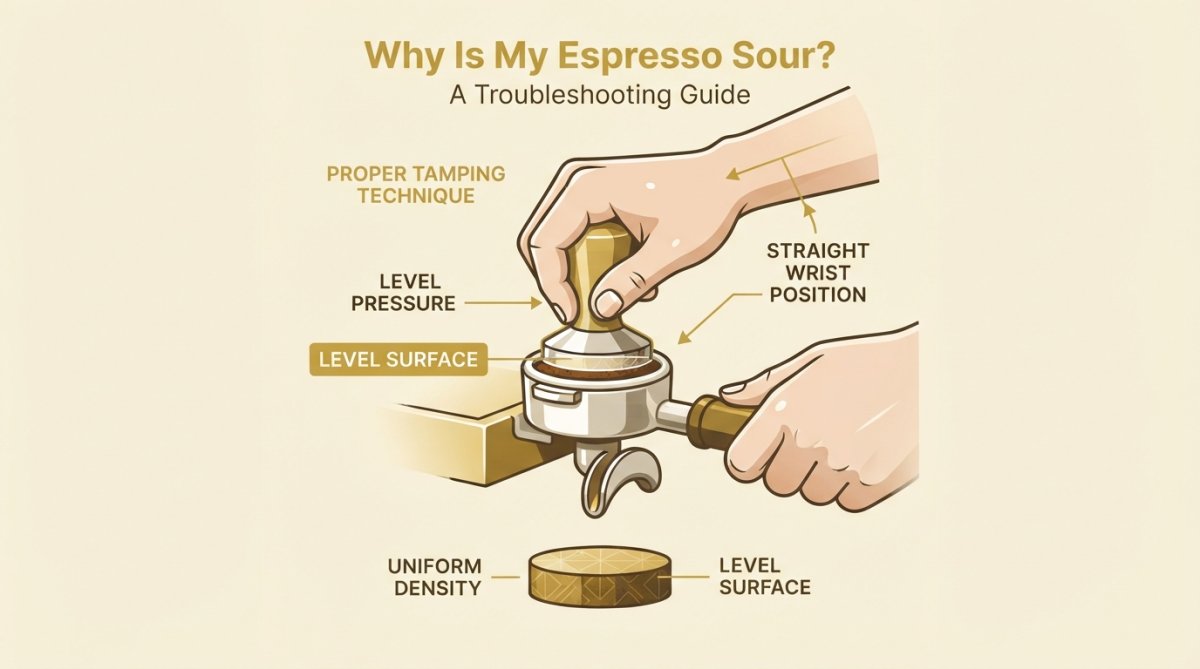
Perfecting your tamping technique requires three elements: even distribution, consistent pressure, and a level tamp. Start by distributing your grounds evenly in the basket, use your finger to gently level the surface. Then tamp straight down with firm, even pressure. Your wrist should remain straight; avoid twisting or angling the tamper. Apply approximately 30 pounds of pressure (roughly the weight of a small child pressing down on your hand). The pressure matters less than the consistency, the same pressure every time produces predictable results.
Many baristas obsess over tamping pressure, but the real issue is consistency. If you tamp hard on one shot and light on the next, your extraction times will vary wildly. A consistent medium pressure, applied level and straight, beats variable heavy tamping every time.
Some machines benefit from a WDT (Weiss Distribution Technique), gently breaking up clumps in the grounds with a thin needle before tamping. This prevents channelling by ensuring water can't find an easy path through the puck. It's an advanced technique, but it solves sourness problems that resist other fixes.
Water Chemistry and Mineral Content: The Hidden Variable
Total dissolved solids (TDS), the mineral content in your water, profoundly affect extraction efficiency. Water that's too soft (under 50 ppm of minerals) extracts poorly, leaving sourness. Water that's too hard (over 200 ppm) extracts too quickly, pulling out excessive bitterness. The sweet spot is typically 75-150 ppm.
Most home baristas never test their water, assuming tap water is fine. But water quality varies dramatically by region. If you live in a soft-water area, common in Scotland and parts of Wales, your espresso will consistently taste sour no matter how well you dial in your grinder.
Testing your water is simple: inexpensive TDS metres cost under £20 and give you an instant reading. If your water is too soft, adding a small amount of mineral-rich water (or using a water mineralisation cartridge) can transform your shots. If it's too hard, a basic water filter removes excess minerals.
This variable is often overlooked because it's invisible. You can see a coarse grind. You can measure dose and yield. But you can't see mineral content without testing. Yet it's frequently the culprit behind persistent sourness that resists all other troubleshooting.
Bean Quality and Roast Profile: Starting With Good Coffee
The roast level of your beans directly influences their acidity profile. Light roasts are naturally more acidic, that's by design. The shorter roasting time preserves bright, fruity, tea-like flavours. Medium roasts balance acidity with body. Dark roasts suppress acidity in favour of deeper, heavier notes.
If you're consistently pulling sour shots, consider whether your beans are a light roast. Light roasts require precise extraction to taste balanced. Under-extract them, and they taste aggressively sour. Over-extract them, and they become thin and hollow. There's a narrower window for success.
Distinguishing sour from natural acidity is critical. A well-extracted light roast should taste bright and complex, with notes of citrus, berries, or floral characters. It should taste lively, not sharp or vinegary. If your light roast espresso tastes vinegary or aggressively sour, you're under-extracting. If it tastes bright and balanced, that acidity is intentional and desirable.
Freshness matters too. Coffee begins to stale after about two weeks from the roast date. Stale coffee extracts poorly, often producing sourness. Check the roast date on your bag. If it's older than three weeks, the beans have likely lost their sweetness. Sourness from stale beans is difficult to fix through technique alone, fresher coffee is the real solution.
Sour vs. Salty vs. Bitter: Identifying Your Problem
These three flavour profiles are distinct, and confusing them leads to chasing the wrong fix. Sourness tastes sharp and acidic, hitting your front palate immediately. Saltiness tastes mineral and flat, rare in espresso but possible with certain water chemistries. Bitterness tastes harsh and burnt, lingering at the back of your throat.
Visual cues during the pour can help diagnose which problem you're facing. Under-extracted shots (sour) typically flow quickly, the espresso pours in under 20 seconds, often with a thin, blonde colour. The crema is thin or absent. Over-extracted shots (bitter) pour slowly, often taking 40+ seconds, with a very dark brown or nearly black colour and thick, dark crema.
A properly extracted shot should take 25-30 seconds and produce a rich golden crema that sits atop the espresso for several seconds after pouring. The colour should be deep brown, not blonde or black.
| Problem | Taste Profile | Pour Time | Colour | Primary Cause |
|---|---|---|---|---|
| Under-extraction (Sour) | Sharp, vinegary, acidic | Under 20 seconds | Blonde or light brown | Grind too coarse, dose too light, or water too cool |
| Proper Extraction | Balanced, complex, sweet | 25-30 seconds | Rich golden brown | Correct grind, dose, and temperature |
| Over-extraction (Bitter) | Harsh, burnt, lingering | Over 40 seconds | Very dark brown or black | Grind too fine, dose too heavy, or water too hot |
If your shot tastes sour but pours at the correct speed (25-30 seconds), the problem isn't extraction time, it's likely bean quality, water chemistry, or roast profile. If it pours quickly and tastes sour, start with grind size. If it pours slowly and tastes bitter, go finer with your grind.
Sourness in espresso rarely points to a single cause. More often, it's a combination of factors, a slightly coarse grind compounded by a light dose and water that's a few degrees too cool. The systematic approach is to adjust one variable at a time, pull a test shot, and observe the result. Grind size is the highest-use variable, so start there. Once you've found a grind that produces the right pour time, fine-tune your dose and temperature.
Coffee Craft Studio's curated range of espresso machines and grinders, including precision models like the Sage The Smart Grinder Pro with 60 unique settings, gives you the tools to diagnose and fix these problems consistently. With reliable equipment that holds temperature, delivers consistent grind adjustment, and allows you to weigh your dose accurately, sourness becomes a solvable problem rather than a persistent frustration. Explore our range and discover how the right equipment transforms your daily espresso ritual.
Frequently Asked Questions
What does sour espresso indicate about extraction?
Sour espresso indicates under-extraction, the water has passed through the coffee bed too quickly without dissolving enough soluble compounds. This typically happens when grind size is too coarse, water temperature is too low, or contact time is insufficient. Under-extracted shots taste sharp and acidic rather than balanced and sweet, signalling that your brewing variables need adjustment to increase extraction time and yield.
How does espresso grind size for sour taste relate to flow rate?
When your espresso grind size is too coarse, water flows through the coffee bed rapidly, reducing extraction time. This fast flow rate prevents proper solubility of flavour compounds, resulting in sour, thin shots. A finer grind increases resistance, slowing flow and allowing water more contact time with the coffee. Dialling in your burr grinder to the correct setting, typically medium-fine for espresso, ensures balanced flow rate and proper extraction.
Can water temperature alone fix sour espresso?
Water temperature plays a significant role but rarely fixes sourness alone. Espresso machine temperature affects how quickly soluble compounds dissolve; cooler water extracts more slowly, contributing to sourness. However, temperature works alongside grind size, dose, and brewing ratio. Increasing temperature to 90-93°C (optimal range) helps, but you'll likely need to adjust grind size finer and verify your brew ratio simultaneously for complete resolution.
What's the difference between sour and bitter espresso?
Sour espresso tastes sharp, tangy, and acidic, indicating under-extraction. Bitter espresso tastes harsh, ashy, and unpleasant, indicating over-extraction. Salty espresso falls between the two. Identifying which you're experiencing is crucial: sour requires finer grinds and longer shot times; bitter requires coarser grinds and shorter times. Tasting carefully and noting the flavour profile helps you adjust the correct variables rather than moving in the wrong direction.
This article was written using GrandRanker