

PID Espresso Machine: What It Is & Why It Matters
Table of Contents
- What Is a PID Espresso Machine?
- How a PID Controller Works in Espresso Machines
- PID vs Pressurestat Espresso Machines
- Benefits of PID in Coffee Machines
- How to Use a PID Espresso Machine
- Retrofitting PID to an Espresso Machine
- PID vs Flow Profiling: Understanding the Difference
- Popular PID Espresso Machines and Upgrades
PID Espresso Machine: What It Is & Why It Matters
Last Updated: July 14, 2026
What Is a PID Espresso Machine?
What is a pid espresso machine? At its core, a PID espresso machine uses proportional-integral-derivative control technology to maintain precise water temperature throughout the brewing process. Coffee Craft Studio has observed that this technology represents one of the most significant advances in home espresso equipment over the past decade, fundamentally changing how baristas approach temperature stability and shot consistency.
A PID controller is a feedback system that continuously monitors boiler temperature and makes micro-adjustments to heating elements to keep the water exactly where you set it. Unlike older machines that rely on simple thermostats or pressure switches, a PID espresso machine delivers the kind of thermal precision previously available only in commercial café equipment.
Temperature fluctuations of just a few degrees dramatically affect extraction. Research from specialty coffee publications shows that inconsistent brew water temperature is one of the primary reasons home espresso shots taste flat, bitter, or under-extracted. With a PID system, you eliminate this guesswork entirely.
The real advantage isn't just accuracy, it's consistency. When your machine holds 200.5°F instead of bouncing between 198°F and 203°F, your extraction becomes predictable. You can dial in a recipe and repeat it perfectly the next day.
How a PID Controller Works in Espresso Machines
The Proportional-Integral-Derivative algorithm sounds complex, but the mechanics are surprisingly elegant. The system measures temperature continuously through a thermocouple (a temperature sensor inside the boiler), compares it to your setpoint (the target temperature you've selected), and adjusts power to the heating element in real time.
Here's how each component of the algorithm functions:
- Proportional: Adjusts heating power based on how far off-temperature you are. The further from setpoint, the more power applied.
- Integral: Eliminates persistent error by accounting for how long you've been off-temperature, making gradual corrections over time.
- Derivative: Anticipates temperature changes by looking at how fast temperature is rising, preventing overshoot.
Together, these three functions create a control loop that responds smoothly to temperature changes without wild swings.
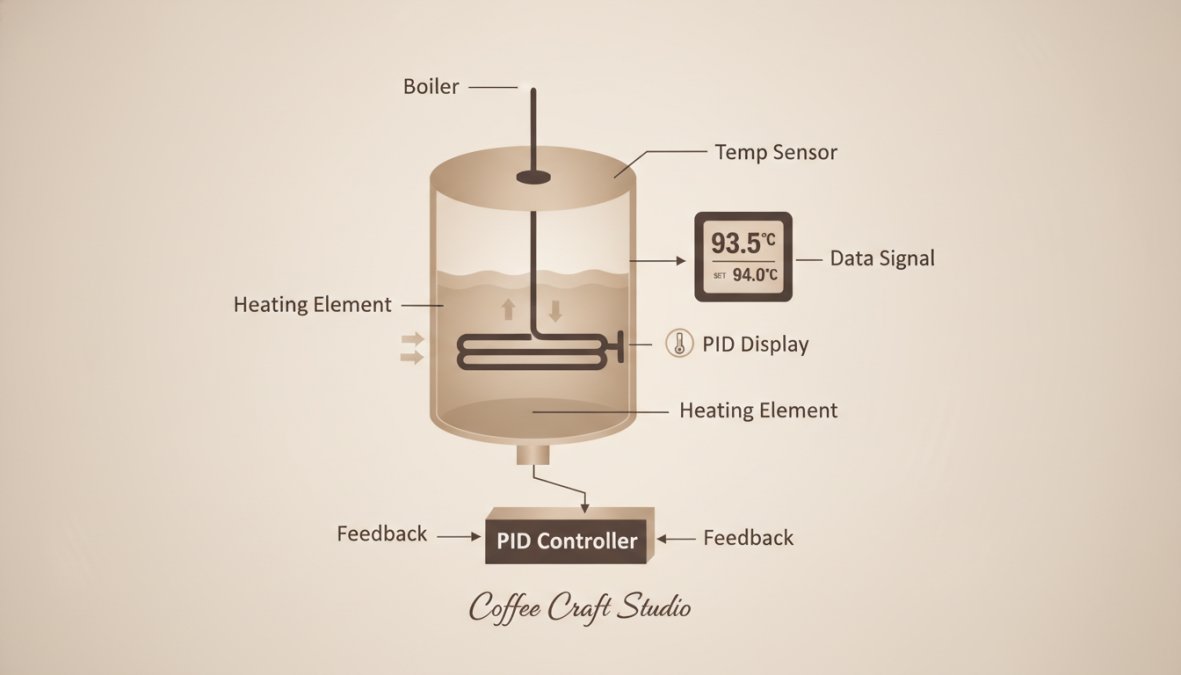
The key hardware components work in concert. A thermocouple sits inside the brew boiler and sends temperature data to the PID controller (the digital brain). The controller then signals an SSR, a solid state relay, which acts like an electronic on-off switch for your heating element. Instead of simple on-or-off operation, the SSR cycles power hundreds of times per second, creating the effect of precise power modulation.
This feedback mechanism is what separates PID from older temperature control methods. A pressurestat machine, by contrast, uses mechanical pressure to trigger heating on and off. It's effective but crude, like controlling your shower temperature with only hot and cold knobs, no fine adjustment.
The digital display on your machine shows real-time temperature. Many modern PID machines also display setpoint, allowing you to see both your target and actual temperature simultaneously. This transparency is invaluable for understanding how your machine behaves during warm-up and throughout the brewing session.
PID vs Pressurestat Espresso Machines
The distinction between these two control methods matters because it directly affects your brewing experience and the investment required. A pressurestat machine uses a mechanical switch that triggers when boiler pressure reaches a certain point. When pressure drops below that threshold, heating resumes. This on-off cycling is simple and durable but creates temperature oscillation.
Pressurestat machines typically experience temperature swings of 5-10°F between heating cycles. You might pull a shot at 200°F, then the next shot at 205°F. That variation compounds across multiple shots, making it harder to develop a consistent recipe.
A PID espresso machine eliminates this oscillation through continuous feedback. Temperature stability translates directly to extraction consistency. According to specialty coffee research, machines with tighter temperature control show 15-20% improvement in shot repeatability compared to pressurestat designs.
| Aspect | PID Machine | Pressurestat Machine |
|---|---|---|
| Temperature Stability | ±1°F | ±5-10°F |
| Setpoint Adjustment | Digital, precise | Mechanical screw adjustment |
| Learning Curve | Moderate | Low |
| Maintenance | Occasional sensor cleaning | Minimal |
| Upgrade Cost | $300-800 for retrofit | N/A (built-in) |
The cost difference matters. A pressurestat machine costs less upfront and requires minimal maintenance. But if you're serious about espresso quality, the temperature consistency of PID justifies the investment. For casual drinkers, a pressurestat might suffice. For anyone chasing shot-to-shot consistency, PID is the clear winner.
Benefits of PID in Coffee Machines
Thermal Stability and Shot Consistency
Thermal stability is where PID machines shine. When your boiler temperature stays locked at your setpoint, extraction becomes predictable. The same grind size, dose, and tamp pressure yield nearly identical shots every time.
This repeatability is transformative for recipe development. Instead of chasing variables, you isolate them one at a time. Dial in your grind at 200.5°F, and you know that tomorrow at 200.5°F, the shot will behave the same way. This is impossible with pressurestat machines where temperature varies shot to shot.
Specialty coffee professionals recognize thermal stability as fundamental to quality. Many third-wave roasters now recommend PID machines specifically because stable temperature extracts the coffee's intended flavor profile. A single-origin Ethiopian light roast, for example, requires precise temperature control to highlight its floral and fruity notes without going bitter.
Extraction Yield and Flavor Development
The relationship between temperature and extraction is direct and measurable. Higher temperatures accelerate extraction, pulling more solids from the coffee. Lower temperatures slow extraction, leaving more in the puck. A 5°F difference can shift your extraction yield by 2-3 percentage points.
Optimal extraction typically falls between 18-22% of the coffee's soluble solids. Below 18% tastes sour and thin. Above 22% tastes bitter and harsh. With PID control, you dial in your machine to hit that sweet spot consistently, then focus on grind, dose, and technique rather than fighting temperature variables.
The flavor difference is noticeable within the first week of PID ownership. Shots taste cleaner, more balanced, and more expressive of the coffee's origin characteristics. This improvement alone justifies the upgrade for anyone invested in specialty coffee.
Energy Efficiency in PID Systems
PID controllers are also more energy-efficient than pressurestat machines. Because the system maintains precise temperature rather than cycling wildly, it uses less total energy over time. The heating element cycles less frequently and less intensely.
For machines left on all day (as many home setups are), this efficiency compounds. A PID machine might use 10-15% less electricity than an equivalent pressurestat machine, which adds up over months and years.
How to Use a PID Espresso Machine
Setting Your Setpoint Temperature
Your setpoint is the target temperature you select for the brew boiler. Most espresso machines operate between 195°F and 210°F, though the exact optimal temperature depends on your coffee, grind size, and personal preference.
Start with 200°F as a baseline. Pull a few shots and evaluate the flavor. If shots taste sour and thin, raise temperature by 1°F increments until the sourness disappears. If shots taste bitter, lower temperature. Most baristas find their sweet spot within a 2-3°F window.
The digital display on your PID machine makes this adjustment simple. Press a button, adjust the setpoint, and the machine maintains that new temperature within seconds. No waiting, no guessing.
Understanding PID Tuning and Offset Adjustment
Advanced PID users adjust tuning parameters (the P, I, and D values) to change how aggressively the system responds to temperature changes. Most machines ship with factory tuning that works well for standard brew boilers.
Offset adjustment is different, it's a simple temperature correction that shifts your entire setpoint up or down. If your machine reads 201°F but your external thermometer shows 199°F, you have a 2°F offset. Adjusting the offset corrects this discrepancy.
Most PID machines include offset adjustment in the menu. Some require a technician to access it. If your machine reads consistently high or low compared to external measurement, offset adjustment restores accuracy.
Monitoring and Troubleshooting Temperature Fluctuations
Even with PID control, occasional temperature fluctuations occur. A sudden 2-3°F dip when you pull a shot is normal, cold water entering the group head cools the boiler temporarily. The PID system quickly compensates.
If you notice persistent temperature swings (±3°F or more), the thermocouple may need cleaning. Mineral buildup on the sensor reduces accuracy. Removing the boiler and gently cleaning the thermocouple with a soft brush restores precision.
If the machine won't hold setpoint at all, the thermocouple may be failing. This is a $50-150 repair depending on machine design. Failure is rare but possible after years of use.
Retrofitting PID to an Espresso Machine
Compatibility and Machine Selection
Not every espresso machine can accept a PID retrofit. Single boiler machines are easiest to retrofit because they have one thermocouple and one heating element. Dual boiler machines are more complex but still retrofittable.
Machines with soldered boilers are difficult to retrofit, you need to drill and tap the boiler to install a thermocouple. Machines with removable boilers are much simpler. Check whether your machine's boiler is accessible before committing to a retrofit.
Popular machines like the Rancilio Silvia and Gaggia Classic have extensive PID retrofit communities. Pre-made kits are available for these models, simplifying installation. For less common machines, you may need to source components separately and do custom installation.
Installation Process and Professional Support
A PID retrofit typically involves these steps: drain and cool the boiler, install the thermocouple, mount the controller, wire the SSR, and test the system. The process takes 2-4 hours for someone with basic electrical knowledge.
If you're uncomfortable with electrical work, professional installation is worth the cost. A qualified technician can complete the retrofit correctly and ensure safety. Many specialty coffee shops offer retrofit services for $300-600 in labor.
Coffee Craft Studio can guide you through machine compatibility and recommend appropriate PID kits for your specific model. Professional installation ensures your retrofit is safe and functions optimally.
PID vs Flow Profiling: Understanding the Difference
Flow profiling and PID temperature control address different aspects of espresso extraction. PID manages water temperature; flow profiling controls water pressure and flow rate during the shot.
A flow profiling machine lets you adjust pressure dynamically, starting at low pressure to pre-infuse the puck, then ramping to full pressure for extraction. This technique extracts different soluble compounds at different pressures, creating more complex, balanced shots.
PID and flow profiling are complementary, not competing. The best modern machines combine both technologies. PID ensures temperature consistency while flow profiling optimizes pressure dynamics. Together, they give baristas unprecedented control over extraction.
Flow profiling requires more skill to use effectively. You need to understand how pressure changes affect extraction at different coffee types and roast levels. PID is more straightforward, set temperature and brew. This makes PID the better starting point for most home baristas.
Popular PID Espresso Machines and Upgrades
Machines with Built-In PID Systems
Modern mid-range espresso machines increasingly ship with PID temperature control as standard. These machines include digital displays, setpoint adjustment, and integrated SSRs. Examples span brands focused on precision and consistency.
Built-in PID machines typically cost $800-2,500 depending on features and boiler size. They're ready to use immediately without retrofit hassle. If you're buying a new machine and temperature precision matters to you, built-in PID is worth the premium.
Aftermarket PID Kits for Classic Machines
If you own an older machine without PID, aftermarket kits offer a cost-effective upgrade path. These kits include a PID controller, thermocouple, SSR, and wiring harness. Installation difficulty varies by machine.
Quality PID kits range from $300-800 depending on features. Budget kits offer basic temperature control. Premium kits include advanced tuning options, larger displays, and better build quality. For most users, mid-range kits ($400-600) strike a good balance between cost and functionality.
Coffee Craft Studio stocks compatible PID kits for popular machine models and can recommend the right solution for your equipment. Whether you're retrofitting a classic Silvia or upgrading a newer machine, precision temperature control is within reach.
Achieving café-quality espresso at home requires controlling variables that seem small but compound dramatically. Temperature consistency is the foundation. Without it, you're constantly chasing inconsistent extractions and fighting to dial in recipes.
A PID espresso machine eliminates temperature as a variable, letting you focus on grind, dose, and technique. Whether you retrofit an existing machine or invest in a new PID-equipped model, the improvement in shot consistency and flavor clarity is immediate and substantial. Coffee Craft Studio's curated selection of precision espresso machines, both built-in PID systems and retrofit-compatible models, ensures you have the tools to craft exceptional shots every single day. Explore our range of PID-equipped machines and discover how temperature precision transforms your espresso experience.
Frequently Asked Questions
What does PID stand for in espresso machines?
PID stands for Proportional-Integral-Derivative. It refers to a control algorithm that continuously monitors and adjusts brew water temperature in espresso machines. A thermocouple measures actual temperature, the PID algorithm compares it to your setpoint, and a Solid State Relay (SSR) adjusts heating elements to maintain precision. This creates the thermal stability essential for consistent espresso extraction.
How does a PID espresso machine improve shot consistency?
A PID espresso machine eliminates temperature fluctuations that occur with traditional pressurestat or thermostat systems. By maintaining precise brew water temperature within 0.5°C of your setpoint, PID ensures consistent extraction yield and flavor development across every shot. This consistency is critical because espresso extraction is highly sensitive to temperature, even small variations significantly impact taste and crema quality.
Can you add a PID to an existing espresso machine?
Yes, retrofitting PID to an espresso machine is possible for many models, particularly single-boiler machines like the Rancilio Silvia. Aftermarket PID kits include a controller, thermocouple, and SSR. Compatibility depends on your machine's design and heating element type. Professional installation is recommended to ensure proper wiring and calibration. Pricing and compatibility vary significantly, so consult Coffee Craft Studio for your specific machine model.
What is the difference between PID and pressurestat temperature control?
A pressurestat uses steam pressure to trigger heating on/off, creating temperature swings of 10-15°C. A PID system actively monitors temperature and makes continuous micro-adjustments, maintaining stability within 0.5°C. PID delivers superior thermal stability and shot consistency, while pressurestat systems are simpler and less expensive. For precision brewing and extraction quality, PID is the clear advantage for serious espresso enthusiasts.
This article was written using GrandRanker