

Upgrading from Entry Level Espresso: A Strategic Guide
Table of Contents
- Understanding the Upgrade Journey: Why Entry-Level Equipment Holds You Back
- The Espresso Grinder Upgrade Importance: Your First Priority
- Dual Boiler Espresso Machine Benefits: The Next Logical Step
- Espresso Accessories Worth Upgrading: The Hidden Impact
- Espresso Machine Maintenance for Longevity: Protecting Your Investment
- Budget-Based Upgrade Paths: Maximising Value at Every Price Point
- Common Mistakes When Upgrading from Entry-Level Espresso
- Your Next Steps: Choosing the Right Upgrade Path
Upgrading from Entry Level Espresso: A Strategic Guide
Last Updated: July 20, 2026
Upgrading from entry level espresso machines unlocks consistency, precision, and the ability to extract the full potential from quality coffee beans. At Coffee Craft Studio, we've worked with hundreds of enthusiasts making this transition, and the patterns are clear: most people upgrade for the wrong reasons, skip the most impactful improvements, and end up disappointed. This guide shows you where to invest for maximum impact, which upgrades genuinely transform your shots, and where you can safely hold back.
Understanding the Upgrade Journey: Why Entry-Level Equipment Holds You Back
Entry-level espresso machines excel at getting you started, but they don't brew consistently. The problem is temperature stability. Budget machines use simple thermostats that cycle on and off, causing group head temperature to fluctuate by 5-15°C between shots. One extraction happens at 88°C, the next at 103°C. This wild swing changes extraction speed, flavour development, and shot quality unpredictably.
Temperature stability affects shot quality measurably. A shot pulled at 90°C extracts differently than one at 95°C, the difference between bright, complex acidity and flat, over-extracted bitterness. Prosumer machines maintain group head temperature within 1-2°C, meaning every shot starts from the same thermal foundation.
The Espresso Grinder Upgrade Importance: Your First Priority
Your grinder deserves more attention than your machine. Many home baristas assume the machine is the bottleneck and upgrade expecting dramatic improvements. The improvement exists, but it's modest, often 10-15% better. The real culprit is usually the grinder.
Espresso works by forcing hot water through a bed of ground coffee. If your grind is inconsistent, water finds paths of least resistance, rushing through coarse particles and stalling at fine ones. You get under-extraction and over-extraction simultaneously in the same shot. A quality burr grinder produces uniform particle size, so water flows evenly through the entire bed. Extraction becomes predictable.
Entry-level grinders produce inconsistent grind sizes. Upgrading to a quality espresso grinder with flat or conical burrs often produces a bigger improvement in shot quality than upgrading your machine.
A single-dose grinder requires you to measure and load beans for each shot, adding 20 seconds per shot. But every grind starts with fresh beans. For someone serious about upgrading from entry level espresso, the consistency gain outweighs the extra time. The Timemore Sculptor 064S Electric Coffee Grinder represents this category well: brushless motor, stepless adjustment, single-dose design.
Dual Boiler Espresso Machine Benefits: The Next Logical Step
Once your grinder is sorted, a dual boiler espresso machine unlocks workflow flexibility and thermal stability. Single boiler machines require waiting between brewing and steaming. A dual boiler maintains two separate boilers, one for espresso at around 90°C, one for steam at 130°C+. You brew and steam simultaneously, moving through drinks with café-like efficiency.
Beyond workflow, dual boilers deliver thermal stability that single boilers cannot match. The espresso boiler maintains consistent temperature independent of steam demand.
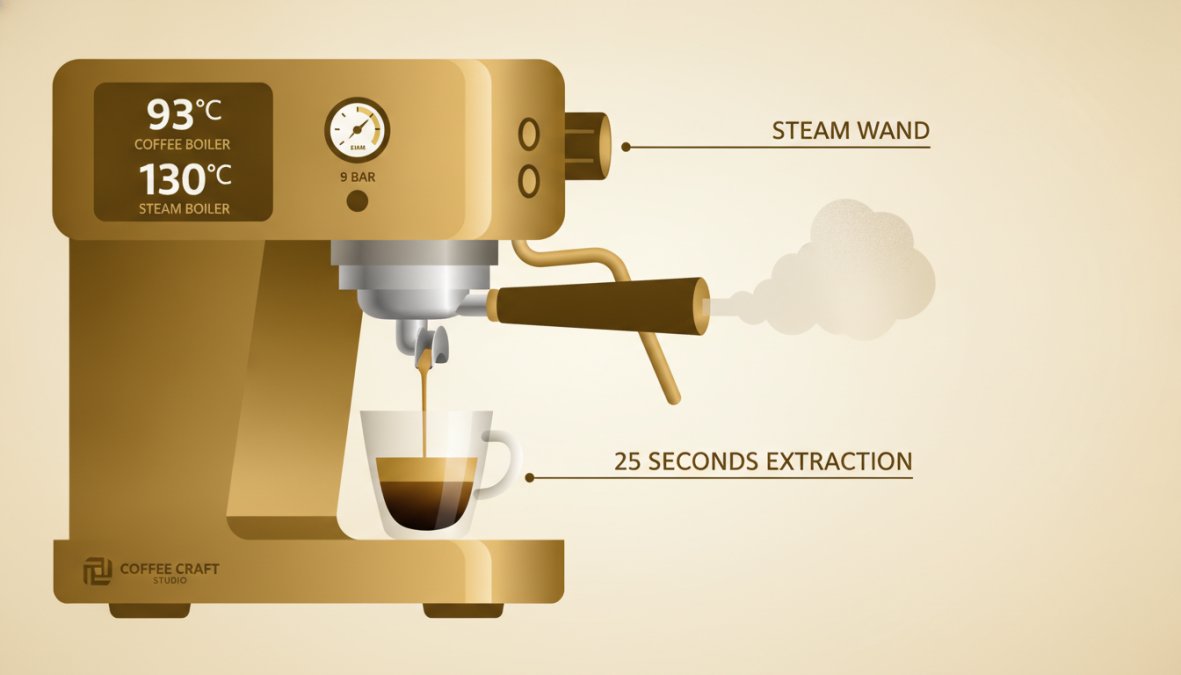
A PID (Proportional-Integral-Derivative) controller manages boiler temperature with precision. Rather than a simple on-off thermostat, a PID reads current temperature, predicts where it's heading, and adjusts heating accordingly. The result is temperature stability within ±1°C. Pressure profiling allows you to adjust pressure during extraction, start lower for pre-infusion, ramp up for extraction, taper off at the end, mimicking manual lever machines and optimising extraction.
The Sage Dual Boiler Espresso Machine offers PID temperature control and dual boilers but uses standard 9-bar pressure. For someone upgrading from entry level espresso, the dual boiler + PID combination represents the practical sweet spot: transformative improvements without overwhelming complexity.
Espresso Accessories Worth Upgrading: The Hidden Impact
Many people overlook accessories when upgrading. A cheap digital scale introduces dose variability; 1g difference changes extraction time by 5-10 seconds and flavour noticeably. A quality espresso scale (±0.1g precision) lets you dial in exact doses and track consistency.
A distribution tool levels the coffee bed before tamping, eliminating a major source of channelling. Combined with a proper tamper (flat, not conical; 58mm to match your portafilter), you've eliminated two major sources of inconsistency.
A single-walled portafilter (one spout) versus double-walled (two spouts) changes how espresso flows. Single-walled requires precise tamping and distribution; mistakes are immediately visible. This forces technique improvement. For someone upgrading from entry level espresso, a single-walled portafilter accelerates skill development.
Espresso Machine Maintenance for Longevity: Protecting Your Investment
Entry-level machines often use aluminium boilers, which corrode over time. Prosumer machines typically use stainless steel boilers that resist corrosion, last 10+ years with basic maintenance, and handle poor water quality better.
Warranty and support matter significantly. Entry-level machines often come with 1-year warranties; prosumer machines typically include 2-3 year warranties with established support networks. Consider repairability: can replacement parts be sourced? Are there local technicians who service the brand? A machine that's impossible to repair is worthless after warranty expires.
Budget-Based Upgrade Paths: Maximising Value at Every Price Point
Upgrading doesn't require spending equally on every component. A common mistake is spreading budget evenly. Better approach: allocate 40% to grinder, 50% to machine, 10% to accessories.
The first £500 spent on a quality grinder produces massive improvements over a cheap burr grinder. The next £500 on a machine produces noticeable but smaller improvements. The next £500 on accessories produces incremental gains.
For £1,000: £400 on grinder, £500 on machine, £100 on accessories. For £2,000: £600 on grinder, £1,200 on machine, £200 on accessories. Prosumer machines hold resale value better than entry-level ones (60-70% versus 40-50% of original price), offsetting some upgrade cost.
Common Mistakes When Upgrading from Entry-Level Espresso
Skipping the grinder upgrade is the most costly mistake. People buy a £1,500 machine with a £150 grinder to "save money," then end up with an expensive machine held back by mediocre grinding.
Electrical requirements and space planning oversights happen frequently. Prosumer machines draw more power than entry-level ones. A Sage Dual Boiler draws around 1,400W. Check your electrical setup before ordering. Measure counter space and confirm clearance above for steam wand movement.
Another error: buying based on features you'll never use. Pressure profiling sounds impressive but requires skill to implement effectively. Focus on features that directly improve shot quality: temperature stability, boiler type, grind consistency.
Your Next Steps: Choosing the Right Upgrade Path
If you're currently using an entry-level machine with a cheap grinder: prioritise the grinder upgrade first. Spend 2-3 months dialling it in before upgrading the machine.
If you already have a decent grinder: a dual boiler machine with PID temperature control is your next logical step.
If you're building from scratch: allocate budget across grinder (40%), machine (50%), and accessories (10%).
The Sage Dual Boiler Espresso Machine represents the practical entry point into prosumer equipment: dual boilers, PID control, solid build quality, and established support. Pair it with the Timemore Sculptor 064S Electric Coffee Grinder for single-dose precision, add a quality scale and distribution tool, and you've built a setup that pulls consistent, café-quality shots reliably.
Upgrading from entry level espresso is about building consistency into every variable you can control. Temperature stability, grind uniformity, dose precision, and workflow efficiency compound together to transform your daily ritual. Choose options that match your upgrade path, and you'll move from hoping for good shots to expecting them reliably.
Frequently Asked Questions
What's the most important upgrade when moving from entry-level espresso equipment?
The grinder is universally the highest-impact upgrade. Entry-level grinders produce inconsistent grind size distribution, which undermines extraction quality regardless of machine capability. Upgrading to a burr grinder with consistent particle size, such as a single-dose or low-retention model, delivers immediate improvement in shot quality, microfoam texture, and dialling-in efficiency. This upgrade alone often produces more noticeable results than many machine improvements.
When should I upgrade my espresso machine versus upgrading accessories first?
Prioritise grinder and essential accessories (scales, tamper, distribution tool) before upgrading the machine itself. These address extraction fundamentals and cost less. Upgrade the machine when your current unit cannot maintain temperature stability, lacks pressure profiling capability, or shows signs of wear affecting consistency. A dual boiler machine with PID control becomes worthwhile once you've mastered dialling in with quality accessories and understand your workflow demands.
How long do prosumer espresso machines typically last, and what warranty should I expect?
Well-maintained prosumer machines, particularly those with dual boilers and saturated group heads, typically last 10-15 years or longer with regular descaling and servicing. Warranty periods vary; premium brands often offer 2-3 years on parts and labour. Longevity depends heavily on water quality (using filtered or softened water extends boiler life significantly) and preventative maintenance. Investing in a machine from a reputable supplier with comprehensive support ensures you're protected beyond the initial warranty period.
Will upgrading from entry-level espresso equipment work if I'm not a trained barista?
Yes. Better equipment actually makes barista skills more accessible. A machine with temperature stability and consistent pressure profiling removes variables, allowing you to focus on technique. Quality accessories like scales and distribution tools reduce guesswork in dose accuracy and tamping. The learning curve shortens because you're working with predictable equipment rather than fighting inconsistency. Start with fundamentals, grind adjustment, dose, and tamping, and improved equipment will reward your efforts immediately.
This article was written using GrandRanker