

Troubleshooting Uneven Espresso Extraction Issues
Table of Contents
- Why Your Espresso Shots Are Inconsistent
- How to Fix Espresso Channeling
- Espresso Puck Preparation: Building a Consistent Coffee Bed
- Espresso Shot Pulling Too Slowly: Diagnosing the Cause
- Espresso Spraying from Portafilter: Stopping the Mess
- A Symptom-to-Cause Diagnostic Framework for Uneven Espresso Extraction
- Conclusion
- Frequently Asked Questions
Last Updated: October 16, 2026
Why Your Espresso Shots Are Inconsistent
Troubleshooting uneven espresso extraction starts with one hard truth: the problem is rarely the machine.
Uneven espresso extraction happens when water finds the easiest path through the puck instead of pushing through evenly.
The good news: it is fixable. Below, we break down each symptom, its cause, and how to test one variable at a time until your shots repeat.
What Uneven Extraction Looks Like in the Cup
- Two spouts, two speeds: one stream runs dark and fast while the other drips pale and slow
- Spitting and sputtering: the portafilter sprays instead of pouring
- Blonding too early: the stream turns pale within a few seconds
A balanced shot pulls as two even, honey-coloured streams and finishes syrupy and sweet. Anything else points to a specific cause.
How to Fix Espresso Channeling
Channeling is water boring a narrow tunnel through the coffee bed instead of saturating the whole puck. It is the most common cause of uneven espresso extraction, and it starts before water touches the coffee: water takes the path of least resistance, so any looser, drier or thinner spot is where it goes.
Here is how we approach it:
- Grind fresh, right before the shot. Stale grounds clump and trap air.
- Break up clumps with a distribution tool or a simple stir with a needle.
- Level the bed so the surface is flat all the way across.
- Tamp straight down, not at an angle.
- Check for air pockets by looking at the puck after the shot.
A common mistake is tamping harder to "fix" a fast shot. Consistency matters far more than force.
Distribution and Leveling Techniques
Distribution spreads the grounds evenly before tamping. Two methods work well:
- WDT (Weiss Distribution Technique): stir the grounds with fine needles to break up clumps. This is the most effective fix for channeling in a home setup.
- Leveling tool: a rotating distributor that scrapes the bed flat.
Do one, then the other. No amount of tamping will rescue poor distribution.
Espresso Puck Preparation: Building a Consistent Coffee Bed
Espresso puck preparation turns loose grounds into a flat, evenly dense bed that water passes through at the same rate everywhere. Get this right and most uneven extraction problems disappear.
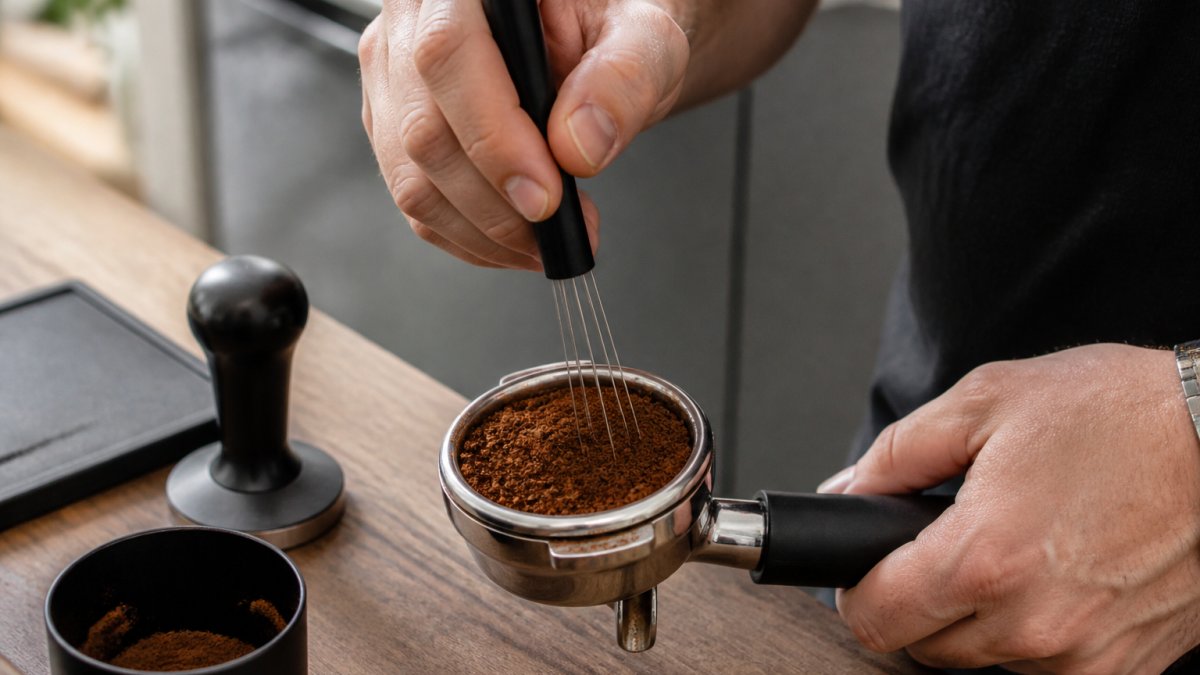
A puck with cracks, air pockets or a sloped surface will always channel, no matter how good your machine is.
Work through these steps in order:
- Dose by weight, not by eye. Use a scale with 0.1 g accuracy.
- Distribute with a needle tool or leveling tool.
- Tamp level with even pressure, keeping the tamper flat.
- Wipe the rim so no loose grounds sit on the basket edge.
- Lock in and pull straight away.
The Specialty Coffee Association's brewing guidance treats consistent preparation as the base of repeatable extraction. We agree entirely.
Tamping Consistency and Pressure
Tamping consistency beats tamping force every time. What matters is a level, repeatable tamp, the same from shot to shot.
Inconsistent tamping is a hidden cause of uneven espresso extraction: press harder on one side and water follows the softer side.
- Keep the tamper flat on the basket rim
- Use the same pressure every time
- Do not twist hard after pressing
For true repeatability, a mechanical tamping system removes your hand from the equation. The Mazzer Easy Tamper with Base applies a constant pressing force with a rotating disc that mimics the natural wrist twist, giving you the same tamp every time.

Espresso Shot Pulling Too Slowly: Diagnosing the Cause
An espresso shot pulling too slowly usually means water cannot get through the coffee bed fast enough. The usual suspects are grind size, dose and freshness, but the machine or basket can also be to blame, and those are the causes most people never check.
Work through the causes in this order, cheapest and most likely first:
- Grind too fine: the most likely culprit. Fine particles pack tightly and restrict flow.
- Dose too high: too much coffee in the basket leaves no room for water to move.
- Basket too small for the dose you are using, so the puck is compressed against the shower screen.
Change one thing, pull another shot and compare. If it speeds up, you found it; if not, move on.
Separating Machine, Basket, and Coffee-Bed Causes
Most slow-shot advice jumps straight to the grinder. That is often right, but not always.
Check the basket next. Confirm it is the correct size for your dose; a shallow basket forces the puck against the shower screen, restricting flow.
Only then adjust the coffee bed. If the machine and basket are sound, the bed is almost always the culprit, and grind size is the first lever to move.
Grind Size and Grind Consistency
Grind consistency matters more than grind size. A grinder producing fine dust and coarse chunks will always channel, because water exploits the fine particles first. That inconsistency also causes slow shots: the fine fraction clogs the bed while the coarse fraction lets water through, so the shot behaves unpredictably.
This is where a quality grinder earns its place. The Baratza Encore ESP Coffee Grinder uses 40mm hardened steel burrs and a dual-range adjustment system with micro-steps for espresso, delivering the repeatable grind resolution you need to dial in a shot and return to the same setting later. For commercial-grade grinding at home, the Mazzer Philos Coffee Grinder runs 64mm flat burrs and a 400W motor, producing uniform particle sizes that help reduce channeling at the source.

Adjust grind in small steps and pull a shot after each change. A single micro-step can shift shot time by several seconds, so large jumps make the sweet spot impossible to find.
Confirming the Fix with a Repeat Shot
A single faster shot is not proof you solved the problem; normal shot-to-shot variation means one good pull can be luck. Confirm the fix with two more shots at the same settings, checking that dose, yield and time stay within a narrow band. If they match the first, you have a repeatable fix. If they drift, re-check the machine and basket before adjusting anything else.
Baratza Encore ESP Coffee Grinder (Black) →
Espresso Spraying from Portafilter: Stopping the Mess
Espresso spraying from the portafilter is channeling made visible: water has found a weak point and blasts through instead of soaking the bed evenly.
A bottomless portafilter is the best diagnostic tool here, letting you watch the extraction from below and see exactly where the spray starts.
What to check, in order:
- Freshness: very fresh coffee releases gas that disrupts the bed
- Dose and basket fill: too little coffee leaves headspace for water to swirl
- Bed prep: cracks and air pockets create spray points
The UK Food Standards Agency guidance on coffee storage and freshness is a useful reference for how storage affects the coffee you brew.
Dose, Basket Fill, and Coffee Freshness
Dose and basket fill decide the headspace above the puck.
Aim for a dose that fills the basket so the puck just clears the screen. Weigh it. Do not eyeball it.
Coffee freshness and roast date matter too. Beans roasted within a few days release carbon dioxide that pushes water away from the grounds, causing gushing and spray.
For measuring all of this precisely, the Wilfa Uni Mini Coffee Scale gives 0.1 g accuracy in a compact size.

| Symptom | Likely Cause | First Fix |
|---|---|---|
| Two spouts, two speeds | Uneven bed | Improve distribution |
| Spraying from portafilter | Channeling, cracks | Check dose and freshness |
| Shot pulling too slowly | Grind too fine | Coarsen grind slightly |
| Shot gushing too fast | Grind too coarse | Fine grind setting |
| Sour, thin taste | Under-extraction | Grind finer, raise dose |
A Symptom-to-Cause Diagnostic Framework for Uneven Espresso Extraction
Diagnosing uneven espresso extraction works best when you separate the causes into three groups: the machine, the basket and the coffee bed. Test them in that order, cheapest fix first, rather than jumping straight to the grinder.
Group 1: The machine
- Water temperature stability
- Pump pressure
- Cleanliness of the shower screen and group head
Group 2: The basket
- Correct size for your dose
- Even hole pattern, no damage
- Fits the portafilter snugly
Group 3: The coffee bed
- Distribution and leveling
- Tamping consistency
- Grind size and freshness
If the machine and basket are sound, the bed is almost always the culprit.
Symptom-to-Cause Diagnostic Flowchart
Before changing any variable, match the symptom to the most likely cause. This stops you adjusting grind when the real problem is a worn basket or dirty screen.
| What you see | Most likely cause | First check |
|---|---|---|
| One spout fast, one slow | Uneven bed density | Distribution and leveling |
| Spraying or spitting | Channeling, cracks, or air pockets | Bed prep and dose |
| Pale, watery stream early | Under-extraction | Grind finer, check freshness |
| Shot gushes under 20 seconds | Grind too coarse or low dose | Grind setting and dose weight |
| Shot runs over 35 seconds | Grind too fine or blocked basket | Grind setting, basket holes |
| Sour, thin taste | Under-extraction | Grind, dose, water temperature |
| Bitter, dry, astringent taste | Over-extraction | Grind coarser, shorten shot |
| Uneven puck colour after the shot | Channeling or uneven tamp | Tamp level, distribution |
Read the symptom first, then test the single most likely cause. Do not change two things at once.
Controlled Testing: One Variable at a Time
Controlled testing is the only way to fix uneven espresso extraction for good: change one variable, pull a shot, record the result, repeat.
- Set a baseline: note dose, yield, and shot time
- Change one thing: grind size, dose, or tamp
- Pull a shot and record the same numbers
- Compare taste and time together, not separately
- Keep the change only if it improved both
Shot measurements and taste must be read as a pair. A shot hitting your target time but tasting sour is still under-extracted; a bitter, dry shot is over-extracted even if the time looks right. A simple log, dose in grams, yield out in grams, shot time in seconds, and one or two words on taste, reveals patterns rather than isolated results.
How Many Shots to Test and How to Confirm a Fix
Repeatability is the real goal. A shot you can reproduce tomorrow matters far more than one lucky perfect shot today.
A fix is only confirmed once you can pull two or three consecutive shots at the same settings with dose, yield and time staying within a narrow band. If the first improves but the next two drift, return to the machine and basket checks before adjusting the coffee bed again.
Conclusion
Uneven espresso extraction is a puzzle, and every symptom points to a specific cause. Most home setups change several things at once, hiding the real cause.
At Coffee Craft Studio, we stock the equipment that makes this consistency achievable. Our Baratza Encore ESP delivers repeatable grind resolution, the Wilfa Uni Mini Coffee Scale measures every shot precisely, and the Mazzer Philos brings commercial-grade grinding home.
Choose options with Coffee Craft Studio and build a workflow that gives you the same great shot every time.
Frequently Asked Questions
Why is my espresso pulling too slowly?
A slow shot usually points to a grind that is too fine or a dose that is too high for the basket. Both restrict water flow through the coffee puck. Check your grind setting first, then verify your dose matches the basket's recommended capacity. If the grind is correct, inspect the basket for clogged holes and confirm your machine is reaching the correct pressure. Adjust one variable at a time and pull a test shot to confirm the fix.
How can I tell if my espresso is channeling?
Channeling shows up as pale, watery streaks in the espresso stream or a spritz of liquid from one side of the portafilter. A bottomless portafilter makes it obvious: you will see liquid jetting through a single point rather than beading evenly across the basket. In the cup, channeling produces a sour, thin shot even when your grind and dose look correct. Inspect the spent puck for cracks or holes after the shot.
Can uneven tamping cause uneven espresso extraction?
Yes. A tamp that is not level creates a thicker coffee bed on one side, so water takes the path of least resistance through the thinner area. This produces uneven espresso extraction and inconsistent flavour. Use a tamper that matches your basket diameter, rest the portafilter on a level surface, and apply steady pressure straight down. A calibrated or self-leveling tamper removes guesswork and helps you repeat the same tamp every time.
What is the best way to fix espresso spraying from the portafilter?
Spraying almost always means water is forcing through a crack or gap in the coffee puck. Start by improving your espresso puck preparation: distribute grounds evenly before tamping, and make sure the tamp is level. Check that your dose fills the basket without touching the shower screen. If spraying continues, your grind may be too coarse, letting water punch through weak points. A bottomless portafilter helps you see exactly where the spray originates.