

Single vs Dual Boiler Espresso Machines: A 2026 Guide
Table of Contents
- What Are Single vs Dual Boiler Espresso Machines?
- Key Differences Between Single and Dual Boiler Espresso Machines
- Temperature Stability and Control in Espresso Extraction
- Espresso Machine Workflow: Sequential vs Simultaneous
- Heat Exchanger Espresso Machines: The Middle Ground
- Espresso Machine Price Comparison and Budget Considerations
- Pros and Cons: Which Machine Suits Your Needs?
- Reliability, Maintenance, and Long-Term Performance
Single vs Dual Boiler Espresso Machines: A 2026 Guide
Last Updated: July 19, 2026
When choosing between single vs dual boiler espresso machines, the decision comes down to workflow, budget, and how seriously you take your coffee. Both designs produce excellent espresso, but they solve different problems. Understanding their core differences will save you thousands of pounds and prevent buyer's remorse.
What Are Single vs Dual Boiler Espresso Machines?
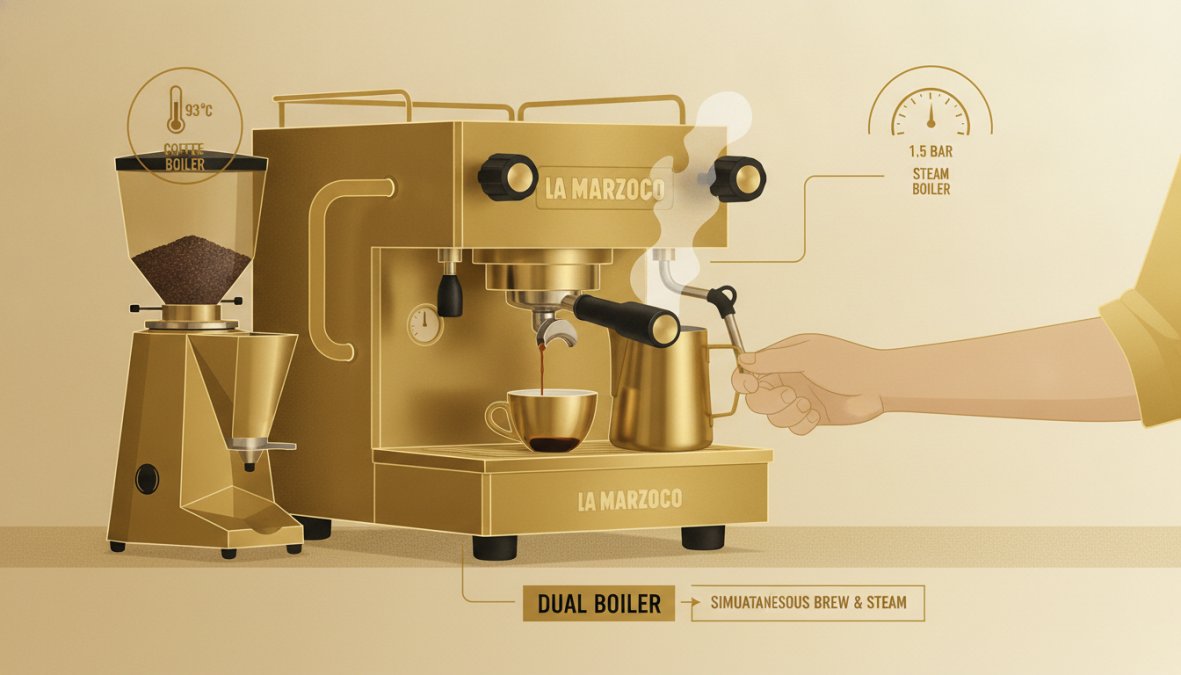
Single boiler espresso machines use one heating vessel to manage both brewing and steaming temperatures, switching between functions. Dual boiler machines maintain separate heating systems: one for brewing (90-95°C) and one for steaming (120-130°C), allowing simultaneous operation without temperature compromise.
Single Boiler Design Explained
A single boiler machine contains one thermal mass heating water for both extraction and steam generation. After pulling your shot, you wait 15-30 seconds for the boiler to reheat to steam temperature before frothing milk. The Rancilio Silvia exemplifies this approach with its saturated group head design improving temperature stability.
Without active temperature control, you'll notice shot-to-shot variation. Many single boiler owners adopt "temperature surfing," monitoring the heating cycle and pulling shots at optimal moments. Optional PID controllers automate temperature management, bringing consistency closer to dual boiler performance.
Dual Boiler Design Explained
Dual boiler machines separate thermal management into two circuits, eliminating the waiting period between brewing and steaming. The Sage Dual Boiler Espresso Machine and Profitec Pro 700 include PID temperature controllers on both boilers, allowing micro-adjustments to extraction and steam temperatures. The La Marzocco Linea Mini brings commercial-grade thermal stability to the home.
Dual boiler machines typically weigh more and occupy more counter space. Their complexity means more components to maintain, but for busy mornings or when serving multiple drinks, the workflow efficiency justifies the investment.
Key Differences Between Single and Dual Boiler Espresso Machines
The fundamental difference lies in thermal management and operational workflow. Single boiler machines force sequential operation: brew, then steam. Dual boiler machines enable simultaneous operation.
Temperature stability matters significantly. Single boiler machines experience temperature swing when switching between brew and steam modes, affecting shot consistency particularly with lighter roasts. Dual boiler machines eliminate this swing because each boiler maintains its target temperature independently.
Heat-up time differs: single boiler machines reach brewing temperature in 10-15 minutes from cold start, whilst dual boiler machines typically need 15-25 minutes. However, once hot, single boiler machines require small reheats between cycles, whilst dual boiler machines maintain temperature continuously.
Maintenance complexity scales with boiler count. Single boiler machines have fewer components, making descaling and repairs simpler. Dual boiler machines require descaling both boilers and managing two heating elements.
Temperature Stability and Control in Espresso Extraction
Temperature stability is technically consequential: a 5°C variation can shift shot character from sour to bitter.
Single Boiler Temperature Management
Single boiler machines rely on thermal mass and heating cycles to maintain temperature. Without PID control, you manage temperature manually through "temperature surfing." With a PID controller retrofit, the machine maintains a setpoint temperature within ±1°C, transforming consistency significantly. However, you still cannot brew and steam simultaneously; the boiler must reheat between functions.
Research from espresso enthusiast communities shows that PID-equipped single boiler machines produce shot-to-shot consistency approaching basic dual boiler machines, provided you wait adequate time between brew and steam cycles.
Dual Boiler Precision and PID Control
Dual boiler machines with PID control on both boilers represent the gold standard for temperature stability. Because each boiler operates independently, pulling a shot doesn't affect steam temperature. This independence allows you to dial in extraction temperature precisely, knowing that subsequent shots will extract identically.
Advanced machines like the Sage Oracle Touch and La Marzocco Linea Mini add app connectivity and customisable pre-infusion profiles. Temperature stability becomes critical when brewing lighter roasts or single-origin coffees demanding narrow extraction windows.
Espresso Machine Workflow: Sequential vs Simultaneous
Workflow efficiency separates casual home baristas from those making multiple drinks regularly.
Single Boiler Workflow Constraints
A typical single boiler workflow: pull espresso shot (25-30 seconds), wait for reheating (15-30 seconds), froth milk (20-30 seconds). Total time per milk drink: 60-90 seconds. For households making one or two milk drinks daily, this rhythm feels natural. For offices or multiple people wanting coffee simultaneously, it becomes tedious.
Single boiler machines excel when making espresso-only drinks or when milk drinks are occasional.
Dual Boiler Simultaneous Capability
Dual boiler workflow eliminates the reheating wait. You pull a shot whilst someone else froths milk, or pull two shots simultaneously, then froth milk for both. For households with multiple coffee drinkers, this changes the experience fundamentally.
A dual boiler cappuccino takes the same 25-30 seconds as a single boiler version, but you're not waiting between functions. If serving two people, you can pull both shots and froth both portions of milk in parallel, cutting total service time by 40-50%.
Heat Exchanger Espresso Machines: The Middle Ground
Between single and dual boiler machines sits heat exchanger machines, which use a single boiler with an internal heat exchanger tube. Cold water enters the tube, gets heated by surrounding boiler water, and exits at brewing temperature whilst the boiler maintains steam temperature.
Heat exchangers offer genuine advantages: lower cost than dual boiler machines, smaller footprint, simpler maintenance. The trade-off is less precise temperature control. For budget-conscious buyers wanting workflow improvement without full dual boiler complexity, heat exchangers deserve consideration.
Espresso Machine Price Comparison and Budget Considerations
Price differences reflect engineering complexity.
Entry-Level Single Boiler Options
Entry-level single boiler machines start around £800-£1,200. The Rancilio Silvia (approximately £995) offers commercial-grade 58mm portafilter and solid build quality. The Breville Barista Express Impress (approximately £800) adds integrated grinder and assisted tamping.
At this price point, you pay less upfront, accept temperature management complexity, and invest time learning technique.
Mid-Range and Premium Dual Boiler Choices
Mid-range dual boiler machines start around £1,100-£1,500. The Sage Dual Boiler Espresso Machine (£1,111.07) delivers PID-controlled temperature stability and reliable workflow improvements. Premium dual boiler machines range from £1,500-£3,000+. The Sage Oracle Touch (£2,099.95) adds touchscreen automation and advanced features. The La Marzocco Linea Mini (approximately £6,620) represents the luxury tier with commercial-grade thermal stability.
The pricing reflects genuine capability differences. A £1,100 dual boiler machine delivers meaningful workflow and temperature improvements over a £1,000 single boiler machine.
Pros and Cons: Which Machine Suits Your Needs?
Advantages and Limitations of Single Boiler Machines
Advantages:
- Lower initial cost (typically £800-£1,500)
- Simpler design with fewer components to maintain
- Smaller footprint, suitable for compact kitchens
- Teaches espresso fundamentals through hands-on temperature management
- Optional PID upgrades available for many models
Single boiler machines excel for learning. The limitation becomes a teacher as you understand heating cycles and thermal mass directly.
Limitations:
- Sequential workflow: wait between brewing and steaming
- Temperature swing affects shot consistency without PID control
- Reheating time accumulates throughout the day
- Skill-dependent consistency without PID
For households making multiple milk drinks daily, these limitations compound frustratingly.
Advantages and Limitations of Dual Boiler Machines
Advantages:
- Simultaneous brewing and steaming capability
- Superior temperature stability with PID control
- Consistent shot quality across multiple extractions
- Efficient workflow for high-volume use
- Advanced features on premium models
- Professional-grade performance in home format
Limitations:
- Higher initial cost (typically £1,100-£6,000+)
- Larger footprint requires dedicated counter space
- More complex maintenance and descaling procedures
- Potentially intimidating for beginners
- Overkill for casual, single-drink usage
For someone making one espresso daily, a dual boiler machine is wasteful complexity.
Reliability, Maintenance, and Long-Term Performance
Both single and dual boiler machines can last 10+ years with proper maintenance, but failure modes and repair costs differ.
Single boiler machines have fewer components, so fewer things fail. Descaling is straightforward. Repairs typically involve element replacement or valve service, both relatively inexpensive.
Dual boiler machines require descaling both boilers and managing two heating elements. If one boiler fails, repair costs are higher. However, quality dual boiler machines from manufacturers like Sage, Profitec, and La Marzocco have established service networks.
Common single boiler issues include heating element failure (typically 5-7 years) and solenoid valve sticking. Common dual boiler issues include heating element failure in either boiler and PID controller malfunction. Dual boiler repairs tend to cost 30-50% more.
Descaling frequency matters for both types. Hard water areas require descaling every 40-80 shots. Using filtered water dramatically extends intervals. Quality single boiler machines routinely exceed 15 years with basic maintenance. Quality dual boiler machines show similar longevity, though with higher cumulative maintenance costs.
Choosing your first espresso machine is choosing how you'll spend 10+ years making coffee. The single boiler versus dual boiler decision isn't about which is objectively better, it's about matching the machine's strengths to your actual daily routine.
If you're serious about consistent, café-quality espresso and making multiple milk drinks, dual boiler machines deliver. At Coffee Craft Studio, we recommend the Sage Dual Boiler Espresso Machine for most serious home users, combining PID-controlled temperature stability, simultaneous brewing and steaming, and reliable build quality without premium pricing. For those seeking the ultimate in thermal stability and app-connected control, the Sage Oracle Touch offers touchscreen convenience and automated dial-in.
Single boiler machines remain excellent for learning espresso fundamentals and for households making one or two drinks daily. But if workflow efficiency and shot consistency matter to your daily experience, the dual boiler investment pays dividends immediately and compounds over years of use.
| Factor | Single Boiler | Dual Boiler | Winner |
|---|---|---|---|
| Initial Cost | £800-£1,500 | £1,100-£6,000+ | Single Boiler |
| Workflow | Sequential (brew then steam) | Simultaneous | Dual Boiler |
| Temperature Stability | Variable without PID | Consistent with PID | Dual Boiler |
| Maintenance Complexity | Simple | Moderate | Single Boiler |
| Space Required | Compact | Larger footprint | Single Boiler |
| Best For | Learning, single drinks | Multiple drinks, consistency | Depends on usage |
Specialty Coffee Association standards for espresso extraction
Home espresso machine reliability study from Coffee Equipment Review
Thermal stability analysis in espresso machines
Frequently Asked Questions
What is the main difference between single and dual boiler espresso machines?
Single boiler machines use one heating element to brew espresso and steam milk sequentially, you must wait for the boiler to reach the correct temperature before switching tasks. Dual boiler machines have separate boilers for brewing and steaming, allowing simultaneous espresso extraction and milk frothing. This fundamental difference affects workflow speed, temperature stability, and the ability to produce multiple milk-based drinks efficiently.
Can you steam milk and pull an espresso shot at the same time with a single boiler machine?
No. Single boiler machines require you to brew espresso or steam milk, but not both simultaneously. After pulling a shot, you must wait for the boiler to reach steam temperature, then switch back to brew temperature before the next extraction. This sequential workflow makes single boiler machines less efficient for producing multiple cappuccinos or lattes in succession, though they remain excellent for occasional milk-based drinks.
How does temperature stability in espresso affect extraction quality?
Temperature stability is critical for consistent espresso extraction. Fluctuations in brew water temperature cause under- or over-extraction, resulting in sour or bitter shots. Dual boiler machines with PID temperature control maintain precise brew temperatures, ensuring repeatable results across multiple shots. Single boiler machines without PID require manual 'temperature surfing', monitoring and adjusting timing to compensate for temperature drift, making them less forgiving for beginners but still capable of excellent espresso.
Is a dual boiler espresso machine worth the investment for home use?
That depends on your usage patterns. If you regularly make milk-based drinks (lattes, cappuccinos) for multiple people, or prioritise speed and consistency, a dual boiler's simultaneous brewing and steaming capability justifies the higher cost. However, if you primarily drink straight espresso or make milk drinks occasionally, a single boiler machine offers excellent quality at lower cost and takes up less counter space. Consider your daily workflow and budget before deciding.
What maintenance differences exist between single and dual boiler espresso machines?
Both require regular descaling and backflushing, but dual boiler machines have more complex systems with two separate boilers, heating elements, and temperature sensors, increasing potential maintenance points. Single boiler machines are mechanically simpler, generally easier to service, and often have lower repair costs. However, quality dual boiler machines from reputable manufacturers are engineered for longevity. Choose based on your comfort with equipment complexity and access to qualified technicians in your area.
This article was written using GrandRanker