

Professional Espresso Machine for Office: 2026 Guide
Table of Contents
- Why Your Office Needs a Professional Espresso Machine
- Bean-to-Cup vs. Traditional Espresso Machines for Offices
- Top Professional Espresso Machines for Office Use
- Office Coffee Machine Maintenance Tips
- Office Coffee Machine Rental vs. Purchase
- Space, Installation, and Plumbing Requirements
- Total Cost of Ownership for Office Espresso Equipment
- How to Choose the Right Machine for Your Office Size
Last Updated: August 13, 2026
Why Your Office Needs a Professional Espresso Machine
A professional espresso machine transforms your workplace beverage programme from functional to exceptional. Rather than relying on instant coffee or basic drip machines, a quality espresso system delivers café-quality drinks that improve employee satisfaction, reduce external coffee runs, and create a genuine workplace amenity.
Employees with access to quality coffee report higher engagement and spend more time in communal spaces, strengthening workplace culture. A professional espresso machine signals that your business values quality and attention to detail, qualities that extend to how clients perceive your operation.
Consider the economics: a single café-quality cappuccino costs £4-6 when purchased externally. If half your team buys coffee twice weekly, a professional machine pays for itself within months whilst eliminating the productivity drain of staff leaving the office for coffee breaks.
Bean-to-Cup vs. Traditional Espresso Machines for Offices
The choice between bean-to-cup and traditional espresso machines depends on your team's size, technical skill level, and maintenance capacity.
Bean-to-cup machines automate grinding, dosing, and tamping. Load beans, press a button, receive a finished drink. These excel in high-volume environments where consistency and speed matter more than customisation. They require minimal training and produce reliable results regardless of operator skill. The trade-off: limited flexibility in espresso profiles and higher maintenance demands due to internal complexity.
Traditional espresso machines require manual grinding, dosing, and tamping but offer superior control over extraction. A trained barista can adjust grind settings, tamp pressure, and extraction time to optimise flavour. These produce richer, more nuanced espresso and milk-based drinks. The downside: they demand operator skill and consistent attention during service.
For most offices, the decision hinges on team size. Under 15 people, a traditional machine with one barista-trained employee works well. Above 25 people, bean-to-cup efficiency becomes essential. Between 15-25, either approach works depending on whether you have someone willing to develop espresso skills.
Top Professional Espresso Machines for Office Use
When selecting a professional espresso machine for office environments, you're balancing café-quality output against practical constraints: space, budget, maintenance resources, and user skill levels.
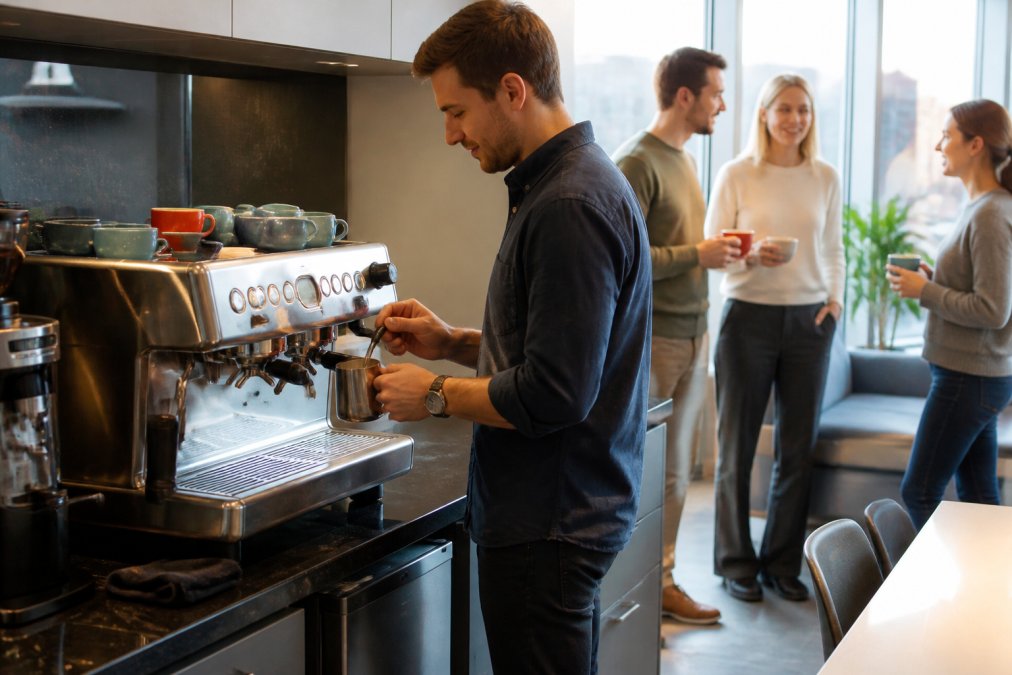
Sage Barista Express: Entry-Level Professional Control
The Sage Barista Express sits at the accessible end of the professional espresso machine spectrum. It combines an integrated conical burr grinder with precise PID temperature control and manual milk texturing. You go from whole beans to espresso in under a minute, with adjustable grind settings to fine-tune extraction for different bean profiles.
What works: The compact footprint fits tight office kitchens. PID temperature control maintains consistency across multiple shots, and the manual steam wand produces silky microfoam. The included temperature-control milk jug helps develop steaming technique.
What doesn't: Manual tamping requires technique development. The single boiler means you can't brew and steam simultaneously, you'll wait 30 seconds between espresso extraction and milk steaming.
Best for: Teams under 10 people or offices where coffee is a secondary amenity.
Sage Barista Pro: Speed and Precision Combined
The Sage Barista Pro addresses the Express's main limitation: speed. Its ThermoJet heating system reaches extraction temperature in just 3 seconds, dramatically reducing wait times between brewing and steaming. It includes an integrated grinder, a larger 54mm commercial-style portafilter, and an LCD display showing grind and extraction progress.
What works: The 3-second heat-up transforms workflow efficiency. Larger portafilter and dose capacity improve espresso quality noticeably. Low-pressure pre-infusion gradually increases pressure during extraction, supporting more balanced flavour development.
What doesn't: Single-boiler design means no simultaneous brewing and steaming. Manual tamping still requires technique.
Best for: Offices with 10-15 people where speed matters and someone on the team wants to develop barista skills.
Sage Dual Boiler: Simultaneous Brewing and Steaming
The Sage Dual Boiler introduces dual boiler technology, a professional feature that fundamentally changes workflow. Separate stainless steel boilers for espresso and steam allow you to brew and texture milk simultaneously, eliminating the wait between shots and steamed milk. It features PID temperature control, a heated group head for thermal stability, and a commercial-style 58mm portafilter.
What works: Simultaneous brewing and steaming cuts service time roughly in half compared to single-boiler machines. Dual boilers maintain stable temperatures throughout extraction and steaming. The heated group head ensures consistent water temperature during busy periods.
What doesn't: Requires dedicated counter space. Still requires manual tamping and grind adjustment.
Best for: Offices with 15-25 people where coffee culture matters and you want professional-grade performance without commercial equipment complexity.
Sage Oracle Touch: Automated Café-Quality Results
The Sage Oracle Touch combines dual boiler performance with intelligent automation: automatic grinding, dosing, tamping, and milk texturing through a touchscreen interface. The integrated burr grinder offers 45 grind settings and automatically adjusts based on the machine's Auto Dial-In system, which monitors extraction and refines settings over time. The Auto MilQ milk texturing system creates silky microfoam automatically, with preset options for dairy, oat, soy, and almond milk.
What works: The touchscreen guides users through drink selection with minimal training required. Automatic tamping and dosing eliminate the learning curve. The Auto Dial-In system continuously improves consistency. Alternative milk presets acknowledge modern workplace preferences. Wi-Fi connectivity allows remote power-on through the Sage+ app.
What doesn't: The touchscreen and automation add complexity that requires occasional troubleshooting.
Best for: Offices with 20-30 people where you want café-quality results without requiring barista training.
Casadio Nettuno: Commercial-Grade High-Capacity Option
The Casadio Nettuno is the only true commercial-grade option on this list. Purpose-built for cafés and hospitality environments, it's equally suited to larger offices. Available in 1-group, 2-group compact, 2-group, and 3-group configurations, it features a positive displacement pump for quiet, efficient pressure delivery and a thermosiphonic system maintaining stable brewing temperatures.
What works: True commercial-grade construction built for continuous service. The positive displacement pump operates quietly, important in open office environments. Thermosiphonic stability maintains espresso quality during peak demand. The Easy Steam system simplifies milk texturing.
What doesn't: Requires professional installation. The commercial-grade build means higher maintenance expectations and more complex diagnostics than home machines.
Best for: Larger offices (30+ people) committed to café-quality coffee as a permanent amenity, or smaller offices where the team is willing to invest in professional equipment for superior results and durability.
| Machine | Boiler Type | Best Volume | Key Advantage |
|---|---|---|---|
| Sage Barista Express | Single | Under 10 people | Affordable entry point, compact |
| Sage Barista Pro | Single | 10-15 people | 3-second heat-up, larger portafilter |
| Sage Dual Boiler | Dual | 15-25 people | Simultaneous brewing and steaming |
| Sage Oracle Touch | Dual | 20-30 people | Automation, minimal training required |
| Casadio Nettuno | Commercial | 30+ people | True commercial-grade, multiple group options |
Office Coffee Machine Maintenance Tips
Proper maintenance separates machines that deliver consistent café-quality coffee from those that decline into mediocrity. Neglected espresso equipment develops temperature instability, scale buildup, and compromised milk system performance.
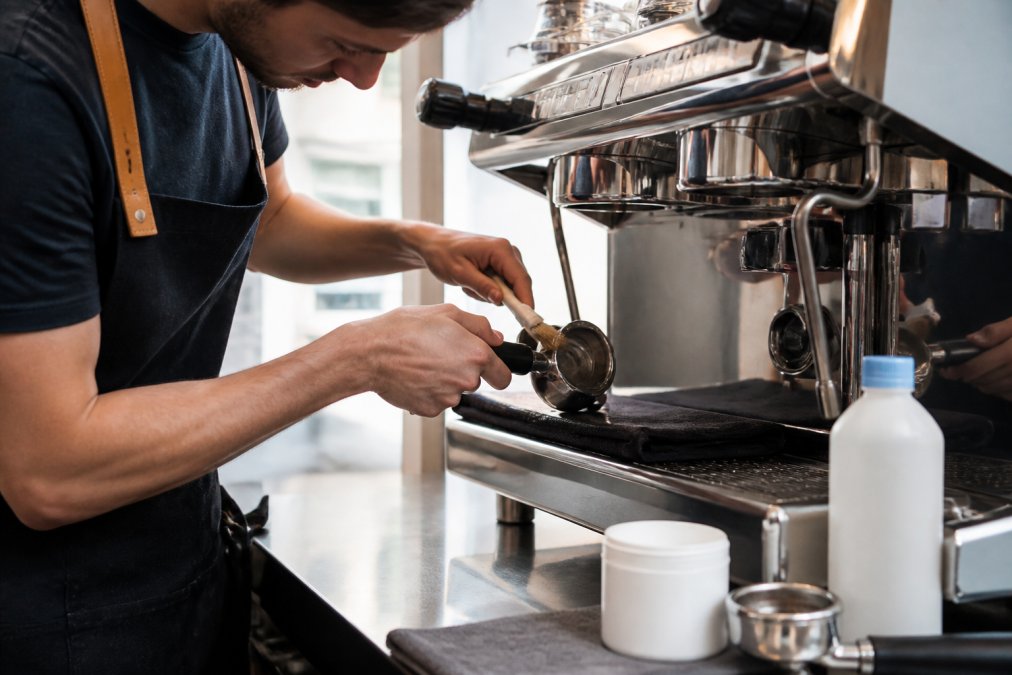
Daily maintenance takes 10 minutes and prevents most problems. Backflush the group head to clear residual grounds and oils. Purge the steam wand immediately after steaming milk, a quick burst of steam clears milk from internal passages, preventing buildup that hardens and blocks steam delivery. Wipe the drip tray and empty the grounds basket.
Weekly descaling removes mineral deposits from the boiler and group head. Hard water deposits accumulate quickly, reducing heat transfer efficiency and degrading espresso extraction. Use descaling powder designed for espresso machines, run it through the group head and steam wand according to manufacturer instructions, then flush thoroughly with fresh water.
Monthly deep cleaning involves removing and soaking the shower screen and portafilter basket in hot water with espresso machine cleaning powder. This removes oils and microscopic residue that daily cleaning misses.
Water quality matters significantly. A water filtration system removes minerals before they enter the machine. In hard water areas, filtration is essential.
Document maintenance tasks on a checklist posted near the machine. Assign responsibility to one or two team members. When maintenance is nobody's responsibility, it becomes everybody's neglect.
Office Coffee Machine Rental vs. Purchase
The rental versus purchase decision depends on your office's commitment level, budget structure, and tolerance for equipment downtime.
Purchasing requires upfront capital but provides long-term value. You own the equipment and control maintenance. The downside: you're responsible for repairs.
Renting shifts capital expense to operational expense. Rental agreements usually include maintenance and repairs, eliminating your responsibility for technical issues.
The break-even point favours purchasing after 18-24 months of rental. If your office plans to maintain the machine beyond two years, purchasing saves money. If you're uncertain about commitment or anticipate equipment replacement within 18 months, renting makes sense.
Consider also the operational difference: rental machines are often commercial-grade equipment maintained by professionals, whilst purchased machines require your team to handle maintenance. If nobody on your team wants that responsibility, renting eliminates the burden.
Space, Installation, and Plumbing Requirements
Professional espresso machines require more than a spot on the counter. Understanding space, electrical, and water requirements prevents costly installation problems.
Counter space: A single-group machine occupies roughly 35-40cm width and depth. Dual-boiler machines range 37-40cm. Commercial machines with multiple groups exceed 45cm width. Measure your office kitchen counter carefully, accounting for clearance on either side for safe operation and maintenance access.
Height considerations: Standard counter height (90cm) works for most machines. The group head typically sits 25-30cm above the counter surface, leaving comfortable reach for portafilter insertion and cup placement.
Electrical requirements: Most espresso machines draw 1,400-3,300 watts depending on size. Verify your office kitchen has a dedicated circuit with sufficient amperage. Plugging a high-draw machine into a shared circuit risks tripping breakers during peak usage.
Water supply: Plumbed-in machines connect directly to your water line, eliminating manual tank refilling. This requires access to a cold water line near the machine location and a drain for waste water. Tank-fed machines work anywhere but require daily refilling, impractical for high-volume offices.
Drainage: Espresso machines produce waste water from backflushing, descaling, and steam condensation. Ideally, connect the drain outlet to your kitchen sink or floor drain. If no nearby drain exists, a catch tray collects waste water for manual emptying.
Installation complexity: Single-group machines typically require 1-2 hours of professional installation if plumbing connections are needed. Commercial multi-group machines require 3-4 hours and may need electrical work.
Total Cost of Ownership for Office Espresso Equipment
Evaluating a professional espresso machine requires looking beyond the purchase price. Total cost of ownership includes the machine, water filtration, maintenance supplies, and potential repairs.
Initial purchase: Ranges from entry-level to commercial-grade options.
Installation: Budget for professional setup if plumbing connections are required.
Water filtration system: Essential in hard water areas to prevent mineral buildup.
Maintenance supplies: Descaling powder, cleaning tablets, and replacement gaskets represent ongoing costs depending on usage volume and water hardness.
Repairs and parts: Budget for unexpected repairs, replacement gaskets, and shower screen maintenance.
Over a 5-year ownership period, total cost of ownership remains far cheaper than external café purchases when calculated per person in your office.
How to Choose the Right Machine for Your Office Size
Team size drives the primary decision between machine types and capacity.
Under 10 people: A single-boiler machine like the Sage Barista Express or Barista Pro works well. Demand remains low enough that waiting between espresso and steaming doesn't create bottlenecks. These machines fit tight kitchens and offer affordable entry points.
10-15 people: The Sage Barista Pro or entry-level Dual Boiler becomes appropriate. At this volume, the 3-second heat-up of the Pro or simultaneous brewing/steaming of the Dual Boiler meaningfully improves workflow.
15-25 people: The Sage Dual Boiler or Sage Oracle Touch becomes necessary. Single-boiler machines create morning queues. Dual boiler efficiency handles demand without dedicated barista attention. If your team lacks espresso technique, the Oracle Touch's automation reduces training burden.

25-40 people: The Sage Oracle Touch or commercial-grade Casadio Nettuno works best. At this volume, you need automation or multiple group heads. The Oracle Touch handles 25-30 people comfortably with automatic operation. Beyond 30, the commercial Nettuno's capacity and durability justify the investment.
40+ people: Commercial-grade equipment becomes essential. The Casadio Nettuno in 2-group or 3-group configuration handles high volume. Alternatively, consider two single-group machines in separate locations rather than one bottleneck machine.
Beyond machine selection, consider staffing. Offices under 15 people can operate with ad-hoc brewing. Above 15, designate one person responsible for daily maintenance and morning service. Also assess your team's coffee culture. If your office includes espresso enthusiasts, they'll drive adoption and maintenance discipline. If coffee is purely functional, automation works better than machines requiring technique.
Choosing a professional espresso machine for office use transforms your workplace coffee experience from transactional to exceptional. The right machine depends on your team size, technical skill, and long-term commitment.
For most offices, the Sage range offers the best balance of quality, affordability, and ease of use. Coffee Craft Studio's curated selection includes machines from entry-level professional control through to commercial-grade capacity, ensuring you find equipment matched to your specific needs. Whether you're a small team testing café-quality coffee or a larger office ready for serious equipment investment, the right professional espresso machine for office use pays dividends in employee satisfaction and workplace culture.
Explore Coffee Craft Studio's professional espresso machines and discover which model suits your office. With expert guidance and premium equipment built for precision and reliability, you'll deliver genuine café-quality coffee to your team every day.
Frequently Asked Questions
What is the best professional espresso machine for a small office?
For small offices with 5-15 staff, a bean-to-cup machine like the Sage Barista Touch or Sage Oracle Touch strikes the right balance. These deliver café-quality espresso, cappuccino, and latte without requiring a trained barista. Single-group machines handle 30-50 cups daily, which suits most small teams. If your office prefers hands-on brewing, the Sage Dual Boiler offers professional-grade control in a compact footprint.
How often should I descale and maintain a professional office espresso machine?
Descale every 200-300 shots or monthly, whichever comes first. Daily maintenance includes purging the group head, cleaning the portafilter, and emptying the drip tray. Weekly, backflush the group head (if your machine allows it) and soak the shower screen. Regular office coffee machine maintenance tips include checking water quality, replacing filters every 2-3 months, and having a technician service the machine annually. Proper upkeep extends equipment life and keeps espresso quality consistent.
Should our office rent or buy a professional espresso machine?
Buying makes sense if you plan to stay in your office for 3+ years and want full control over equipment and drink menu. Renting suits offices with uncertain tenure or those wanting predictable monthly costs with included servicing. Office coffee machine rental vs. purchase depends on your budget: buying requires upfront investment (£630-£3,000+) but eliminates recurring fees; renting spreads costs but adds up long-term. Consider total cost of ownership, including maintenance, water filtration, and bean costs, before deciding.
Do I need professional barista training to use a professional espresso machine?
No, modern machines like the Sage Barista Touch Impress and Sage Oracle Touch automate grinding, tamping, and milk texturing, so untrained staff can produce café-quality drinks immediately. Machines with touchscreen interfaces guide users through each step. If you prefer hands-on control, the Sage Dual Boiler and Sage Barista Pro require some practice but are learnable in a few days. Most offices benefit from a brief induction session to cover basic operation, cleaning, and safety.
What size espresso machine do I need for a 20-person office?
A 20-person office typically needs a machine capable of 60-100 cups per day. Single-group commercial machines (like the Casadio Nettuno 1 Group) handle this comfortably with a 3-5 minute turnaround between orders. If your team makes drinks simultaneously during peak times, a 2-group machine reduces queues and wait times. Consider bean-to-cup options if barista skill varies; they maintain consistency even under high volume and free staff from brewing duties.
This article was written using GrandRanker