

Low Retention Coffee Grinders: 2026 Review
Table of Contents
- What Is Grind Retention and Why It Matters
- Single-Dose Coffee Grinders: Design and Benefits
- Burr Types and Their Role in Retention
- Top Low Retention Coffee Grinders Compared
- How to Clean Coffee Grinder Retention and Maintain Performance
- Grind Adjustment and Consistency for Espresso
- Conclusion
Last Updated: August 12, 2026
What Is Grind Retention and Why It Matters
Grind retention is the amount of coffee that remains stuck inside a grinder after grinding stops. Particles cling to the burr chamber and grind path through static electricity and friction, then oxidise between uses, becoming stale and bitter. When you grind fresh beans next, old particles contaminate your dose, muddying shot clarity and consistency.
For espresso, where shot quality depends on precise particle distribution, retention is a silent saboteur. A grinder holding dead space forces you to grind more beans than needed, wasting specialty coffee and inflating per-cup costs.
How retention affects shot quality and consistency
Stale, oxidised grounds extract slower and taste hollow, muddying your flavour profile. Espresso shots become harder to dial in because you're chasing a moving target as old particles shift the particle distribution. A 1-gram variance in retention between shots changes your extraction time and pressure profile. Single-dose grinders eliminate this variance by grinding only what you need, right when you need it.
The impact of dead space on workflow efficiency
Dead space forces inefficiency into your routine. Traditional hopper-fed grinders mean you're always grinding excess beans to ensure enough fresh coffee reaches your portafilter. Single-dosing grinders compress your entire workflow into one continuous motion: grind, distribute, tamp, pull shot. No waiting, no stale intermediates, no waste.
Single-Dose Coffee Grinders: Design and Benefits
A single-dose coffee grinder grinds only the amount you need for one shot or brew, then empties completely. No hopper. No dead space. The design forces zero retention by making it physically impossible for coffee to remain inside after grinding stops.
Zero retention through grind path design
Single-dose grinders achieve near-zero retention through optimised design. The grind path is as short and direct as possible, with fewer corners and crevices where static electricity can trap particles. The exit chute typically sits directly beneath the burr chamber, angled downward so gravity pulls grounds out immediately as they're created.
The Mazzer Philos exemplifies this approach. Its compact design and optimised burr chamber mean almost all ground coffee falls straight through into your dosing cup or portafilter, compared to traditional grinders where coffee must travel through long chutes and past multiple surfaces where particles stick.

Workflow efficiency and bean freshness
Single-dosing means you grind individual doses on demand, so beans spend minimal time exposed to air between grinding and extraction. Aromatic compounds remain intact, translating to noticeably brighter, more nuanced shots. The difference between a shot pulled from beans ground 30 minutes ago versus 30 seconds ago is measurable in cup clarity.
The workflow trade-off is time. Single-dosing adds 30-60 seconds to your routine, but for committed home baristas, this forces intentionality into each cup.
Burr Types and Their Role in Retention
Burr design directly influences both grind consistency and how much coffee gets trapped during grinding.
Flat burrs versus conical burrs for minimal waste
Flat burrs sit parallel to each other, producing more uniform particle sizes because coffee passes through the same grinding zone repeatedly. They generate more static electricity, which can increase retention slightly, but are easier to design with minimal dead space, making them the preferred choice for low-retention grinders.
Conical burrs are cone-shaped, with coffee spiralling downward between them. They produce slightly wider particle distribution but generate less static. For espresso, where consistency matters, flat burrs win. The Baratza Sette 270 uses 40mm conical burrs and still achieves extremely low retention through its straight-through design.
Burr size and particle distribution
Larger burrs (64mm versus 40mm) grind more slowly, producing finer control over particle size and dissipating heat more effectively. For single-dosing, burr size becomes less critical because you're grinding small quantities. A 40mm burr set can grind 18-20 grams of espresso in 8-12 seconds; a 64mm burr set does the same in 6-9 seconds.
Particle distribution consistency matters more than absolute speed. Flat burrs with optimised burr geometry produce tighter particle distributions, which is why they dominate the low-retention category.
Top Low Retention Coffee Grinders Compared
1. Mazzer Philos: Premium single-dose engineering
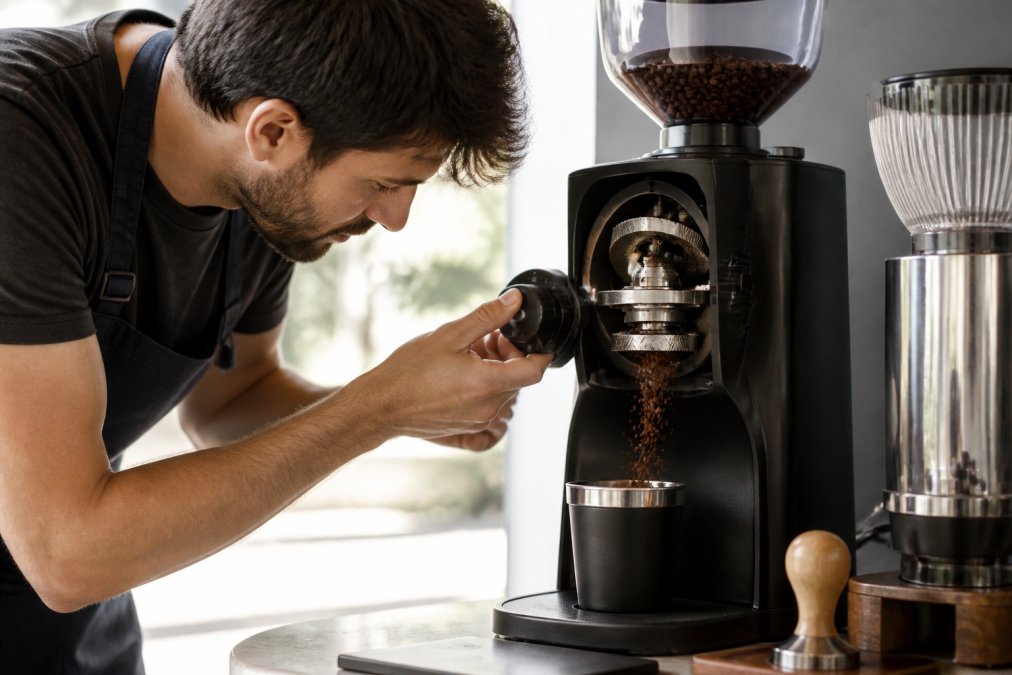
The Mazzer Philos is purpose-built for single-dosing with 64mm flat burrs and a grind path engineered for zero retention. Its burr chamber is compact, the exit chute is direct, and there's nowhere for coffee to hide. Grinding 18 grams produces almost no leftover particles; you get 18 grams out, every time.
The motor runs at 1,400 RPM, meaning slower grinding (15-20 seconds for espresso doses) but better heat control and finer adjustment resolution. The grind adjustment is stepless, giving infinite micro-adjustments between macro settings.
Where it falls short: it's bulky for a single-dose grinder, loud during operation, and expensive. For serious home baristas who want zero-retention engineering without compromise, it's unmatched. At Coffee Craft Studio, the Mazzer Philos is our top recommendation for espresso enthusiasts.
2. Baratza Sette 270: Speed and precision for espresso
The Baratza Sette 270 uses a straight-through design where beans drop directly from a small loading chamber into the burrs, then fall straight out into your portafilter. There's no path for coffee to stick.
The 40mm conical burrs and 1,500 RPM motor make it the fastest grinder in this comparison. An 18-gram espresso dose grinds in 8-10 seconds. The macro/micro adjustment system gives you precision dialling without fiddliness.
The real advantage is workflow speed. The straight-through design means almost zero retention. The downside: it's noisy, and some users report durability concerns with the adjustment mechanism after heavy use. The smaller burrs produce slightly less consistent particles than larger flat burr sets, which matters for very light roasts.
3. Option-O Lagom P64: Customisation and clarity
The Option-O Lagom P64 offers burr customisation (Mizen or SSP Red Speed burrs) and stepless adjustment with variable RPM control, making it the most flexible grinder on this list. It uses 64mm flat burrs and is engineered for single-dosing with minimal dead space.
Grind clarity is exceptional. The Lagom P64 produces some of the most uniform grinds available, which translates to predictable extraction and easier dialling. Retention is virtually zero, and the metal construction suggests longevity.
The catch: it's complex. Variable RPM and burr options require knowledge to exploit fully. For baristas who view grinding as a technical craft worth optimising, the investment pays off.
4. Weber Workshops EG-1: Professional-grade performance
The Weber Workshops EG-1 is the pinnacle of grinder engineering, featuring 80mm blind flat burrs, variable RPM up to 1,800, and a magnetically sealed grind chamber with tool-free burr removal.
The standout feature is engineering precision. Grind size adjustments allow sub-millimetre accuracy. Variable RPM lets you control heat generation and particle distribution independently. The magnetically sealed chamber and built-in purge function achieve near-perfect zero retention.
This is the grinder for baristas who've exhausted what other machines can teach them. It will produce identical grinds across weeks and months; your dialling baseline never drifts. The obvious drawback is cost and size, unsuitable for small kitchens. But if you're asking whether a grinder can be the limiting factor in your coffee quality, this machine eliminates that limit.
| Grinder | Burr Type | Retention | Best For |
|---|---|---|---|
| Mazzer Philos | 64mm flat | Near-zero | Serious home espresso, consistency priority |
| Baratza Sette 270 | 40mm conical | Near-zero | Speed and affordability, espresso focus |
| Option-O Lagom P64 | 64mm flat | Near-zero | Customisation, burr experimentation |
| Weber Workshops EG-1 | 80mm flat | Near-zero | Professional performance |
How to Clean Coffee Grinder Retention and Maintain Performance
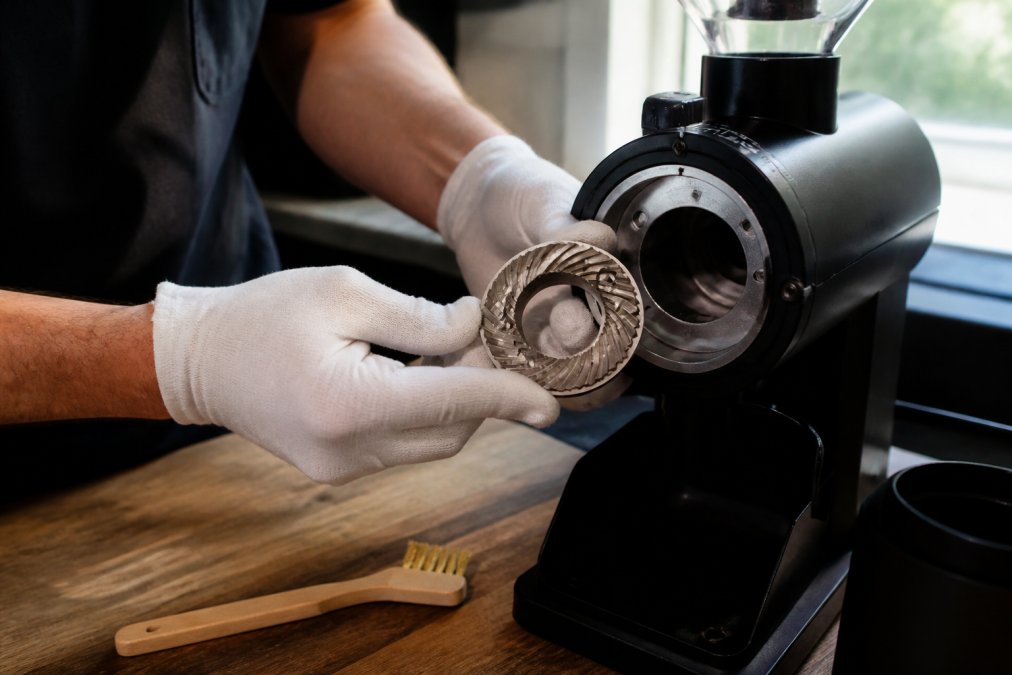
Retention doesn't disappear on its own. Even low-retention grinders accumulate stale grounds over weeks of use. Regular cleaning keeps your grinder performing at its design specification.
Routine cleaning protocols for retention reduction
Purging, running the grinder empty for 3-5 seconds after each grinding session, pushes lingering particles out through the exit chute. Weekly deep cleaning is more effective: unplug the grinder, remove the burr set if possible, and use a soft brass brush to sweep out the burr chamber and grind path. Avoid metal brushes, which can damage the burr surface.
Monthly, consider running a cleaning agent through the grinder. Cafiza or similar products dissolve oils and residue that accumulate on the burrs. Run a small amount through, then purge with cheap beans to clear the cleaning agent before returning to your regular coffee.
For single-dose grinders, this routine is simpler because there's less dead space to accumulate grime.
Anti-static measures and workflow optimisation
Static electricity makes particles stick to the chamber walls. Reducing static reduces retention. The most effective anti-static measure is humidity. A grinder in a 60-65% relative humidity environment produces noticeably less static than one in a dry room.
Workflow optimisation also matters. Switch from static-prone plastic dosing cups to metal ones. If you're using very light roasts, grind slightly more slowly to reduce static generation. Some baristas lightly mist their beans with water before grinding, though this is controversial because moisture can affect grind consistency.
Long-term mechanical wear and retention drift
Over months and years, burr surfaces wear and the burr geometry changes slightly. This affects particle distribution and can increase retention as the fit between burr and chamber becomes less precise.
Signs of wear include slower grinding, more fines in your grinds, and increasing difficulty dialling in consistent shots. The solution is burr replacement. Most grinders allow you to swap burrs without replacing the entire machine. Burr sets typically cost £80-£200 and take 10 minutes to install.
Retention drift is normal and doesn't mean your grinder is failing; it means the burrs are approaching the end of their useful life. High-quality burrs last 500-1,000 hours of grinding before noticeable wear occurs. For home users, that's 2-4 years of daily use. Regular cleaning removes abrasive particles that accelerate burr damage.
Grind Adjustment and Consistency for Espresso
Espresso demands consistency. A 0.5mm shift in grind size changes your shot time by 2-3 seconds and your flavour profile noticeably. Low-retention grinders matter because retention variance adds noise to your dialling process.
Stepless adjustment versus stepped mechanisms
Stepless grinders allow infinite micro-adjustments between settings, giving you maximum precision for dialling in. The trade-off is that stepless adjustments can feel imprecise without tactile feedback.
Stepped grinders have discrete click positions, each representing a fixed burr movement (usually 0.3-0.5mm). This gives tactile feedback and makes it easy to return to a previous setting. The trade-off is less granular control.
For espresso, stepless is generally preferred. The Mazzer Philos and Option-O Lagom P64 both use stepless adjustment. The Baratza Sette 270 uses a hybrid approach: 31 macro clicks plus stepless micro-adjustment.
Dialling in and retention testing across roast levels
Dialling in is adjusting your grind size until shots pull at the target time (usually 25-30 seconds for espresso). Retention testing means measuring how much coffee remains in your grinder after grinding a dose. For low-retention grinders, this is typically 0.1-0.5 grams.
Roast level affects grinder performance. Light roasts are denser and harder, grinding slower and producing slightly more fines. Dark roasts are more porous, grinding faster and producing fewer fines. This means your grind setting might shift by 1-2 clicks when switching between roast levels. Low-retention grinders minimise this variance because there's less stale coffee mixing with your fresh dose.
Conclusion
Low retention fundamentally changes how you approach espresso. It removes the guesswork from dialling in, preserves bean freshness, and eliminates waste. The grinders above represent the spectrum of options, from the Baratza Sette 270's speed and affordability to the Weber Workshops EG-1's absolute precision.
At Coffee Craft Studio, we recommend the Mazzer Philos (£1,185.00) if consistency is your priority. Its 64mm flat burrs, stepless adjustment, and engineered zero-retention design make it the ideal balance of performance and practicality for serious home baristas. We also offer the Mazzer Super Jolly V Up (£713.00) and the Mazzer Super Jolly V Pro (£831.00) for those seeking reliable, professional-grade grinding. Explore our curated selection of premium grinders and espresso machines, each designed for precision and performance. Choose options that match your workflow, your space, and your commitment to craft, because the best grinder is the one you'll use every day.

Frequently Asked Questions
What does low retention mean in a coffee grinder?
Low retention refers to the amount of ground coffee that remains inside the grinder after dispensing. High retention means stale coffee sits in dead space, the chamber, chute, and around the burrs, affecting flavour and consistency. Low retention grinders minimise this wasted space through direct grind paths and single-dose designs, ensuring each shot uses freshly ground beans rather than yesterday's grounds mixed with today's.
Which coffee grinder has the least retention?
Grinders with straight-through designs and minimal dead space achieve near-zero retention. The Baratza Sette 270 and Weber Workshops EG-1 are renowned for extremely low retention due to their no-chute designs and magnetically sealed chambers. Single-dose grinders like the Mazzer Philos and Option-O Lagom P64 also deliver exceptional results by design, grinding only what you need directly into your portafilter or dosing cup.
Why is low retention important for espresso?
Espresso demands precision. Retention causes old grounds to mix with fresh ones, creating inconsistent particle distribution and compromising extraction. This leads to variable shot quality, unpredictable dialling-in, and lost aromatics. Low retention ensures each shot starts fresh, improving shot quality and making your workflow more efficient, you spend less time purging stale grounds and more time pulling consistent, flavourful shots.
Are zero-retention grinders worth the investment?
For home baristas pulling 2-3 espressos daily, low-retention grinders eliminate frustration with inconsistency and waste. They're particularly worthwhile if you're serious about dialling in and achieving repeatable results. Models like the Mazzer Super Jolly V Up at £713 deliver professional-grade retention control at a reasonable price point. Higher-end options offer additional benefits like stepless adjustment and customisable burrs, but entry-level low-retention designs solve the core problem.
This article was written using GrandRanker