

How to Choose a Commercial Coffee Machine for a Small Office 2026
Table of Contents
- Assessing Daily Cup Volume and Peak-Hour Capacity
- Bean-to-Cup vs Traditional Espresso Machine for Office
- Countertop Footprint, Plumbing and Installation Requirements
- Commercial Coffee Machine Maintenance Checklist
- Office Coffee Machine Leasing vs Buying: Which Makes Sense
- Noise, Sustainability and Service Level Agreements
- Conclusion
- Frequently Asked Questions
Last Updated: September 15, 2026
Assessing Daily Cup Volume and Peak-Hour Capacity
The first question to settle when you choose a commercial coffee machine for a small office is not which brand looks best on the counter. It is how many cups your team actually drinks, and how many of those land in the same twenty minutes.

A commercial coffee machine is a plumbed or tank-fed appliance built for repeated daily use, with a cup-per-day rating that tells you how much output it can sustain without strain (bsigroup.com). Getting this wrong is the most expensive mistake in the whole process: buy too small and you queue at 9am, buy too big and you pay for capacity nobody uses.
Start with a simple count:
- Headcount, multiplied by average cups per person per day
- Add visitors, meetings and client coffees
- Identify your peak window, usually the first hour of the morning
A ten-person office where most people drink two coffees a day needs roughly twenty cups, but if fifteen of those fall between 8:30 and 9:30, you need a machine rated well above twenty. Daily throughput matters less than peak-hour capacity.
Bean-to-Cup vs Traditional Espresso Machine for Office
Bean-to-cup wins for most small offices. A bean-to-cup machine grinds, doses, tamps and extracts at the push of a button, which means anyone can make a consistent coffee without training.
Traditional espresso machines demand more: separate grinder, manual tamping, and a learning curve that shows up in the cup. In a home or a café staffed by enthusiasts, that control is the point. In an office, it is a bottleneck.
Here is how the two compare in practice:
| Factor | Bean-to-Cup | Traditional Espresso |
|---|---|---|
| Skill needed | None | Moderate to high |
| Consistency | Push-button | Depends on the operator |
| Cleaning | Automated programmes | Manual daily routine |
| Best for | Offices, mixed teams | Trained baristas, homes |
The trade-off is flexibility. A traditional setup lets you dial in a single-origin bean precisely; a bean-to-cup machine gives you repeatability across dozens of drinks a day. For a small office, repeatability usually wins.
Countertop Footprint, Plumbing and Installation Requirements
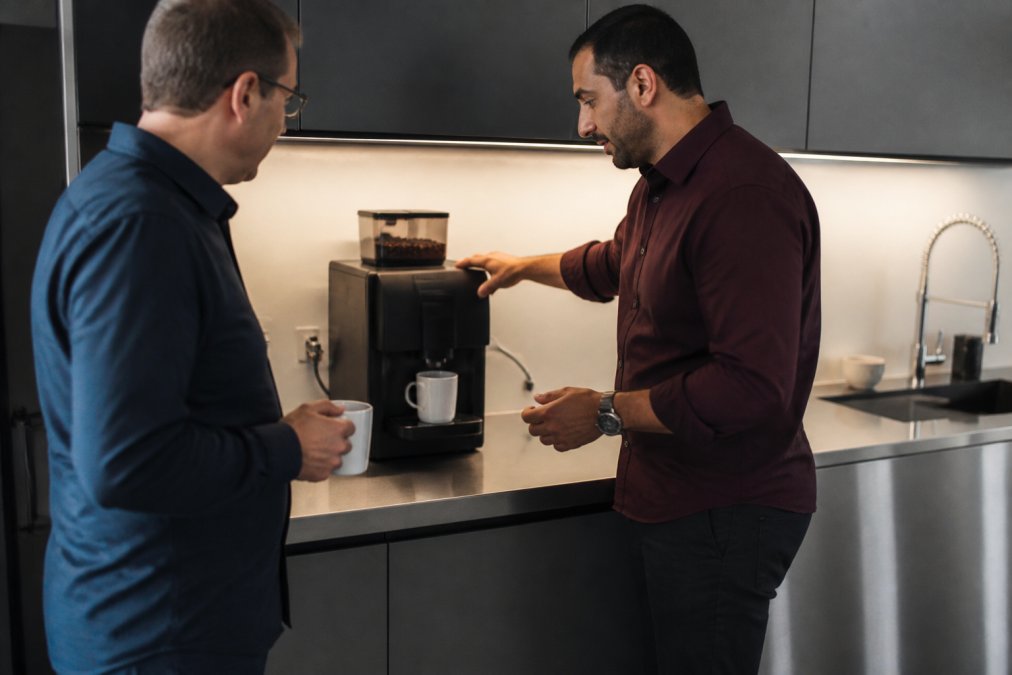
Measure your counter before you fall in love with a machine. Commercial models vary enormously in countertop footprint, and a unit that fits the space but blocks the kettle is not a solution.
Plumbed-in machines connect to the mains water supply and never need refilling, which suits high-volume sites. Tank-fed models need a refill every day or two but install anywhere with a socket. Water filtration matters in both cases: hard water scales a boiler faster than anything else, and a filter is cheaper than a repair (How to buy the best water softener).
Check three things before ordering:
- Counter depth and height clearance, including the bean hopper lid
- Distance to a mains water point and a drain, if plumbing in
- Whether the machine needs a dedicated circuit or just a standard socket
Commercial Coffee Machine Maintenance Checklist
Maintenance is where ownership costs hide, and it is also where most small offices quietly lose a machine. A unit that is cleaned daily lasts years longer than one cleaned when someone remembers, but the checklist itself is only half the story. The other half is what happens when a step is skipped.
Work through this on a realistic rhythm:
- Rinse the milk system after every use, milk residue turns sour within hours and clogs lines (food.gov.uk)
- Empty the drip tray and grounds bin daily, before they overflow into the chassis
- Run the automated cleaning programme weekly, using the manufacturer's tablets, not generic descaler
- Descale on the manufacturer's schedule, adjusted for your local water hardness
- Replace the water filter at the stated interval, most small offices hit this every two to three months
- Book a professional service annually, and keep the service record
Milk frothing systems are the usual weak point. Left unrinsed, milk residue turns sour and clogs the lines, which is why daily rinsing beats any deep clean. The second weak point is the grinder: oily beans leave residue on the burrs, and a grinder that is never cleaned drifts out of calibration, so shots run fast and taste thin. A weekly brush-out takes two minutes and prevents a service call.
What maintenance neglect actually costs
A machine that is not maintained does not fail dramatically. It degrades: shots get weaker, steam pressure drops, and the queue at 9am gets longer. By the time someone reports a fault, the office has usually been tolerating mediocre coffee for weeks.
The hidden cost is downtime. If your only machine is out of action, a repair visit plus parts can take the office out of coffee for days, and staff revert to buying nearby. Before you buy, ask the supplier three questions:
- What is the stated response time for a fault under warranty?
- Is preventive maintenance included, or billed separately?
- Is a loan machine provided while yours is repaired?
A common pattern is that the cheapest machine to buy is the most expensive to keep running, because filters, tablets and service visits are not bundled and the warranty excludes wear items. Read the warranty terms for what is excluded, not just what is covered.
Office Coffee Machine Leasing vs Buying: Which Makes Sense
Buying suits offices that will keep the machine for years and want no ongoing commitment beyond servicing. Leasing spreads the cost and often bundles maintenance, filters and repairs into one monthly figure.
The decision comes down to three questions: how long you will stay in the space, how much you value predictable costs, and whether you want to own the asset outright. If you are fitting out a permanent office and coffee is a genuine workplace amenity, buying usually works out cheaper over the machine's life. If you are in a short lease or want the supplier to handle every fault, leasing removes the admin.
Whichever route you take, ask what the service level agreement covers.
Noise, Sustainability and Service Level Agreements
Noise in an open-plan office
Practical mitigations, in order of effectiveness:
Sustainability and waste in a corporate setting
Service level agreements: the hidden cost of downtime
A useful SLA states:
Conclusion
Frequently Asked Questions
What is the best commercial coffee machine for a small office with under 20 staff?
For under 20 staff, a compact bean-to-cup machine with a 3L water tank and around 500g bean hopper covers most days without constant refilling. The Jura W4, at £1,445, suits this size well: it uses the Professional Aroma Grinder and delivers push-button consistency for black coffee and speciality drinks. If your team drinks mostly milk-based coffees, check the milk frothing system and drip tray capacity before committing.
How do I calculate the daily cup capacity needed for my office?
Multiply headcount by average cups per person per day, then add a buffer for meetings. A 15-person office where each person has two cups needs roughly 30 cups daily, with peak-hour capacity around 15 to 20 in a single hour. Match this to the machine's cup-per-day rating and daily throughput, not just its tank size. Machines rated at 150 cups per day handle this comfortably; smaller models may struggle during morning peaks.
Should I choose a bean-to-cup or traditional espresso machine for my office?
Bean-to-cup machines win on ease of use, automated cleaning and push-button consistency, which suits offices where staff rotate and nobody wants barista training. Traditional espresso machines give more control over espresso extraction and milk frothing, but demand skill and daily attention. For most small offices, bean-to-cup reduces downtime and maintenance friction. Choose traditional only if you have trained staff and want hands-on control.
What does a commercial coffee machine maintenance checklist include?
A practical checklist covers daily rinsing of the drip tray and milk system, weekly cleaning cycles using the machine's automated programme, monthly descaling where water hardness demands it, and regular grinder checks for grind retention. Water filtration should be replaced on schedule to protect the boiler structure. Log each task and note when the maintenance cycle is due. Skipping descaling is the fastest route to costly repairs and inconsistent espresso extraction.
Is leasing or buying a commercial coffee machine better for a small office?
Leasing spreads cost and often bundles servicing, water filtration and replacement parts under a service level agreement, which suits offices that want predictable monthly outgoings and no repair surprises. Buying gives full ownership and lower long-term cost if the machine lasts several years. Compare total cost of ownership: purchase price, maintenance cycle costs, descaling, filters and warranty coverage. For high-use offices, leasing usually wins on convenience.
How does water filtration affect coffee quality in a commercial office setting?
Water filtration controls hardness and removes compounds that dull flavour and scale up the boiler. Hard water causes faster limescale build-up, shorter maintenance cycles and inconsistent espresso extraction. A filtered supply protects the pressure pump and heating system, and keeps speciality drinks tasting consistent. If your machine is plumbed-in, fit an inline filter and replace it on schedule. Tank-fed machines still benefit from filtered water.