

Is a Flat Burr Grinder Worth the Upgrade?
Table of Contents
- Flat Burr Grinder Upgrade: What Changes
- Conical vs Flat Burr Grinder: The Key Differences
- Flavour Profile Differences You'll Actually Taste
- Best Flat Burr Grinder for Home Espresso
- Cost vs Performance: Is It Worth Your Money?
- Commercial vs Home Use: Which Burr Type Performs Better
- The Verdict: Who Should Upgrade
Last Updated: August 14, 2026
Flat Burr Grinder Upgrade: What Changes
Whether grinding for espresso or filter coffee, upgrading to a flat burr grinder represents a meaningful shift in how you approach coffee preparation. The difference affects particle distribution, heat retention, workflow, and ultimately, what ends up in your cup.
A flat burr grinder upgrade delivers three immediate changes: sharper grind consistency, reduced heat generation during grinding, and less coffee retention between doses. These are mechanical realities rooted in how the two burr types function. Understanding what actually changes helps you decide whether the investment makes sense for your brewing habits and budget.
At Coffee Craft Studio, we provide an expertly curated selection of premium espresso machines, grinders, and coffee infrastructure designed for those who demand café-quality results. The question isn't whether flat burrs are "better" in the abstract. It's whether they solve problems you actually have.

Conical vs Flat Burr Grinder: The Key Differences
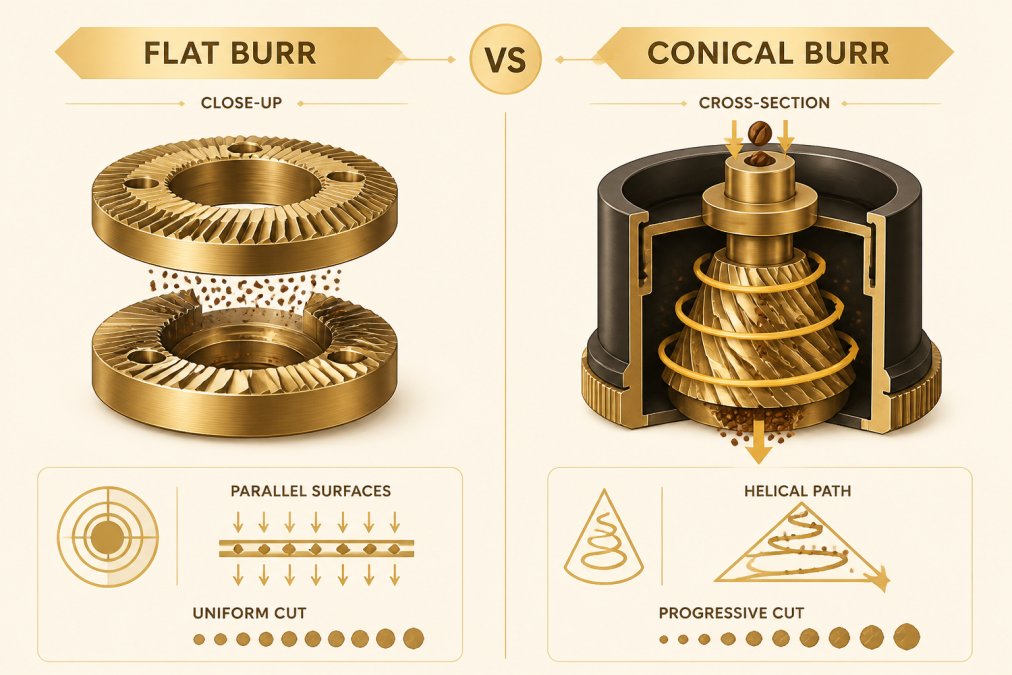
Flat and conical burrs operate on fundamentally different grinding principles. Flat burrs use two parallel, circular grinding surfaces that cut coffee between them with consistent pressure. Conical burrs use a cone-shaped burr rotating inside a conical chamber, with grinding occurring along a helical path as beans work downward.
Particle Distribution and Consistency
Flat burrs produce a unimodal particle distribution, where most grounds cluster tightly around your target grind size with fewer fines and oversized particles. Conical burrs produce a bimodal distribution, creating a wider spread of particle sizes. Uneven particles extract at different rates, with finer particles over-extracting and larger ones under-extracting, resulting in muddled flavour.
Flat burrs maintain consistent pressure across the entire grinding chamber, so every bean experiences the same mechanical treatment. This uniformity translates directly to extraction yield and flavour clarity. Espresso pulled from flat burr grounds typically shows cleaner acidity, better origin character, and more balanced mouthfeel.
Conical burrs apply variable pressure as beans move through the helical grinding path, creating inconsistency that compounds over time, particularly noticeable when dialling in espresso or preparing pour-over coffee.
Heat Retention and Thermal Stability
Flat burrs spin at higher speeds (typically 1,400-1,600 rpm) and allow better heat dissipation because grinding surfaces are exposed to air flow between rotations. Conical burrs trap heat more effectively because beans remain contained within the conical chamber, reducing air circulation.
For espresso, thermal stability matters enormously. Grinding generates heat that can alter the coffee's surface chemistry before it reaches your portafilter. Flat burr grinders, particularly models with larger burr diameters like 83mm designs, dissipate heat more efficiently. Commercial models include cooling systems specifically designed to manage thermal load during continuous operation.
Home users grinding 2-3 espressos daily won't notice significant temperature differences. But grinding 20+ shots daily reveals thermal stability as a real performance factor, as the grinder's warmth can shift the coffee's flavour profile, requiring constant readjustment.
Flavour Profile Differences You'll Actually Taste
Switching to a flat burr grinder changes what you taste in three measurable ways: increased clarity, reduced bitterness, and more pronounced origin character.
Clarity refers to the distinctness of individual flavour notes. A single-origin Ethiopian coffee might show floral notes, berry acidity, and subtle spice. With conical burrs, these blend into a general "fruity" impression. Flat burrs separate them distinctly. This results directly from unimodal particle distribution allowing more consistent extraction.
Bitterness reduction happens because fewer fines mean less over-extraction. Fines are dust-like particles that extract almost instantly, releasing bitter compounds disproportionately. Flat burr grinders produce roughly 30% fewer fines than conical models, translating to shots that feel cleaner on the palate with less harsh finish.
Origin character, the flavours unique to where and how the coffee was grown, becomes more apparent. Conical burrs' bimodal distribution masks these subtleties, whilst flat burrs preserve them through consistent extraction that doesn't overshadow delicate notes.
Best Flat Burr Grinder for Home Espresso
For home baristas, the choice depends on workflow, budget, and daily espresso volume.
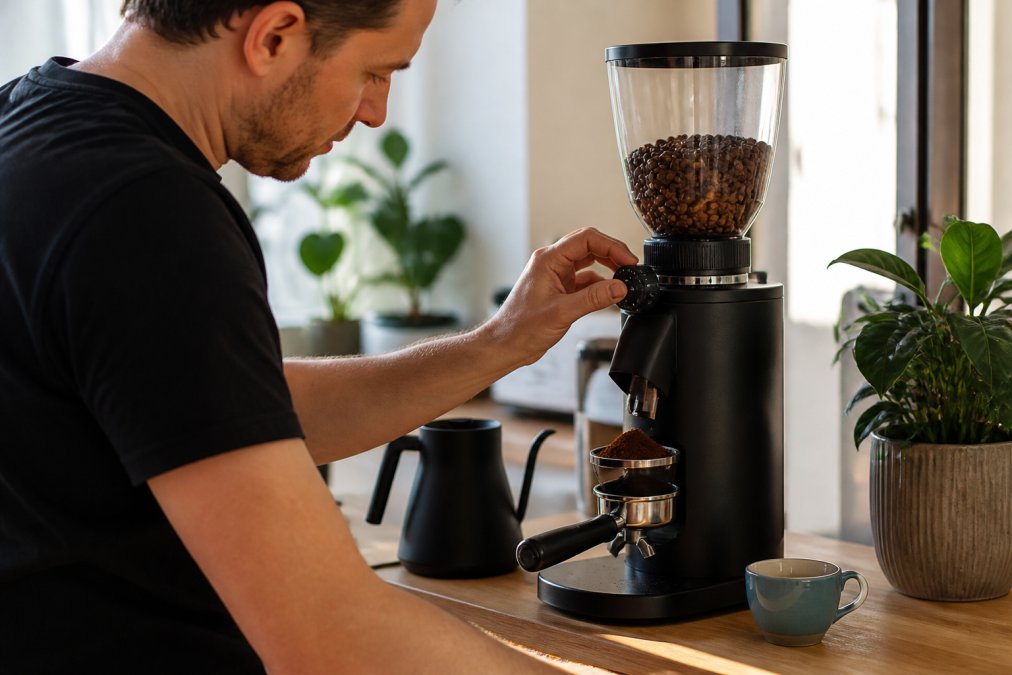
The Baratza Forté BG suits home users wanting commercial-grade performance without commercial complexity. It features 54mm steel flat burrs, dose-by-weight technology accurate to 0.1g, and a macro-micro adjustment system dividing each grind step into 26 sub-settings. The touchscreen handles programmable doses and burrs remove easily for cleaning. It optimises for filter coffee rather than espresso's tighter tolerance window.
For espresso-first home baristas, the Mazzer Philos is the standout choice. Engineered as a single-dose grinder, it eliminates retention by loading beans immediately before grinding and emptying the chamber completely after. The 64mm flat burrs are available in two configurations (I189D for espresso focus, I200D for filter clarity). Stepped or stepless micrometric adjustment is available depending on your preference for tactile feedback versus smooth dialling.

If you're pulling 5+ espressos daily or running a small office setup, the Mazzer Super Jolly V Up bridges home and commercial use. It features 64mm flat burrs, stepless adjustment, and a 1.1kg hopper reducing refilling frequency. The Grind Flow Control system minimises clumping and static. Available in Manual, Timer, Automatic, or Electronic versions depending on workflow preference.
For serious home setups or small commercial operations, the Mazzer Major V delivers 83mm flat burrs with a powerful 650W motor. The larger burr diameter produces finer grind adjustments and handles higher volumes without thermal stress. Double fan cooling and optional IoT connectivity provide future-proofing. It's overkill for 2-3 espressos daily, but ideal for home cafés or small office coffee bars.
Single-Dose vs Hopper-Fed Workflow
Single-dosing (loading beans immediately before grinding) eliminates retention almost entirely. Every morning, you load exactly the beans needed, grind, and empty the chamber. Old grounds never linger, keeping every shot fresher, particularly noticeable in filter coffee where subtle flavours matter more.
The downside: single-dosing adds 30-60 seconds per shot. For home baristas pulling 1-2 espressos, this is negligible. For someone making 5+ cups daily, it becomes tedious.
Hopper-fed grinders maintain a bean reservoir, eliminating reloading. The trade-off is retention, grounds stick to burrs and chamber walls, accumulating over hours. A typical hopper-fed grinder retains 2-5g of grounds, equivalent to one full espresso shot's worth of stale grounds affecting the next brew.
Modern hopper-fed grinders like the Mazzer Super Jolly V Up minimise retention through low-retention grinding paths and static-reducing materials. If you're grinding light roasts where freshness is critical or switching between coffees frequently, retention becomes noticeable. If you're grinding the same coffee repeatedly, hopper-fed workflow is faster and more convenient.
Grind Retention and Coffee Freshness
Grind retention, the amount of ground coffee remaining inside the grinder after grinding, directly impacts flavour freshness. Every particle oxidising inside your grinder is staling and potentially affecting your next brew.
Flat burr grinders typically retain less than conical models because the parallel burr design allows easier ground clearance. A single-dose grinder like the Philos might retain 0.5-1g, whilst a hopper-fed model like the Super Jolly V Up retains 3-5g depending on purging thoroughness. That difference compounds across multiple brews.
For filter coffee, retention matters less because brewing is longer and more forgiving. For espresso, where extraction happens in 25-30 seconds and every variable is magnified, retention becomes significant. Stale grounds produce flat, muted shots. Fresh grounds produce vibrant extraction with clear acidity and complexity.
If you're grinding light roasts (which oxidise faster and taste noticeably stale after hours), single-dosing or low-retention designs become worth the workflow inconvenience.
Cost vs Performance: Is It Worth Your Money?
Whether upgrading is worth it depends on what you're upgrading from and what you actually brew.
If you're upgrading from a budget conical grinder (£100-200 range), the improvement in grind consistency justifies the cost. You'll taste cleaner espresso, clearer filter coffee, and less bitterness immediately.
If you're upgrading from a mid-range conical grinder (£300-500), the improvement is real but more subtle. You'll notice it in lighter roasts and single-origin coffees if you're paying attention.
If you're already using a decent flat burr grinder, upgrading to a more expensive model delivers diminishing returns. Both produce excellent grind consistency. The more expensive model handles volume better, retains less, and offers more adjustment precision, but you're paying for capability you may not use.
The real cost consideration is the coffee's price. If you're buying premium single-origin beans, a poor grinder wastes that investment. A good flat burr grinder preserves it. From this perspective, a premium grinder protecting a quality coffee habit makes economic sense.
If you're buying budget coffee, a premium grinder is wasted money. The coffee itself isn't good enough to reveal the grinder's advantages.
Commercial vs Home Use: Which Burr Type Performs Better
Commercial espresso bars grind continuously, sometimes 200+ shots daily. Thermal stability becomes critical. A grinder performing flawlessly for your first 10 shots can drift as it warms up, requiring constant readjustment. Flat burr grinders, particularly larger models with cooling systems, maintain consistency across high-volume grinding.
Retention also matters differently. Commercial bars can't afford single-dosing time. Hopper-fed workflow is necessary for speed. But high-volume grinding means retention compounds faster. Commercial-grade flat burr grinders minimise this through optimised grinding paths and materials.
Programmable dosing, available on electronic models, becomes valuable in commercial settings, ensuring consistency across busy periods. This is nice-to-have for home use but essential for commercial operations where consistency directly affects customer satisfaction.
Home baristas have different constraints. You're grinding 1-5 shots daily, so thermal drift isn't an issue. Retention matters more because you're often switching between coffees or brewing methods. Single-dosing becomes feasible because you're not grinding dozens of times daily.
For home use, the Mazzer Philos represents optimal balance with single-dose design eliminating retention concerns. For commercial operations, the Mazzer Super Jolly V Up or Major V are standards chosen by speciality coffee shops worldwide for reliability and consistency at volume.

The Verdict: Who Should Upgrade
Upgrading to a flat burr grinder makes sense if you meet any of these criteria:
You're brewing espresso and currently using a conical grinder. The improvement in shot clarity and bitterness reduction is immediate and noticeable.
You're grinding light roasts where origin character and acidity are central to the coffee's appeal. Flat burrs preserve these delicate flavours.
You're pulling more than 3 espressos daily. At this volume, retention and thermal stability become real performance factors affecting consistency throughout the day.
You're already investing in premium, specialty-grade coffee. A poor grinder wastes that investment.
You're running a commercial operation or small office coffee bar. Consistency, reliability, and workflow efficiency directly impact your business.
Don't upgrade if you're grinding dark roasts where flavour complexity is already muted. Don't upgrade if you're pulling 1-2 espressos daily and consistency isn't a priority. Don't upgrade if you're buying budget coffee where the beans themselves are the limiting factor.
The upgrade decision ultimately hinges on this: does your current grinder create problems you actually experience? If yes, a flat burr grinder solves them. If no, you're paying for capability you won't use.
| Grinder Model | Burr Type | Burr Size | Best For |
|---|---|---|---|
| Baratza Forté BG | Flat (steel) | 54mm | Filter coffee, home espresso |
| Mazzer Philos | Flat (stainless) | 64mm | Home espresso, single-dosing |
| Mazzer Super Jolly V Up | Flat (stainless) | 64mm | Small cafés, light commercial |
| Mazzer Super Jolly V Pro | Flat (stainless) | 64mm | Professional cafés, advanced features |
| Mazzer Major V | Flat (stainless) | 83mm | High-volume commercial, serious home use |
Upgrading to a flat burr grinder delivers measurable improvements in grind consistency, extraction clarity, and coffee freshness. The question isn't whether flat burrs are better in theory, they are, mechanically. The question is whether the improvement solves real problems in your specific brewing routine.
If you're ready to experience the difference, Coffee Craft Studio offers a curated range of premium flat burr grinders engineered for precision and performance. The Mazzer Philos Coffee Grinder delivers exceptional single-dose capability for home espresso, whilst the Mazzer Super Jolly V Up Coffee Grinder and Mazzer Major V Coffee Grinder models provide commercial-grade reliability for higher-volume operations. Each model combines proven burr geometry with thoughtful design that minimises retention and thermal drift. Mazzer's engineering standards have made these grinders the choice of speciality coffee professionals worldwide. Explore our collection and find the grinder that matches your brewing ambitions.
Frequently Asked Questions
Are flat burrs objectively better than conical burrs?
Flat burrs produce more uniform particle distribution with fewer fines, which typically results in clearer flavour and higher extraction yield. Conical burrs generate more heat and create a wider range of particle sizes. For espresso, flat burrs generally offer better consistency. However, the difference is most noticeable with high-quality beans and precise technique, entry-level machines may not reveal the improvement.
What is the best flat burr grinder for home espresso?
The Mazzer Philos with 64mm flat burrs (£1,185) excels for single-dose home use with minimal retention. The Baratza Forté BG (£649.96) offers excellent value for filter and espresso with dose-by-weight accuracy. For those wanting commercial reliability at home, the Mazzer Super Jolly V Up (£713) delivers café-standard performance. Your choice depends on budget, workflow preference, and whether you prioritise espresso or filter coffee.
Does upgrading to a flat burr grinder really make a difference?
Yes, but the impact depends on your current setup and brewing method. If you're upgrading from a blade grinder or low-end burr grinder, you'll notice sharper acidity, better clarity, and more consistent extraction. The difference is most pronounced in espresso and pour-over brewing. With a decent conical grinder, the upgrade delivers refinement rather than transformation, improved mouthfeel and reduced bitterness rather than a dramatic flavour shift.
How does particle distribution differ between flat and conical burrs?
Flat burrs produce a tighter, more uniform particle distribution (unimodal), meaning most grounds are nearly identical in size. This consistency maximises extraction yield and flavour clarity. Conical burrs create a broader particle distribution (bimodal), with more fines and larger pieces mixed together. The wider distribution can lead to uneven extraction, some particles over-extract while others under-extract, resulting in muddier flavours and less clarity in the cup.
Will a flat burr grinder work with my current espresso machine?
Yes. Any flat burr grinder is compatible with any espresso machine. However, the upgrade's impact depends on your machine's consistency. Pairing a high-end flat burr grinder like the Mazzer Philos with an entry-level machine may not fully reveal the grinder's capability, since the machine itself introduces variables. Conversely, upgrading a quality espresso machine with a premium flat burr grinder creates a genuinely café-quality setup that delivers noticeable improvement in every shot.
This article was written using GrandRanker