

Espresso Machine vs Manual Brew Methods: A 2026 Guide
Table of Contents
- Espresso Machine vs Manual Brew Methods: Core Differences
- Understanding Manual Coffee Brewing Techniques
- Key Espresso Machine Benefits for Home Baristas
- Coffee Grind Size for Espresso vs Manual Brew Methods
- Home Barista Setup UK: Equipment Costs and Maintenance
- Environmental Impact and Sustainability Comparison
- Skill Level and Learning Curve: Which Method Suits You?
- Flavor Profile and Coffee Origin: Clarity and Aromatic Expression
Espresso Machine vs Manual Brew Methods: A 2026 Guide
Last Updated: July 27, 2026
When comparing espresso machine vs manual brew methods, the choice fundamentally shapes your daily coffee ritual, skill development, and flavour clarity. This decision isn't simply about convenience versus control; it's about understanding how pressure, grind size, extraction time, and your workflow intersect to define what "good coffee" means to you.
Espresso Machine vs Manual Brew Methods: Core Differences
An espresso machine forces hot water through finely ground coffee at 9 bars of pressure, extracting a concentrated shot in 25-30 seconds. Manual brew methods rely on gravity and time to pull water through grounds over 2-5 minutes.
This pressure difference is everything. Espresso's high-pressure extraction creates emulsification, producing characteristic crema and a heavier body with concentrated flavour compounds. Manual methods tend toward cleaner cups with more distinct aromatic clarity and origin character.
The workflow difference is equally significant. Espresso machines require grinding, dosing, tamping, and pulling in quick succession, 3-5 minutes from bean to cup, including milk steaming. Manual methods are slower but often more forgiving: a pour-over or AeroPress gives you time to adjust your pour rate and bloom time as you brew.
How Pressure and Extraction Define Each Method
When a pump forces 9 bars of pressure through finely ground coffee, it accelerates extraction dramatically. Water dissolves more soluble compounds in 25-30 seconds than gravity alone could in minutes, producing total dissolved solids (TDS) of around 8-10%, significantly higher than manual methods. This concentration creates the heavier body, deeper colour, and thicker mouthfeel espresso drinkers expect. The pressure also causes emulsification, breaking fats and oils into tiny droplets and creating the golden-brown crema layer.
Manual methods operate at atmospheric pressure (1 bar). Gravity alone pulls water through grounds, making extraction slower and gentler. A pour-over typically extracts over 2-4 minutes; an AeroPress uses a plunger but still nowhere near espresso's intensity. The result is lower TDS (typically 1.2-1.8%), producing a cleaner, lighter cup with more transparency.
The grind size requirement reflects this pressure difference directly. Espresso demands a very fine, consistent grind because high pressure would otherwise push water straight through without proper extraction. Manual methods use coarser grinds, allowing water to pass through at a slower, more controlled rate.
| Brewing Method | Pressure | Extraction Time | TDS % | Body | Crema |
|---|---|---|---|---|---|
| Espresso machine | 9 bars | 25-30 seconds | 8-10% | Heavy | Yes |
| Manual lever | 5-9 bars | 30-50 seconds | 6-8% | Medium-heavy | Minimal |
| Pour-over | 1 bar | 2-4 minutes | 1.2-1.8% | Light-medium | No |
| AeroPress | 1-2 bars | 1-2 minutes | 1.5-1.8% | Medium | No |
| Immersion (French press) | 1 bar | 4 minutes | 1.5-2% | Medium-heavy | No |
Workflow and Time Investment Comparison
Espresso machines demand active engagement. You grind beans (1 minute), dose the portafilter (30 seconds), distribute and tamp grounds (1-2 minutes), lock the portafilter, and pull the shot (30 seconds). Add 1-2 minutes for milk steaming. Total: 4-6 minutes. Once dialled in, the process becomes automatic and consistency improves dramatically.
Manual methods are slower but more flexible. A pour-over takes about 3-4 minutes once water is heated and beans ground. An AeroPress takes under 2 minutes of active brewing. A French press requires 4 minutes of steeping but almost zero active work during that time.
The real workflow difference emerges in busy mornings. Espresso's speed is valuable when rushing. Manual methods are less forgiving if interrupted mid-brew, but offer a more meditative experience if you have quiet minutes.
Understanding Manual Coffee Brewing Techniques
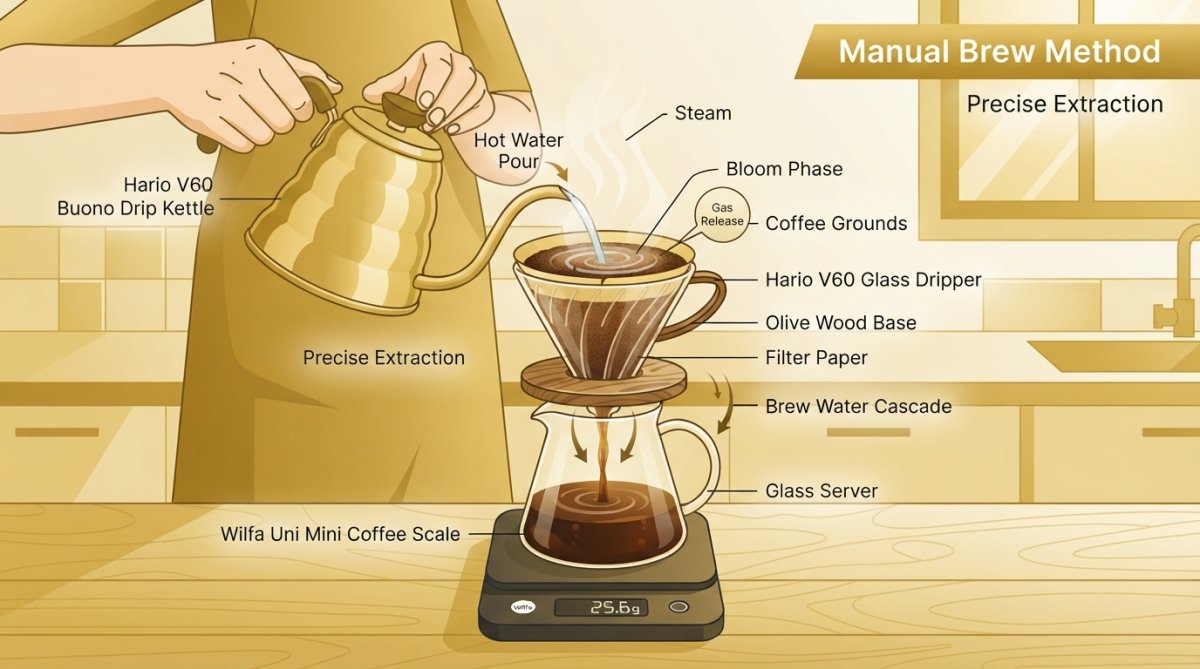
Pour-over brewers like the Hario V60, Chemex, or Kalita Wave use gravity and your pouring technique to control extraction. Water flows through a cone or flat-bottomed dripper into a cup below. The V60's conical shape and large single hole mean extraction speed depends entirely on your pour rate: pour slowly and you'll over-extract (bitter, dry); pour too fast and you'll under-extract (sour, thin). Paper or metal filters remove most oils and sediment, producing a clean, bright cup that showcases origin character beautifully.
Immersion brewers, French press, cupping bowls, and full-immersion methods, work differently. Grounds steep in hot water for a set time (typically 4 minutes), then you separate liquid from solids by pressing or pouring. Because grounds are in contact with water for the entire duration, extraction is more uniform and forgiving. The downside: immersion methods leave more sediment and oils in the cup, creating a heavier body but also slightly more bitterness if water temperature is too high.
The Hario V60 Switch bridges these approaches, letting you switch between immersion and percolation modes mid-brew for greater control.
Pour-Over and Immersion Methods Explained
Pour-over brewing is a dialogue between you and your coffee. You're actively managing water temperature, pour rate, and bloom time to dial in extraction. The process begins with a bloom: pour just enough hot water (around 195-205°C) to saturate grounds, then wait 30-45 seconds. After the bloom, pour in a slow, controlled spiral, maintaining consistent water level. The entire brew takes 2-4 minutes.
Pour-over's clarity is its strength. Because water moves through grounds relatively quickly and paper filters trap oils and fine particles, the resulting cup highlights delicate flavours, acidity, and origin character. If you're drinking a high-quality single-origin coffee with interesting terroir notes, pour-over is often the best way to experience them.
Immersion methods eliminate most technique sensitivity. You simply add grounds to hot water, let them steep, and separate them. A French press steeps for 4 minutes, then you press the plunger down to trap grounds at the bottom. Because grounds are in constant contact with water, extraction is more uniform. However, immersion methods leave more sediment and oils in the cup, creating a fuller body but slightly murkier flavour profile.
Manual Lever Espresso Makers
Manual lever espresso makers, like the Flair Classic, occupy a unique middle ground. They're not true espresso machines (no electricity, no pump), but they generate pressure through human-powered use, allowing you to pull shots closer to café-style espresso than any other manual method.
A manual lever works like this: you load finely ground coffee into a portafilter, add hot water to a brewing chamber, then pull down on a long lever. Your downward force creates pressure that forces hot water through the coffee puck. A quality manual lever can generate 5-9 bars of pressure, enough to produce some crema and a concentrated shot in 30-50 seconds. The appeal is threefold: they're portable and require no electricity, they offer exceptional hands-on control, and they're significantly cheaper than entry-level espresso machines. However, manual levers have a steep learning curve, and pulling consistent shots requires practice.
Key Espresso Machine Benefits for Home Baristas
Espresso machines deliver three things manual methods struggle to match: consistency, crema, and café-quality results.
Consistency is the machine's superpower. Once you've dialled in your grind size, dose, and tamping pressure, an espresso machine produces nearly identical shots every time. This repeatability is invaluable if you're learning to steam milk, experimenting with espresso blends, or simply want the same quality every morning without thinking about variables.
Crema is the golden-brown layer of emulsified oils and CO2 that sits on top of a properly pulled espresso shot. It's visually striking and contributes distinctive texture and subtle bitterness that many coffee drinkers love. Manual methods cannot produce true crema because they lack the pressure needed for emulsification.
Café-quality results matter psychologically. Pulling a shot on a real espresso machine feels professional and deliberate in a way manual brewing doesn't quite match.
Semi-Automatic and Super-Automatic Options
Semi-automatic machines are the most common home espresso machines. You control grinding, dosing, tamping, and shot pulling manually, but the machine handles water temperature and pump pressure automatically. This gives you maximum control over the brewing process whilst removing the variability of manual pressure generation. The Sage Barista Express Impress is a semi-automatic that includes an integrated grinder, simplifying the workflow considerably.
Super-automatic machines do almost everything for you. You load whole beans into a hopper, press a button, and the machine grinds, doses, tamps, pulls the shot, and ejects the puck automatically. Some models even steam milk at the touch of a button. Super-automatics are ideal if you want café-quality espresso without learning technique. The Sage The Oracle is a super-automatic that uses artificial intelligence to optimise grind size and extraction automatically, bridging the gap between ease of use and shot quality.
Coffee Grind Size for Espresso vs Manual Brew Methods
Grind size is the single most important variable you can control to dial in your brew. It directly affects extraction time and flavour balance.
For espresso, you need a very fine, consistent grind, almost powder-like. If your grind is too coarse, water will rush straight through the puck without proper extraction, producing a sour and thin shot. If too fine, water will move so slowly that you'll over-extract, producing a bitter, dry cup. A good burr grinder with 30+ grind settings gives you the precision needed.
Pour-over brewers use a medium grind, finer than drip coffee but much coarser than espresso. Immersion methods (French press, cupping) use medium-coarse or coarser grinds. Because grounds are steeping rather than being percolated, you want larger particles that won't slip through the metal mesh filter.
The AeroPress is flexible, working well with anything from medium-fine to medium grind. The shorter brew time (1-2 minutes) means you're less likely to over-extract dramatically.
Grind Consistency and Extraction Yield
Grind consistency matters as much as grind size. If your grinder produces a mix of fine powder and larger chunks, the powder will over-extract whilst the chunks under-extract, and flavours will be muddled. A quality burr grinder produces particles of uniform size, ensuring even extraction.
Extraction yield measures how much soluble material you've pulled from the coffee. For espresso, the target is typically 18-22% extraction yield. Below 18%, the shot tastes sour and thin; above 22%, it tastes bitter and dry. Manual methods have a wider acceptable range (around 15-20% for pour-over), which is why they're more forgiving for beginners.
Tamping, Bloom, and Total Dissolved Solids
Tamping is compressing ground coffee into the espresso portafilter before pulling a shot. Proper tamping creates a level, evenly packed puck that allows water to flow through uniformly. Inconsistent tamping pressure or angle leads to channelling, where water finds the path of least resistance and flows unevenly through the puck, producing sour, thin shots. Most baristas aim for a firm, level tamp using about 30 pounds of pressure.
The bloom phase is critical for all manual brewing methods and increasingly recognised as important for espresso. When you first pour hot water onto ground coffee, CO2 trapped in the beans is released, and water begins dissolving the most soluble compounds. During the bloom (30-45 seconds for pour-over, 5 seconds for espresso), the coffee expands slightly. After the bloom, extraction continues more evenly because CO2 is no longer blocking water from penetrating the grounds.
Total dissolved solids (TDS) measures the percentage of soluble compounds in your brewed coffee. For espresso, target TDS is 8-10%. For filter coffee (pour-over, drip), it's typically 1.2-1.8%. Higher TDS means a more concentrated, intense cup; lower TDS means a lighter, cleaner cup.
Home Barista Setup UK: Equipment Costs and Maintenance
An entry-level espresso machine setup requires a quality burr grinder. The Sage Barista Express Impress includes an integrated grinder, saving money and counter space, making it an excellent starting point. The Sage The Oracle is a super-automatic option offering consistency and ease of use. Manual methods are far cheaper: a Hario V60 ceramic dripper costs around £30, an AeroPress costs £39.99, and a manual lever espresso maker costs £139 or less. You'll still need a quality burr grinder, but even with that, manual setups are significantly cheaper than espresso machines.
However, upfront cost is only part of the story. Espresso machines require regular maintenance: descaling every 40-80 shots (depending on water hardness), backflushing the group head, cleaning the portafilter and basket, and replacing gaskets and seals every 1-2 years. Manual methods require almost no maintenance, just rinse your dripper or press after each use.
Maintenance Burden and Cleaning Requirements
Espresso machine maintenance is non-negotiable if you want the machine to last and perform consistently. After each use, you need to purge the group head, backflush the group head, and soak the portafilter and basket in hot water. Weekly, you should deep-clean the group head and shower screen. Every 40-80 shots, you need to descale the entire machine to remove mineral buildup.
Manual methods require almost zero maintenance. After brewing, rinse your dripper or press under hot water, and you're done. No descaling, no backflushing, no gasket replacement. This simplicity is one of manual brewing's greatest appeals for casual coffee drinkers.
Environmental Impact and Sustainability Comparison
Espresso machines consume electricity, typically 1-2 kWh per day if you're making 2-3 cups. Over a year, that's roughly 400-700 kWh. Manual methods consume almost no electricity, just the energy to heat water, which you'd use regardless of brewing method. From an energy perspective, manual brewing is far more sustainable.
However, the full picture includes packaging and consumables. Espresso machines are durable; a quality machine lasts 10-15 years, amortising its manufacturing footprint over many cups. Manual methods generate more waste if you use paper filters: each cup generates a small amount of paper waste. Metal filters (reusable) reduce this, but some sediment remains in the cup.
The most sustainable approach is probably a manual method with a reusable metal filter, or an espresso machine that you keep for many years and maintain carefully.
Skill Level and Learning Curve: Which Method Suits You?
Espresso machines have a steep learning curve, but the rewards are significant once you've climbed it. Manual methods are more forgiving initially, but reaching advanced skill still requires practice.
Espresso requires understanding multiple variables simultaneously: grind size, dose, tamp pressure, water temperature, and shot time. If any one is off, your shot will taste wrong. For beginners, this can feel overwhelming. You'll pull 10-20 bad shots before you dial in properly. However, once you understand the relationship between these variables, learning accelerates.
Manual methods are more intuitive initially. A pour-over's relationship between grind size and brew time is simpler than espresso's multi-variable system. If your first pour-over tastes sour, you grind finer or pour slower. The AeroPress is particularly beginner-friendly because it's hard to make a truly bad cup.
Barista Skills Required for Espresso vs Manual Brewing
True barista skills, the ability to consistently produce excellent shots and steam milk properly, are almost exclusively tied to espresso machines. Steaming milk to the right temperature and microfoam texture is an art that takes months to master, and you can't practise it with manual brewing methods.
If your goal is to make café-quality cappuccinos and flat whites at home, an espresso machine is essential. The Sage Barista Express Impress includes a steam wand, giving you the tool to learn milk steaming. The Sage The Oracle includes an automatic milk frother, eliminating the learning curve but also removing the satisfaction of manual steaming.
For filter coffee (pour-overs, AeroPress, French press), the required skills are simpler: grind size selection, water temperature control, and pouring technique.
Workflow Integration for Busy Mornings
If your mornings are rushed, an espresso machine's speed is valuable. Pull a shot, steam milk, and you have a cappuccino in 5-6 minutes. A super-automatic like the Sage The Oracle is even faster. Manual methods are slower: a pour-over takes 4-5 minutes of active attention, and you can't rush it without sacrificing quality.
However, if your mornings have a few quiet minutes, manual brewing's meditative pace becomes an asset. Pour-over brewing is a moment of intentionality before the day's chaos begins. Many coffee enthusiasts find this ritual more satisfying than the speed of espresso.
The real workflow consideration is flexibility. If you're sometimes in a rush and sometimes have time, a semi-automatic espresso machine offers a middle ground: fast when you need it, but still offering hands-on control if you want it.
Flavour Profile and Coffee Origin: Clarity and Aromatic Expression
Espresso's high-pressure extraction produces a heavy body, lower acidity, and concentrated sweetness. The crema adds subtle bitterness and textural complexity. If you're drinking a well-roasted espresso blend, the flavours are bold, intense, and somewhat homogeneous.
Manual methods, particularly pour-over, emphasise clarity and origin character. Because extraction is gentler and paper filters remove oils, the resulting cup highlights the coffee's acidity, sweetness, and terroir. If you're drinking a light-roasted single-origin coffee with interesting origin notes, pour-over is often the best way to experience them. The body is lighter, the acidity is more pronounced, and subtle flavours like stone fruit, floral, or chocolate notes are more distinct.
This difference isn't about quality; both can be excellent. It's about what you're tasting. Espresso is like a bold red wine: concentrated, intense, with layers that emerge as you sip. Pour-over is like a crisp white wine: bright, clear, with distinct flavour notes that stand out.
The Hario V60 and Hario V60 Switch are specifically designed to highlight origin character through their conical dripper design and water flow dynamics. If you're exploring single-origin coffees and want to taste what makes each one unique, these tools are excellent choices.
Body, Acidity, and Sweetness Across Methods
Body is the weight and texture of the coffee in your mouth. Espresso has a heavy body because of its high TDS and emulsified oils. Manual methods have lighter bodies because of lower TDS and the filtering out of oils. Neither is objectively better; it depends on your preference.
Acidity is the coffee's brightness and liveliness. Counter-intuitively, lighter-roasted coffees have higher acidity, and manual methods (which don't obscure this) make it more apparent. Espresso's pressure and body tend to mute acidity, which is why espresso blends are often darker-roasted. If you enjoy acidity and want to taste a coffee's origin character, manual methods are better. If acidity bothers you, espresso's heavier body and darker roasts are more forgiving.
Sweetness in coffee comes from sugars that dissolve during extraction. Proper extraction maximises sweetness by dissolving the right amount of sugars without over-extracting bitter compounds. Both espresso and manual methods can produce sweet, balanced cups if dialled in correctly.
Choosing between espresso machine vs manual brew methods ultimately depends on your priorities: speed and consistency versus flexibility and clarity, investment versus simplicity, ritual versus routine. If you're serious about espresso and want café-quality drinks at home, an espresso machine is the only option. If you're exploring coffee and want forgiving, affordable entry into specialty brewing, manual methods are ideal. If you want the best of both worlds, precision engineering with hands-on control, the semi-automatic machines in Coffee Craft Studio's range, particularly the Sage Barista Express Impress and Sage The Oracle, combine reliability and performance with the flexibility to grow your skills. Whichever path you choose, understanding how pressure, grind size, and extraction time work together ensures you'll get the most from your equipment and your coffee.
Frequently Asked Questions
What is the main difference between an espresso machine and manual brewing methods?
Espresso machines use 9+ bar pressure to force hot water through finely ground coffee in seconds, producing crema and concentrated shots. Manual brewing methods, such as pour-over, immersion, or manual lever, rely on gravity, hand pressure, or simple mechanics to extract coffee more slowly, typically without crema. Espresso machines prioritise consistency and speed; manual methods offer greater control and often cleaner, more aromatic cups that highlight origin characteristics.
Which brewing method requires the least skill for consistent results?
Super-automatic espresso machines require minimal skill, as they grind, dose, tamp, and brew at the push of a button. Semi-automatic espresso machines demand moderate barista skills for tamping and timing. Manual pour-over methods like the Hario V60 have a learning curve but reward practice with exceptional flavour clarity. For true beginners, automatic machines deliver consistency fastest, whilst manual methods offer more control once mastered.
How does coffee grind size for espresso vs manual brew methods affect extraction and flavour?
Espresso requires a fine, consistent grind to withstand 9+ bar pressure and achieve proper extraction in 25-30 seconds. Manual pour-over methods use medium-fine grinds and longer brew times (2-4 minutes) to allow percolation and immersion. Incorrect grind size causes under-extraction (sour, thin coffee) or over-extraction (bitter, muddy flavour). Total dissolved solids (TDS) and extraction yield are optimised when grind size matches the method's pressure and brew time profile.
What are the long-term maintenance costs for espresso machines versus manual brewing methods?
Manual brewing methods (pour-over, AeroPress) have minimal maintenance costs, mainly replacement filters and occasional cleaning. Espresso machines require regular descaling, group head backflushing, and eventual pump or heating element repairs, costing £50-200+ annually. Over five years, espresso machines typically cost 3-5 times more to maintain. Manual methods are ideal for budget-conscious users; espresso machines suit those who prioritise convenience and consistency enough to justify ongoing investment.
Can manual brewing methods produce espresso-style coffee?
True espresso requires 9+ bar pressure, which manual methods cannot replicate. However, manual lever makers like the Flair Classic can produce concentrated, espresso-like shots with proper technique and hand pressure. AeroPress creates a strong, concentrated brew resembling espresso but without crema. For authentic espresso with crema and the full sensory experience, an espresso machine is necessary. Manual methods excel at producing clean, aromatic coffee rather than true espresso.
This article was written using GrandRanker