

Espresso Machine Descaling Guide for Hard Water
Table of Contents
- Why Hard Water Wrecks Espresso Machines
- How to Measure Your Water Hardness Before You Descale
- How Often to Descale an Espresso Machine in Hard Water
- Choosing the Right Descaling Solution for Espresso Machines
- How to Descale an Espresso Machine: Step-by-Step
- Filtered Water for Espresso Machines as Prevention
- Troubleshooting After Descaling
- Conclusion: Protect Your Investment
- Frequently Asked Questions
Last Updated: October 6, 2026
Why Hard Water Wrecks Espresso Machines
Hard water is the biggest threat to your espresso machine's lifespan.
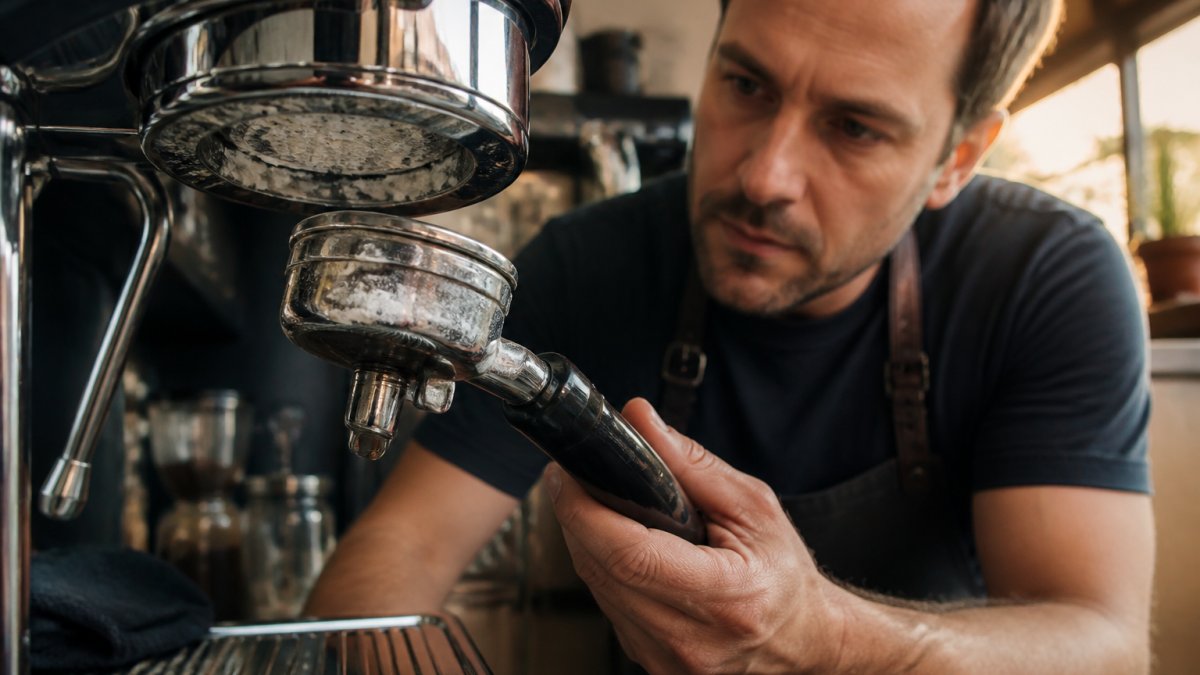
Scale builds fast, narrowing water flow, slowing the heating element and throwing off brew temperature.
Calcium and magnesium are the main culprits. Harmless in drinking water, inside a hot machine they form hard deposits that cling to metal.
This espresso machine descaling guide for hard water exists because most owners descale too rarely, with the wrong product, or not at all.
How to Measure Your Water Hardness Before You Descale
Before you descale, find out how hard your water actually is. You cannot set a sensible schedule without that number, and guessing from a vague "hard water area" label damages machines.
Three methods work for most homes:
- Check your water supplier's website. Every UK water company publishes a hardness figure for your postcode area, usually in mg/l of calcium carbonate. Free and quick, but it gives an area average rather than the reading at your tap.
- Use a test strip or titration kit. Dip the strip in tap water and match the colour to the chart. Titration kits are more accurate but need more steps.
- Use a TDS meter. A cheap TDS meter gives total dissolved solids in ppm. It is not hardness-specific, but it tracks changes well: if your reading rises over a few weeks, scale is building.
For the most reliable schedule, combine methods: use your supplier's figure as a baseline, then confirm with a strip or meter at the tap you fill the reservoir from.
Hardness Units Explained (ppm, dH, Clarke)
Hardness figures appear in several units:
- ppm (parts per million) equals mg/l of calcium carbonate. This is the most common unit and the one most UK supplier reports use.
- dH (German degrees) is roughly 17.8 ppm per degree. So 10 dH is about 178 ppm.
- Clarke is roughly 14.3 ppm per degree and still appears on some UK supplier reports. So 10 Clarke is about 143 ppm.
- grains per gallon (gpg) is used in some imported test kits. One gpg is roughly 17.1 ppm.
As a rough guide, water above 200 ppm counts as hard, and above 300 ppm is very hard. Soft water sits under 100 ppm. Medium water falls between 100 and 200 ppm.
Turning Your Reading into a Machine-Specific Schedule
A hardness number alone does not tell you when to descale. Combine it with your machine's water use and the manufacturer's recommendation.
Use this method:
- Note your hardness in ppm. Convert dH or Clarke using the figures above.
- Check your manual for a descale interval. Manufacturers often publish one in months or litres of water used.
- Adjust for hardness. Above 200 ppm, shorten the interval by roughly a third; above 300 ppm, by half; under 100 ppm, extend it slightly.
- Adjust for usage. Ten shots a day passes far more water than two. Daily steam wand use concentrates minerals, so shorten further.
- Watch your machine's alerts. Treat a descale counter or warning light as a backstop, not a replacement for your own schedule.
For example, if your manual says every six months and your water reads 280 ppm, plan for every three to four months; with daily steam wand use, every two to three months. Note when the descale light first appears and adjust so you descale slightly before it comes on.
Signs Your Machine Needs Descaling
Your machine usually tells you before it fails. Watch for a descale light, slower water flow, a steam wand losing pressure, flatter or more bitter espresso, a louder pump, or visible white crust around the group head. If you spot two or more, descale now.
How Often to Descale an Espresso Machine in Hard Water
How often you descale depends almost entirely on your water hardness. Use your reading to set the schedule:
| Water Hardness | Typical Interval | Watch For |
|---|---|---|
| Soft (under 100 ppm) | 6-12 months | Rare warning lights |
| Medium (100-200 ppm) | 3-6 months | Slower flow |
| Hard (200-300 ppm) | 2-3 months | Frequent descale light |
| Very hard (300+ ppm) | Every 4-8 weeks | Steam wand pressure loss |
These are starting points, not fixed rules. Daily use, high volume and steam wand use push you toward the shorter end. If unsure, descale slightly more often than you think you need: a descale cycle is cheap, a new boiler is not.
Choosing the Right Descaling Solution for Espresso Machines
The right descaling solution for espresso machines depends on your machine's materials and design, not price. Manufacturers design descalers around their own boilers, so matching the product to the machine matters more than buying the strongest option.
Broadly, you have three choices:
- Tablets, dissolved in water and run through the machine. Precise and easy to dose.
- Liquid descalers, often pre-mixed and simple to pour.
- Powder sachets, which you mix yourself and which usually work out cheapest per cycle.
For Jura owners, we stock Jura 2-Phase Descaling Tablets at £15.50. Made for Jura automatic machines, they remove scale from the thermoblock and brewing system, then protect pipes and internal components against corrosion.

What Is Actually in a Descaler
Most descalers use one of a few acids to dissolve calcium carbonate:
- Citric acid is common in mild descalers. It works on light scale but can be slow on heavy deposits.
- Lactic acid suits espresso-specific descalers because it works at lower temperatures and rinses cleanly.
- Sulphamic acid acts quickly but needs careful rinsing.
- Phosphoric acid appears in proprietary blends and must be used at the correct dose.
The acid type matters because materials react differently. Aluminium is attacked by strong acids, so always check your manual before using a citric-acid-based product on a machine with aluminium parts.
Why Vinegar Is Usually the Wrong Choice
Vinegar is the most common home descaler and the most likely to cause problems. Its acetic acid dissolves scale but attacks seals, gaskets and aluminium, and leaves a taste that lingers for several shots if the rinse is incomplete. Some manufacturers state that vinegar use voids the warranty, and even where it is not forbidden it is a false economy: a damaged seal or corroded boiler costs far more than a proper descaler.
Jura 2-Phase Descaling Tablets →
Matching the Descaler to Your Machine Type
Espresso machines are not all built the same way, and the descaler that suits one may be wrong for another.
- Thermoblock machines heat water in a narrow block with a small water path that scale blocks quickly. Use a descaler designed for thermoblocks and follow the dose carefully, as a strong solution can sit in the block and attack it.
- Single-boiler machines have a larger water volume and more metal surface. They tolerate a wider range of descalers but still need a full rinse.
- Dual-boiler machines have separate brew and steam boilers, and the steam boiler scales faster because it runs hotter. Check whether the descale programme covers both.
- Heat-exchanger machines often require a specific procedure, and some manufacturers recommend professional servicing rather than a home cycle.
If your manual names a specific descaler, use that one. A non-approved descaler can void the warranty, and some manufacturers, including Jura and Sage, are strict about this.
Material Compatibility Cautions
Not every descaler suits every machine, and this is where most damage happens.
- Aluminium parts react badly to strong acids. Check your manual before using a citric-acid-based product.
- Non-approved descalers can void the warranty. Jura, Sage and others are strict about this.
- Never mix descalers. Combining products can create fumes or damage seals.
- Follow the dose on the label. More is not better and can attack seals.
If unsure, check the manual or contact the manufacturer before you start. A five-minute check is cheaper than a replacement boiler.
How to Descale an Espresso Machine: Step-by-Step
Here is the process we recommend for a standard automatic or semi-automatic machine.
What you'll need:
- Your chosen descaler
- A large container for waste water
- Fresh water for rinsing
- Your machine's manual
Step 2: Mix the descaler [2 minutes] Dissolve the tablet or powder in the amount of water your manual states.
Step 5: Reassemble and test [2 minutes] Refit the reservoir and pull a shot. Discard the first one.
Expected result: steady water flow, normal steam pressure and a clean-tasting espresso.
Common Mistakes to Avoid
- Using vinegar. Too harsh for many machines and can damage seals and aluminium.
- Skipping the rinse. Leftover descaler ruins the taste of every following shot.
- Descaling only the group head. The boiler and steam wand need the solution too.
- Ignoring the steam wand. It scales up faster than anything else.
Filtered Water for Espresso Machines as Prevention
Filtered water for espresso machines is the most effective way to slow limescale and costs far less than repeated repairs, removing much of the calcium and magnesium before it reaches the boiler.
For Sage machines, the Sage ClaroSwiss Water Filter at £14.95 fits models including the Barista Express, Barista Pro, Dual Boiler and Oracle Touch. Check your machine's batch code before ordering.

Jura owners have two strong options. The Jura CLARIS Pro Blue+ Filter Cartridge at £37.50 uses ion exchange and activated carbon to cut limescale, chlorine and heavy metals while keeping the minerals that make coffee taste good. For high-volume machines, the Jura CLARIS Pro Smart Maxi Filter Cartridge at £70.00 adds RFID recognition, so compatible machines track the filter and tell you when to swap it.

Troubleshooting After Descaling
Most problems after descaling come down to not enough rinsing, a blocked shower screen, or a machine that needs a second cycle.
- Espresso tastes odd: run two more rinse cycles with fresh water.
- Water flow still slow: repeat the descale. Heavy scale sometimes needs two passes.
- Descale light stays on: some machines need the cycle completed in full before the light resets. Check your manual.
- Leaks after descaling: a seal may have dried out or shifted. Stop using the machine and get it checked.
If a second cycle does not fix the flow, the scale may have hardened into a blockage that needs a service.
Conclusion: Protect Your Investment
Limescale is patient. It will not ruin your machine today, but in hard water it shortens its life year by year unless you stay ahead of it.
At Coffee Craft Studio, we stock the maintenance kit that makes this simple, from Jura 2-Phase Descaling Tablets to Jura CLARIS Pro Smart Maxi Filter Cartridge and the Sage ClaroSwiss Water Filter.
Choose options from our care and maintenance range and keep your espresso machine brewing at its best for years.
Frequently Asked Questions
Will hard water ruin my espresso machine?
Hard water won't destroy a machine overnight, but limescale builds up on heating elements, thermoblocks and valves with every brew. Over time this restricts water flow, raises brewing temperatures and can lead to costly repairs or a shortened machine lifespan. Regular descaling, combined with filtered water, is the most effective way to prevent scale buildup and keep your espresso machine performing consistently.
Do I need to descale my espresso machine if I use filtered water?
Filtered water reduces mineral content but does not eliminate it entirely, so descaling is still necessary. Filters such as the Jura CLARIS Pro Smart Maxi can reduce limescale buildup and, when used correctly, may eliminate the need for descaling in compatible machines. Check your manufacturer instructions and your local water hardness reading to set a realistic descaling schedule rather than skipping it altogether.
What is the ideal water hardness for an espresso machine?
Most espresso machine manufacturers recommend water between roughly 2 and 4 degrees of hardness (around 35 to 70 ppm), which balances flavour extraction with scale control. Above 7 dH, limescale forms quickly in the boiler and thermoblock. If your supply reads higher, use a water filter or switch to bottled water with a known mineral profile, and descale more frequently to compensate.
Can I use vinegar or citric acid to descale an espresso machine?
Vinegar and citric acid dissolve limescale, but they can damage seals, gaskets and aluminium components in many espresso machines. Purpose-made descaling solutions are formulated to remove calcium and magnesium deposits while protecting internal parts. For Jura machines, genuine Jura 2-Phase Descaling Tablets are designed for the internal water system and provide corrosion protection after scale removal, making them a safer choice than household alternatives.