

Dual Boiler vs Heat Exchanger Machines: A 2026 Guide
Table of Contents
- Dual Boiler vs Heat Exchanger Machines: Core Differences
- How Dual Boiler Espresso Machines Work
- How to Use a Heat Exchanger Espresso Machine
- Espresso Machine Temperature Stability: Dual Boiler Advantage
- PID Controller Espresso Machine Benefits
- Comparison Table: Dual Boiler vs Heat Exchanger
- Choosing Between Dual Boiler and Heat Exchanger: Key Factors
- Conclusion
Last Updated: July 14, 2026
Dual Boiler vs Heat Exchanger Machines: Core Differences
Understanding the distinction between dual boiler and heat exchanger machines is essential for an informed purchase decision. A dual boiler machine maintains two separate boilers, one for brewing, one for steaming, whilst a heat exchanger uses a single boiler with internal circulation to achieve different temperatures. This architectural difference shapes extraction quality and workflow efficiency.
Architecture and boiler configuration
Dual boiler espresso machines feature two independent stainless steel boilers, each with its own heating element and thermostat. The brew boiler operates at approximately 90-92°C, whilst the steam boiler runs at around 120-130°C. This separation allows each boiler to maintain its ideal temperature without interference.
Heat exchanger machines use a single large boiler heated to steam temperature. A tube running through this boiler carries water for brewing. As cold water enters the tube, it absorbs heat from the surrounding boiler water, reaching brew temperature by the time it exits. The Rocket Appartamento exemplifies this design, with its compact E61 group head acting as both heat exchanger and pre-infusion mechanism.
Simultaneous brewing and steaming capability
Dual boiler machines can brew espresso and steam milk simultaneously without temperature compromise. Whilst one boiler maintains brew temperature, the other stands ready at full steam temperature. This matters significantly if you're pulling multiple shots for cappuccinos or lattes.
Heat exchanger machines can steam whilst brewing, but require a trade-off. After steaming, you typically need to run water through the group head, a "cooling flush", to bring brew temperature back down. This adds 30-60 seconds to your workflow and wastes water. For high-volume brewing, this becomes tedious.
How Dual Boiler Espresso Machines Work
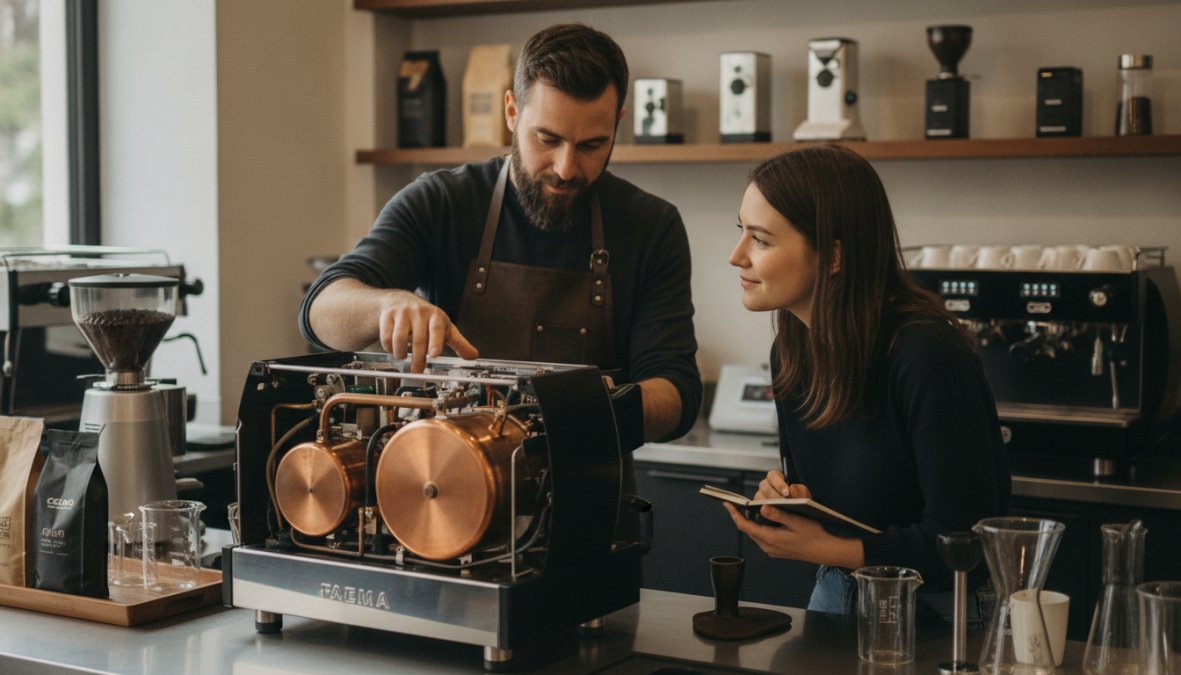
Each boiler has its own heating element, thermostat, and safety valve. When powered on, both boilers heat simultaneously. The brew boiler reaches its target temperature first (typically within 10-15 minutes), whilst the steam boiler continues heating to its higher set point.
Independent temperature control
Modern dual boiler machines employ PID (Proportional-Integral-Derivative) controllers to maintain precise temperature stability. A PID controller continuously monitors the brew boiler temperature via a sensor and adjusts heating element power to keep the temperature within 0.5°C of the target. This means your first shot and your twentieth shot experience identical water temperature.
Temperature stability directly impacts extraction consistency. Espresso extraction is exponentially sensitive to water temperature; a 2°C variation can shift extraction time by 3-5 seconds, dramatically changing the flavour profile. With a dual boiler and PID control, you eliminate this variable.
Brew group and steam boiler separation
The separation of brew and steam functions into distinct boilers creates an optimal thermal environment for each. The brew boiler's lower temperature prevents premature solenoid activation and reduces thermal shock. The steam boiler's higher temperature generates the pressure needed for powerful, consistent steam production.
This separation also means you can adjust brew temperature without affecting steam capability. If you're dialling in a light roast that needs cooler water, you simply lower the brew boiler setpoint. The steam boiler remains at full power.
How to Use a Heat Exchanger Espresso Machine
Operating a heat exchanger machine requires understanding its thermal dynamics. The machine heats a single large boiler to steam temperature (typically 130°C). When you pull a shot, cold water enters the heat exchanger tube and absorbs heat as it travels through the boiler, exiting at brew temperature.
Water circulation and temperature management
Heat exchanger machines rely on a principle: the longer water spends in the heat exchanger tube, the hotter it becomes. If you pull a shot immediately after steaming, the group head is superheated and your brew temperature will be too high. If you wait 60 seconds, the group cools slightly and temperature normalises.
The E61 group head, used on machines like the Rocket Appartamento, includes a thermosiphon, a small circulation loop that continuously cycles hot water through the group to maintain temperature stability. This design addresses one of heat exchanger's core weaknesses: temperature fluctuation.
Water flow rate also affects heat exchanger temperature. Fast flow means water spends less time in the tube and exits cooler. Slow flow means more heat absorption and hotter exit temperature. This creates a relationship between pump pressure and final brew temperature that you must learn to manage.
Cooling flushes and thermal stability techniques
The cooling flush is the heat exchanger operator's primary tool for temperature management. After steaming, you open the group head's 3-way solenoid valve without inserting the portafilter, allowing hot water to purge for 5-10 seconds. This removes the superheated water that accumulated during steaming, lowering the group temperature back to brew range.
Experienced operators develop a rhythm: steam milk, perform a cooling flush, insert the portafilter, and pull the shot. However, this adds labour and water waste compared to dual boiler machines. For commercial settings pulling 200+ shots daily, the accumulated time and resource cost becomes significant.
Some advanced heat exchanger machines, like the ECM Technika V Profi PID, incorporate a PID controller that monitors and adjusts boiler temperature based on usage patterns, reducing the need for cooling flushes.
Espresso Machine Temperature Stability: Dual Boiler Advantage
Temperature stability is where dual boiler machines demonstrate their clearest advantage. Espresso extraction is temperature-dependent; even small variations produce noticeable flavour shifts. A dual boiler machine with PID control maintains temperature to within 0.5°C across dozens of consecutive shots.
PID controllers and precision brewing
A PID controller uses feedback from a temperature sensor to continuously adjust the heating element's power. It measures current temperature, calculates the difference from the target, and applies proportional power to close that gap. This prevents overshoot and oscillation.
This precision matters most when dialling in coffee. If your water temperature is drifting by 2-3°C between shots, you can't isolate whether a slower extraction was caused by your grind adjustment or temperature variation. A PID-controlled dual boiler removes this variable, making the dialling process faster and more reliable.
Heat exchanger temperature fluctuations
Heat exchanger machines experience inherent temperature instability because brew temperature depends on several uncontrolled variables: boiler temperature, water flow rate, group head temperature, and time since last steam cycle. A shot pulled immediately after steaming will be significantly hotter than one pulled 90 seconds later.
This isn't a design flaw, it's a fundamental characteristic of the architecture. Heat exchanger machines with PID control substantially improve temperature stability, but still can't match the precision of a true dual boiler system.
PID Controller Espresso Machine Benefits
A PID controller transforms an espresso machine into a precision instrument. The benefits extend beyond temperature stability into extraction consistency, flavour repeatability, and workflow efficiency.
Consistency across multiple shots
When pulling 10 shots for service, temperature consistency becomes critical. Without PID control, your first shot experiences a different water temperature than your fifth shot. With PID control, all 10 shots experience identical thermal conditions. Research shows PID-controlled machines produce extraction times that vary by less than 1 second across 20 consecutive shots, whilst non-PID machines experience 3-5 second variations.
The practical benefit: you dial in your grind once in the morning and trust that setting for the entire service period. You're not constantly adjusting because temperature is drifting.
Extraction quality and flavour optimisation
Espresso extraction operates within a narrow optimal window, typically 2-3°C wide. A PID controller keeps you in that window reliably. This precision enables you to experiment with different coffees more effectively. When temperature is stable, you can isolate how grind size, dose, and tamping pressure affect extraction.
Light roasts often benefit from slightly cooler water (88-90°C) to avoid over-extraction. Dark roasts might prefer hotter water (92-94°C) to fully develop body and sweetness. With PID control, you simply adjust the setpoint and the machine maintains that temperature precisely.
Comparison Table: Dual Boiler vs Heat Exchanger
| Feature | Dual Boiler | Heat Exchanger |
|---|---|---|
| Temperature Stability | ±0.5°C with PID | ±2-3°C without PID |
| Simultaneous Brew & Steam | Yes, no compromise | Yes, requires cooling flush |
| Warm-Up Time | 15-20 minutes | 10-15 minutes |
| Counter Space | Larger footprint | Compact design |
| Complexity | Higher (two systems) | Lower (one boiler) |
| Price Range | £1,100-£2,500+ | £800-£1,800 |
| Learning Curve | Gentler (less manual adjustment) | Steeper (requires cooling flush skill) |
| Best For | Consistency-focused enthusiasts | Space-conscious traditionalists |
Choosing Between Dual Boiler and Heat Exchanger: Key Factors
Your choice depends on several practical considerations beyond pure technical capability.
Budget and investment considerations
Dual boiler machines command a price premium over equivalent heat exchanger models, typically £200-£400 more. The Sage Dual Boiler Espresso Machine sits at the accessible end of the dual boiler market, whilst the Sage Oracle Dual Boiler Espresso Machine represents the premium segment.
Heat exchanger machines offer genuine value for budget-conscious buyers. The Rocket Appartamento delivers proven E61 technology at a lower entry point. However, the true cost of ownership includes labour and water waste from cooling flushes. Over five years, this adds up, though the difference remains modest for home users.
If you're pulling 20+ shots daily, the time savings from eliminating cooling flushes justifies the dual boiler premium. If you're pulling 2-3 shots daily, the extra cost is harder to justify purely on financial grounds.
Usage patterns and workflow demands
If you're making multiple drinks back-to-back, a dual boiler machine's ability to brew and steam simultaneously without compromise is genuinely valuable. You pull a shot whilst steaming milk for the previous drink, maintaining rhythm and efficiency.
If you're typically making one or two drinks at a time with gaps between them, a heat exchanger machine's simplicity becomes less of a burden. Commercial users and café owners almost universally prefer dual boiler machines because workflow efficiency compounds across hundreds of daily shots.
Skill level and learning curve
Heat exchanger machines demand more operator skill. You must develop intuition about cooling flush timing and recognise when the group head has reached thermal equilibrium. This learning curve is real, though experienced operators handle it effortlessly.
Dual boiler machines are more forgiving. The machine maintains temperature regardless of your actions, so you can focus on grind, dose, and tamping without fighting thermal variables. For beginners, this reduces frustration and accelerates the learning process.
Counter space and kitchen integration
Heat exchanger machines are noticeably more compact. The Rocket Appartamento's footprint is roughly 20% smaller than a comparable dual boiler machine. If your space is limited, this matters practically.
Dual boiler machines are larger because they house two boilers, two heating elements, and additional plumbing. Before purchasing, measure your available space carefully. However, compactness comes with trade-offs. Heat exchanger machines often lack the strong steam power that dual boiler machines deliver.
Choosing between dual boiler and heat exchanger machines ultimately reflects your priorities: consistency and efficiency versus simplicity and space. The Sage Dual Boiler Espresso Machine and Graef Estessa Espresso Machine represent the dual boiler category with precision PID control and strong steam capability. If you prioritise temperature stability, simultaneous brewing and steaming without compromise, and consistent extraction across dozens of shots, a dual boiler machine rewards your investment.
Frequently Asked Questions
What is the main difference between a dual boiler and a heat exchanger espresso machine?
The primary difference lies in boiler architecture. Dual boiler machines feature two separate boilers, one for brewing and one for steaming, allowing simultaneous independent temperature control. Heat exchanger machines use a single boiler with a tube system that circulates water at different temperatures. This fundamental design difference affects temperature stability, workflow efficiency, and ease of use. Dual boiler machines typically offer superior temperature consistency and eliminate the need for cooling flushes between shots.
How does espresso machine temperature stability benefit extraction quality?
Temperature stability is crucial because espresso extraction is highly sensitive to water temperature. Consistent temperatures ensure repeatable extraction times and flavour profiles across multiple shots. Dual boiler machines with PID controllers maintain precise brew temperatures within 0.5°C, producing more balanced, nuanced espresso. Heat exchanger machines experience natural temperature fluctuations due to their single-boiler design, requiring manual adjustments through cooling flushes. This inconsistency can lead to variable shot quality and makes dialling-in recipes more challenging for home baristas.
Are dual boiler machines significantly more expensive than heat exchanger models?
Dual boiler machines generally command a premium price due to their advanced engineering and dual heating systems. Entry-level dual boiler options start around £1,100, whilst premium models exceed £2,400. Heat exchanger machines typically range from £1,200 to £2,200 depending on features and build quality. However, price alone doesn't determine value, consider your brewing frequency, workflow needs, and desired level of control. Many home enthusiasts find the temperature stability and convenience of dual boilers justify the investment.
How do you use a heat exchanger espresso machine effectively?
Heat exchanger machines require understanding thermal dynamics. Water continuously circulates through the boiler and group head, so you must perform cooling flushes, running water through the group without the portafilter, to achieve optimal brew temperatures. The number of flushes depends on how long the machine has been idle. Once dialled-in, maintain consistent shot timing and water temperature by monitoring steam boiler pressure. This workflow demands more active management than dual boiler machines, but many experienced baristas appreciate the tactile control and proven reliability of heat exchanger systems.
What are the key benefits of a PID controller in espresso machines?
PID (Proportional-Integral-Derivative) controllers automatically regulate brew temperature with exceptional precision, typically maintaining stability within ±0.5°C. Benefits include: repeatable shot quality without manual adjustments, faster heat recovery between shots, reduced need for cooling flushes, and the ability to experiment with temperature-based extraction profiles. PID controllers are standard on dual boiler machines and increasingly available on premium heat exchanger models. For serious home baristas pursuing consistency and flavour development, PID control significantly reduces variables and accelerates the learning curve.
This article was written using GrandRanker