

Best Pressure Profiling Espresso Machines 2026
Table of Contents
- What Is Pressure Profiling and Why It Matters
-
Best Pressure Profiling Espresso Machines Compared
- Sage The Oracle: Automated Precision for Home Baristas
- Graef Estessa: Dual Pump Control and Manual Profiling
- Decent DE1XL: App-Integrated Profiling for Data-Driven Brewers
- La Marzocco GS3 MP: Mechanical Paddle Control and Thermal Stability
- Rocket Espresso R Nine One: Programmable and Manual Profiles Combined
- Slayer Single Group: Needle-Valve Flow Rate Mastery
- Manual vs. Automated Pressure Profiling: Which Suits You?
- Flow Control Espresso Machines and Pressure Profiling Technology
- Manual Espresso Machine Options with Pressure Profiling
- Espresso Extraction Techniques for Optimal Pressure Profiles
- Home Barista Espresso Machines with Pressure Profiling in 2026
- Key Features to Look For in a Pressure Profiling Machine
Best Pressure Profiling Espresso Machines 2026
Last Updated: July 26, 2026
What Is Pressure Profiling and Why It Matters
Pressure profiling is the deliberate manipulation of water pressure during espresso extraction to optimise flavour development and extraction yield. The best pressure profiling espresso machines give you control over this critical variable, allowing you to adapt your brewing approach to different coffee origins and roast profiles.
Most espresso machines maintain fixed 9 bar pressure throughout the shot. Pressure profiling lets you start lower at 2-3 bar during pre-infusion, then ramp up progressively to full pressure. This prevents channelling, improves contact time between water and grounds, and extracts more desirable compounds whilst minimising bitter over-extraction.
Specialty Coffee Association extraction guidelines define optimal extraction as 18-22% of the ground coffee's soluble solids. Pressure profiling helps you hit this target consistently, which is why it's become standard in third-wave specialty coffee shops and increasingly common in serious home setups.
How Pressure Affects Espresso Extraction
Water pressure forces water through the coffee puck and determines flow speed. Lower pressure means slower water flow, longer contact time, and deeper extraction of solubles. Higher pressure accelerates flow but risks over-extraction if applied too early, when the puck is still settling.
The traditional 9 bar standard is a practical middle ground, but not optimal for all coffees. A pre-infusion at 2-3 bar allows the puck to bloom and distribute water evenly. Once saturation is complete, typically after 5-10 seconds, ramping to 6-8 bar extracts sweetness and body without excessive astringency.
According to research on espresso extraction dynamics, pressure changes during the shot directly influence which compounds dissolve into your cup. Acids dissolve first, followed by sugars and salts, then bitter compounds. By controlling pressure timing, you extract more desirable middle compounds and less harsh tail-end bitterness.
Pressure Profiling vs. Flow Profiling: Key Differences
Flow profiling and pressure profiling are related but distinct. Pressure profiling controls the force pushing water through coffee. Flow profiling controls the volume of water passing through per unit time. Some machines offer both; others focus on one.
Flow profiling is often easier to implement mechanically through needle valves or rotary pump adjustment. Pressure profiling typically requires either a manual lever or electronic solenoid valves. For most home baristas, pressure profiling matters more than flow profiling. You can achieve excellent results with fixed flow and variable pressure.
Best Pressure Profiling Espresso Machines Compared
Sage The Oracle: Automated Precision for Home Baristas
The Sage The Oracle brings pressure profiling into the automatic espresso machine category. Rather than requiring manual lever control or extensive programming, it profiles pressure automatically based on the coffee and dose you input. The machine learns your preferences and adjusts pressure curves accordingly.
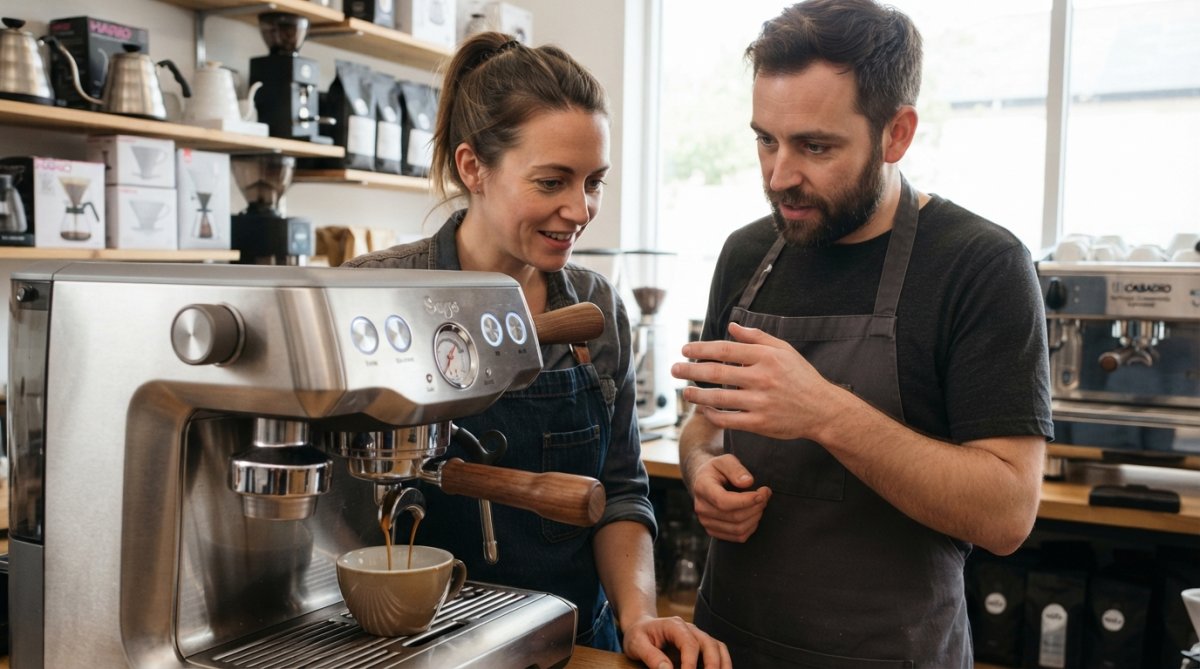
This machine suits home users who want café-quality results without the learning curve of manual profiling. Setup takes minutes rather than months of dialling-in.
Graef Estessa: Dual Pump Control and Manual Profiling
The Graef Estessa stands out for its dual-pump system, uncommon outside commercial machines. One pump supplies the group head, another supplies the steam wand. This separation prevents pressure fluctuations when steaming milk, maintaining group head stability.
The Estessa uses a mechanical lever for manual pressure profiling combined with electronic PID temperature control. You feel pressure changes directly through the lever, building muscle memory and intuitive understanding of extraction dynamics. The dual-pump design maintains consistent pressure even during high-demand sessions, particularly valuable in home café setups or when entertaining guests.
Decent DE1XL: App-Integrated Profiling for Data-Driven Brewers
The Decent DE1XL represents maximum data, maximum customisation, and maximum complexity. Every aspect of the shot is programmable via a tablet interface. You see real-time graphs of pressure, flow rate, temperature, and water debit throughout extraction.
This machine appeals to espresso enthusiasts who want to experiment endlessly with profiles. You can programme multiple pressure curves and A/B test them on the same coffee. The app lets you share profiles with other Decent users worldwide, building a community of data-driven profiling.
La Marzocco GS3 MP: Mechanical Paddle Control and Thermal Stability
The La Marzocco GS3 MP is the gold standard for manual pressure profiling. The mechanical paddle lets you modulate pressure throughout the shot by adjusting lever position. La Marzocco's saturated group head maintains exceptional temperature stability, with dual PID control for separate coffee and steam boilers.
The paddle system has a learning curve, but once mastered, it offers intuitive control that many baristas find deeply satisfying. This machine is built for longevity, with La Marzocco machines regularly operating for 15+ years with minimal maintenance.
Rocket Espresso R Nine One: Programmable and Manual Profiles Combined
The Rocket Espresso R Nine One offers both programmable and manual pressure profiling, giving you flexibility as your skills develop. Five preset profiles are available at the touch of a button, or you can use the paddle system for manual control on any shot.
Rocket's saturated group and dual boiler system provide thermal stability needed for consistent extractions. The colour graphic touch display makes selecting profiles intuitive. The machine is quieter than many competitors, thanks to a permanent magnet pump.
Slayer Single Group: Needle-Valve Flow Rate Mastery
The Slayer Single Group represents the pinnacle of flow rate control through patented needle-valve technology. The needle valve lets you grind finer than traditional machines allow, because you're controlling flow rate independently of pressure.
The independent brew and steam tanks with PID control maintain exceptional temperature stability. The touchscreen interface lets you save and recall your favourite profiles. This is a professional-grade machine requiring significant expertise to operate well.
Manual vs. Automated Pressure Profiling: Which Suits You?
Manual profiling, using a lever to adjust pressure during extraction, teaches you more about coffee and extraction dynamics. You develop intuition about how coffee responds to pressure changes. Automated profiling prioritises consistency and speed, delivering the same shot the same way every time.
Many serious home baristas prefer manual profiling despite the difficulty. However, if you have limited time and want reliable results, automated profiling is the rational choice.
Flow Control Espresso Machines and Pressure Profiling Technology
Flow control and pressure profiling often work together in modern machines. Flow control restricts water volume without requiring pressure adjustment, whilst pressure profiling controls the force behind that water.
For practical purposes, if you can only choose one, pressure profiling matters more. You can achieve excellent results with variable pressure and fixed flow.
Manual Espresso Machine Options with Pressure Profiling in 2026
Manual espresso machines, lever-operated without electric pumps, have experienced a renaissance among specialty coffee enthusiasts. Machines like the La Marzocco GS3 MP use mechanical levers to control pressure profiling.
These machines appeal to baristas who want complete control and minimal electronics. The downside is consistency, manual machines require genuine skill to operate well.
Espresso Extraction Techniques for Optimal Pressure Profiles
Optimal extraction begins before water touches the coffee. Puck preparation, grinding fineness, dose, tamping pressure, and distribution determine whether your pressure profile will work effectively. A well-prepared puck has even density throughout, ensuring uniform water flow.
Pre-Infusion and Progressive Pressure for Enhanced Flavour
Pre-infusion is the first stage of pressure profiling. You apply low pressure (2-3 bar) for 5-10 seconds before ramping to full pressure. This allows water to saturate the puck evenly, blooming the coffee and ensuring even extraction. Pre-infusion reduces channelling dramatically and is the single most impactful profiling technique for improving shot quality.
Pressure Profiling for Specific Roast Profiles
Light roasts and dark roasts require different pressure approaches. Light roasts have denser cell structures and benefit from slightly higher pressure to achieve adequate extraction. Dark roasts are more porous and can over-extract easily, benefiting from lower pressure and shorter contact time.
A light roast might use 2 bar for 8 seconds (pre-infusion), then ramp to 8 bar for the body of the shot. A dark roast might use 3 bar for 5 seconds, then ramp to 6 bar. This is where pressure profiling becomes genuinely useful, allowing you to optimise for each coffee in your rotation.
Home Barista Espresso Machines with Pressure Profiling in 2026
The home espresso machine market has matured significantly. Machines that were exotic five years ago, dual boilers, PID control, pressure profiling, are now standard in mid-range equipment. This is good news for home baristas seeking pressure profiling without premium costs.
Key Features to Look For in a Pressure Profiling Machine
Beyond pressure profiling itself, several features determine whether a machine will serve you well long-term.
Thermal stability matters more than most people realise. A machine that maintains consistent group head temperature pulls consistent shots. PID controllers regulate boiler temperature precisely. Saturated group heads keep the group at brewing temperature always. Dual boilers separate coffee and steam functions, preventing temperature conflicts.
Build quality determines longevity. Brass and stainless steel components last decades. Commercial-grade internals cost more initially but save money over the machine's lifetime.
Ease of maintenance affects your willingness to keep the machine clean. Machines with accessible group heads and simple gasket replacement are easier to maintain.
Noise level matters if your kitchen is near bedrooms or living spaces. Rotary pumps are quieter than vibratory pumps.
PID Controllers and Thermal Stability
PID (Proportional-Integral-Derivative) controllers regulate boiler temperature by adjusting heating element power, maintaining temperature within ±0.5°C. Machines without PID rely on simple thermostats that cycle heating on and off at wider temperature swings. For pressure profiling to be effective, thermal stability matters. Dual boiler machines use separate PID controllers for coffee and steam boilers, representing the gold standard.
Software and App Integration for Advanced Control
Some machines integrate tablet or smartphone apps that let you programme and monitor shots in real time. App integration enables profile sharing, allowing you to download profiles created by other users. However, app integration adds complexity and potential points of failure. For most home users, basic electronic controls are sufficient.
| Feature | Manual Lever | Programmable | App-Integrated |
|---|---|---|---|
| Learning Curve | Steep | Moderate | Very Steep |
| Consistency | High (once mastered) | Excellent | Excellent |
| Flexibility | Maximum | High | Maximum |
| Complexity | Low | Moderate | High |
| Best For | Enthusiasts | Most home users | Data-driven experimenters |
Choosing the best pressure profiling espresso machines means balancing your skill level, budget, and desired level of control. The Sage The Oracle delivers automated profiling if you want excellent coffee without mastering manual technique. For those committed to hands-on mastery, the La Marzocco GS3 MP offers mechanical precision and build quality that justifies its premium cost.
At Coffee Craft Studio, we understand that pressure profiling transforms what's possible at home. Our expertly curated selection of pressure profiling machines, from the accessible Graef Estessa to the sophisticated Decent DE1XL, ensures you'll find equipment matching your specific needs. Whether you're optimising extraction for single-origin light roasts or dialling in espresso blends, our machines deliver the precision and thermal stability required for café-quality results. Explore our range and discover how pressure profiling elevates your daily ritual.
Frequently Asked Questions
What is pressure profiling in espresso machines and why does it matter?
Pressure profiling is the ability to control and adjust water pressure throughout the espresso extraction process. Rather than maintaining a fixed 9 bar pressure, profiling allows you to start with lower pressure for pre-infusion, then increase gradually to optimise extraction. This technique enhances flavour complexity, reduces channelling, and improves sweetness and body in your cup. Modern pressure profiling espresso machines use either manual levers, programmable solenoid valves, or app-controlled systems to achieve this precision.
How does pressure profiling affect the flavour of espresso?
Pressure profiling directly influences extraction yield and flavour development. A gentle pre-infusion at lower pressure allows coffee grounds to bloom evenly, improving water distribution and reducing channelling. Progressive pressure increases during the shot optimise the release of desirable flavour compounds, acidity, sweetness, and body, whilst minimising bitterness. Different roast profiles benefit from tailored pressure curves: lighter roasts often need higher sustained pressure, whilst darker roasts may benefit from a slower ramp. This control transforms espresso from a one-dimensional extraction into a nuanced, multi-layered experience.
What's the difference between manual and automated pressure profiling espresso machines?
Manual pressure profiling uses mechanical levers or paddle systems that require the barista to adjust pressure intuitively during the shot, offering tactile control but requiring skill and practice. Automated profiling employs programmable solenoid valves or app-integrated systems that execute pre-set pressure curves consistently, eliminating human variability. Manual machines like the La Marzocco GS3 MP suit experienced baristas who enjoy hands-on craftsmanship, whilst automated options like the Sage Oracle or Decent DE1XL are ideal for those seeking consistency and repeatability without extensive training.
Are pressure profiling espresso machines worth the investment for home baristas?
Pressure profiling machines justify their cost if you're serious about espresso quality and consistency. They unlock flavour complexity impossible with fixed-pressure machines, improve extraction yield from premium beans, and allow you to experiment with different roast profiles. However, if you're content with basic espresso or make only occasional cups, a standard semi-automatic may suffice. For home baristas investing in quality beans and seeking café-level results, pressure profiling delivers measurable improvements in taste and consistency that compound over time.
Can you retrofit pressure profiling onto an existing espresso machine?
Retrofitting full pressure profiling onto older machines is challenging and expensive, typically requiring replacement of the pump, group head, and valve systems. However, some modifications are possible: upgrading to a rotary pump, adding a needle valve for basic flow control, or installing a PID controller for thermal stability. Professional retrofitting services exist but often cost £500-£2,000+. For most home users, purchasing a machine with integrated pressure profiling technology is more practical and reliable than attempting complex modifications to an existing setup.
This article was written using GrandRanker