

Best Home Espresso Machine 2026: Top Picks for Every Skill Level
Table of Contents
- Best Home Espresso Machine 2026: Quick Comparison Table
- Best Overall Home Espresso Machine
- Best Home Espresso Machine for Beginners
- Best High-End Prosumer Machine
- Manual vs Automatic Espresso Machines: Which Should You Choose?
- Essential Espresso Machine Maintenance Tips for Long-Term Performance
- What to Look for When Selecting Your Home Espresso Machine
- Long-Term Costs and Water Chemistry Considerations
Last Updated: July 13, 2026
Best Home Espresso Machine 2026: Quick Comparison Table
Finding the best home espresso machine requires balancing budget, skill level, and your long-term coffee ambitions. The market has shifted dramatically, and what separates a great machine from a mediocre one isn't always the price tag, it's whether the machine matches your actual workflow and maintenance commitment.
Here's a quick overview of the top contenders across different skill levels and budgets:
| Machine | Type | Best For | Key Feature | Heat-Up Time |
|---|---|---|---|---|
| Breville Barista Express Impress | Semi-automatic | Beginners | Assisted tamping system | 3 minutes |
| Gaggia Classic Pro E24 | Semi-automatic | Budget enthusiasts | Commercial 58mm portafilter | 5 minutes |
| Profitec GO | Single boiler PID | Intermediate | Precise temperature control | 8 minutes |
| Rocket Appartamento TCA | Heat exchanger | Design-focused | E61 group head | 12 minutes |
| La Marzocco Linea Micra | Dual boiler | Serious baristas | App connectivity | 15 minutes |
| Ascaso Steel Duo PID | Dual thermoblock | Speed-focused | Rapid simultaneous brewing/steaming | 4 minutes |
| Cafelat Robot | Manual lever | Purists | Complete pressure control | Instant |
| Jura E8 | Super-automatic | Convenience-first | One-touch espresso | 45 seconds |
| De'Longhi La Specialista Maestro | Semi-automatic | Families | Multiple brew modes | 6 minutes |
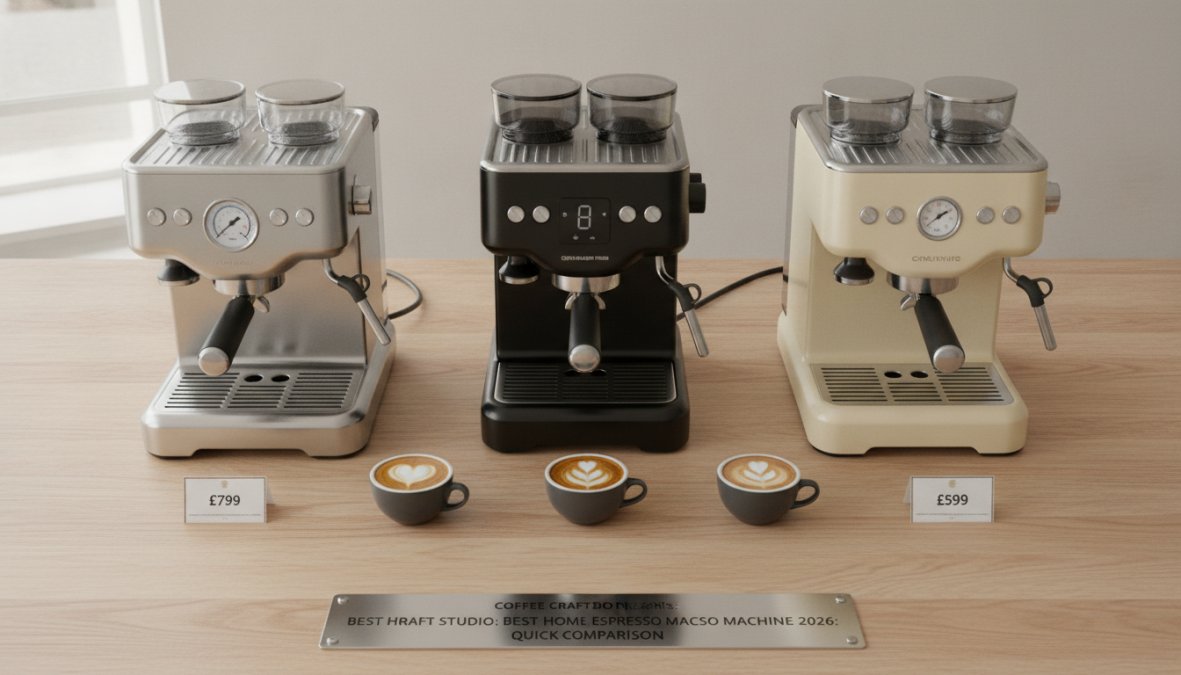
The real decision is which machine fits your daily routine. A prosumer dual-boiler system is wasted on someone who makes one espresso per week. A super-automatic machine frustrates someone who loves the tactile control of manual tamping.
Best Overall Home Espresso Machine
The Breville Barista Express Impress stands out as the best home espresso machine for most households because it solves the fundamental problem that stops beginners: inconsistent tamping. The assisted tamping system removes guesswork from one of the most critical variables in shot consistency while preserving manual control over everything else that matters.
The integration is seamless: grind, dose automatically, tamp to precise pressure, and pull the shot. The 25 grind settings span from espresso-fine to French press coarse, so you're not locked into a single brewing style. The PID digital temperature control maintains water temperature within 0.5 degrees Celsius, delivering barista-quality extraction without the learning curve of manual boiler management.
The manual steam wand requires engagement. You won't get microfoam as easily as a super-automatic, but you'll develop proper technique. This is intentional, the line between convenient appliance and coffee tool.
Weaknesses include a small drip tray, frequent water tank refilling, and limited grinder granularity. For someone making 1-3 espresso drinks daily, these tradeoffs are negligible compared to consistency gains.
Best Home Espresso Machine for Beginners
The Gaggia Classic Pro E24 costs less than half the price of the Barista Express yet delivers something the Breville doesn't: a direct connection to how professional machines work. This machine teaches you espresso rather than hiding the mechanics.
The commercial-style 58mm chrome-plated brass portafilter is the real advantage. It's the same size used in cafés, so every technique you learn transfers directly to professional equipment. The 3-way solenoid valve creates dry pucks, preventing the soggy mess that frustrates beginners on cheaper machines.
The tradeoff is immediacy. This machine lacks PID temperature control, so you'll run water through the group head for 20-30 seconds before pulling shots to reach optimal brewing temperature. It's a ritual, not a flaw. The community around this machine is enormous, with thousands of modification guides for adding PID controllers or upgrading components. Many home baristas keep their Gaggia for five years, upgrading as their skills develop.
For someone with a tight budget who wants to learn genuine espresso technique without a five-year commitment to a $3,000 machine, the Gaggia Classic Pro E24 is the most honest starting point.
Best High-End Prosumer Machine
The La Marzocco Linea Micra represents the ceiling for home equipment. This is the machine you buy when you've already owned three others and want to stop upgrading. It's built to commercial specifications in a footprint that fits a residential kitchen.
The dual-boiler system means you never compromise. Brew at 9 bars while simultaneously steaming milk at the pressure the wand requires. The integrated group head maintains temperature stability that single-boiler machines can't match. The app connectivity lets you adjust temperature and schedule pre-infusion profiles from your phone, genuine control over extraction variables that directly affect shot quality.
Heat-up time is the only real drawback. Fifteen minutes from cold to first shot is considerably longer than thermoblock machines. But thermal stability once warm is exceptional. You'll pull identical shots back-to-back without temperature management rituals.
For serious baristas pulling 30+ espresso shots per week, it's genuinely an endgame purchase.
Manual vs Automatic Espresso Machines: Which Should You Choose?
The distinction between manual and automatic espresso machines determines whether you're crafting coffee or automating it.
Manual machines like the Cafelat Robot give you real-time control over pressure throughout extraction. You feel resistance build as water pushes through the puck and can adjust your lever position mid-shot to compensate for channeling. This tactile feedback teaches you espresso at a mechanical level. The downside is consistency: identical shots require identical technique every time.
Semi-automatic machines (Breville Barista Express, Gaggia Classic, Profitec GO) automate water delivery but leave extraction variables to you. You control tamp pressure, grind size, and dose. This is the sweet spot for most home baristas, it automates mechanical work while preserving the skill elements that matter.
Super-automatic machines (Jura E8) handle everything: grinding, dosing, tamping, extraction, and milk frothing. You press a button and receive a cappuccino. The advantage is speed and consistency. The disadvantage is control: you can't adjust for different coffee origins, and milk frothing rarely matches hand-steamed microfoam quality.
Essential Espresso Machine Maintenance Tips for Long-Term Performance
Maintenance separates machines that last five years from those lasting twenty. Most home baristas underestimate how much their machine's lifespan depends on water chemistry and regular descaling.
Backflushing, running water backward through the group head without the portafilter, is essential for machines with a 3-way solenoid valve. Do this 5-10 times daily to clear coffee residue and prevent buildup that degrades shot consistency.
Descaling every 40-80 shots (roughly monthly for daily users) removes mineral deposits from the boiler and heating elements. Use commercial espresso machine descaler, not vinegar. Run the solution through the group head and steam wand, then flush with fresh water for 2-3 minutes.
Water filtration is underrated. A simple charcoal filter removes chlorine and reduces mineral content, extending machine life and improving shot taste. A $40 water filter prevents a $400 repair.
The steam wand requires immediate cleaning after each use. Wipe with a damp cloth immediately after steaming, then run steam through it for 3-5 seconds. Weekly deep cleaning with a small brush removes stubborn deposits.
Soak portafilter and basket in hot water for 15 minutes weekly to remove coffee oils that oxidize and impart stale flavors to fresh shots.
What to Look for When Selecting Your Home Espresso Machine
Choosing the right machine means understanding what actually affects shot quality. The variables that matter are pressure stability, temperature control, and grind consistency.
Pressure stability means the machine maintains 9 bars throughout extraction. Machines with OPV (over-pressure valve) adjustment let you dial in exact pressure for different coffee origins.
Temperature control can be achieved through passive boiler heating (cheapest, least consistent), thermoblock systems (fast heat-up, moderate stability), or PID controllers with dual boilers (highest precision, slowest heat-up). For daily use, thermoblock machines offer the best practical balance.
Grind consistency matters because fines extract faster than larger particles. Espresso demands a burr grinder. Conical burrs are slightly more forgiving with inconsistent tamping, while flat burrs produce slightly more uniform particle size.
Look for professional-grade components in the water path: brass fittings rather than plastic, stainless steel or brass group heads, and quality pump design.
Heat-up time matters only if you pull shots back-to-back. A 15-minute warm-up is fine for one espresso per morning but frustrating for multiple drinks sequentially.
Shot consistency depends on temperature stability and pressure consistency more than machine cost. A well-maintained Gaggia Classic produces more consistent shots than a neglected La Marzocco.
Long-Term Costs and Water Chemistry Considerations
The purchase price of an espresso machine is misleading. Long-term ownership costs include water filtration, descaling solutions, replacement gaskets, and potentially boiler repairs.
Water hardness is the silent killer of espresso machines. Hard water deposits minerals in boilers and heating elements, reducing heat transfer efficiency and causing temperature fluctuations. A simple water softener or filtration system costs $40-200 and extends machine life by years.
According to the Specialty Coffee Association's water standards, optimal water for espresso contains 75-250 mg/L of total dissolved solids. Most tap water exceeds this. Testing your water hardness takes 10 minutes with an inexpensive test kit. If your water exceeds 200 mg/L, invest in filtration immediately.
Replacement gaskets and seals cost $10-30 and last 1-2 years depending on usage. Budget roughly $50 annually for descaling solution and gasket replacement for regular users.
Used and refurbished machines represent genuine value if you know what to inspect. A five-year-old Rancilio or Lelit machine with 15,000 shots through it has proven reliability. Inspect the group head for deep scoring, test temperature stability across 10 consecutive shots, and verify consistent pump pressure. Refurbished machines from reputable sellers often cost 40-50% less than new while delivering identical performance.
Coffee equipment durability studies from the Specialty Coffee Association indicate that machines with proper maintenance last 10-15 years. Machines with neglected water chemistry fail within 3-5 years. The difference is discipline, not equipment quality.
Finding the best home espresso machine means matching equipment to your actual routine, not your aspirations. Most home baristas overestimate how much they'll use advanced features and underestimate how much water chemistry matters. Start with a machine that matches your current skill level, invest in water filtration immediately, and plan for monthly maintenance. The best machine is the one you'll actually use and maintain properly.
Frequently Asked Questions
What is the best home espresso machine for beginners in 2026?
The Breville Barista Express Impress is ideal for beginners seeking barista-quality results without steep learning curves. Its assisted tamping system, integrated conical burr grinder with 25 grind settings, and PID digital temperature control eliminate guesswork during extraction. The machine balances automation with manual control, allowing you to develop skills while achieving consistent crema and microfoam for café-style drinks from day one.
Do I need a separate grinder for my home espresso machine?
A dedicated burr grinder significantly improves shot consistency and extraction quality. While some machines like the Breville Barista Express include integrated grinders, standalone burr grinders offer superior grind size control and flexibility. For semi-automatic and manual machines, a quality burr grinder is essential, the grind size directly affects flow rate, pressure profiling, and whether you achieve proper crema and microfoam during espresso extraction.
What's the difference between semi-automatic and super-automatic espresso machines?
Semi-automatic machines (like the Gaggia Classic Pro) require manual control over shot timing and milk steaming, offering hands-on extraction and barista-quality customization. Super-automatic machines (like the Jura E8) handle grinding, tamping, extraction, and steaming at the touch of a button, prioritizing convenience over control. Semi-automatics suit enthusiasts who enjoy the craft; super-automatics suit users wanting speed and consistency without technical involvement.
How often should I descale and backflush my home espresso machine?
Descaling frequency depends on water hardness; typically every 200-300 shots or monthly for hard water. Backflushing (with a 3-way solenoid valve) should occur daily to clear coffee residue from the group head and portafilter. Both maintenance tasks prevent mineral buildup that degrades heat-up time, temperature stability, and extraction quality. Use filtered water to reduce descaling needs and protect your machine's internal components.
Are expensive home espresso machines worth the investment?
High-end machines like the La Marzocco Linea Micra deliver superior thermal stability, dual-boiler systems for simultaneous brewing and steaming, and exceptional build quality that lasts decades. However, value depends on your commitment. Casual users benefit more from mid-range options like the Profitec GO; serious baristas justify prosumer investment through consistent shot quality, faster heat-up times, and advanced pressure profiling that unlocks the full potential of specialty coffee beans.
This article was written using GrandRanker